THE CLASSIC COLLECTION✦Salve Venetia, gleanings from Venetian history; vol. IICLASSIC FREE BOOKS
Salve Venetia, gleanings from Venetian history; vol. II
F. Marion (Francis Marion) Crawford
THE CLASSIC COLLECTION · 1892
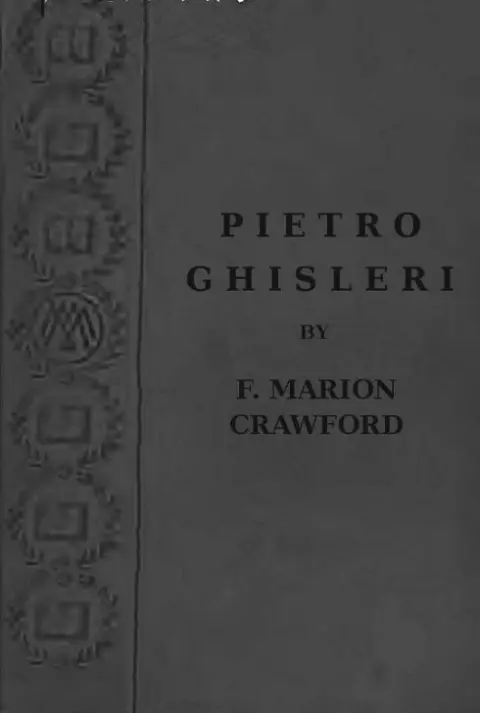
"Pietro Ghisleri" by F. Marion Crawford is a novel written in the late 19th century. The story revolves around complex relationships between two step-sisters, Laura Carlyon and Adele Braccio, in the context of a Roman high-society backdrop, exploring themes of love, jealousy, and social dynamics. The narrative delves into the intricacies of their family life, including the interests of their parents and the young men in their circle, particularly focusing on the attention that each step-sister garners in society. The opening of the novel introduces the family dynamics between the step-sisters and their parents, particularly the Honourable Mrs. Carlyon and Prince Gerano. Laura, who is described as beautiful yet without a dowry, and Adele, an heiress who is lively and somewhat vain, grow up with contrasting personalities and ambitions. As their stories unfold, romantic tensions arise, especially regarding Don Francesco Savelli, who is intended for Adele but finds himself attracted to Laura instead. This leads to jealousy and rivalry, setting the stage for deeper conflicts and emotional developments further along in the story. In this initial chapter, readers sense the societal pressures and personal struggles that will define the relationships at play.
Introduction adapted from the source catalogue; source summaries may be automatically generated.
Free to read · English · 153,334 words · No account needed
MAKE TIME FOR A GOOD BOOK
On by default. Untick to stop anonymous reading totals. Each page counts after 10 seconds in view. How this works.
Anonymous counting is on unless you have switched it off.
Maddalena was pleased, as was natural. She chanced to be in one of her best humours on that day, and indeed of late she had been much more her former self when she was with Ghisleri. A month earlier, the discussion about Laura Arden could not have passed off so peaceably, for the Contessa would then have resented anything approaching to the intimacy which now appeared to exist between Lady Herbert and Pietro. The latter wondered what change had taken place in her character, but accepted her gentle behaviour towards him very gratefully as a relief from a former phase of jealous fault-finding which had cost him many moments of bitterness. As he saw, from time to time, how her cold face softened, he almost believed that he loved her as dearly as ever, though the illusion was not of long duration. He left her, on that afternoon, with a regret which he had not felt for some time at the moment of parting, and he would gladly have stayed with her longer. They agreed to meet in the evening at one of the embassies, where there was to be a dance. In the mean time, they were to dine out at different houses, and the Contessa had a visit to make before going to the ball.
Pietro was sorry that he had promised not to quarrel about the story of the evil eye. The affair irritated him to an extraordinary degree, and though he had grown calmer under Maddalena's influence, his anger revived as he walked home and thought over it all. He dined that evening in Casa San Giacinto, and found himself placed between Donna Maria Boccapaduli and Donna Christina Campodonico. The latter was a slim, dark, graceful woman of five and twenty, remarkably quiet, and reported to be very learned, a fact which contributed less to her popularity than her own beauty and her husband's rather exceptional reputation. Gianforte Campodonico was a man whom Ghisleri would have liked if they had not known each other some years previously in circumstances which made liking an impossibility. He respected him more than most people, for he had fought a rather serious duel with him in days gone by, and had seen the man's courage and determination. Campodonico was the brother of the beautiful Princess Corleone who had died in Naples shortly after the above-mentioned duel, and who was said to have been the love of Ghisleri's life. Gianforte, for his sister's sake, had made up his mind to kill Ghisleri or to die in the attempt, with a desperate energy of purpose that savoured of earlier ages. He was, moreover, a first rate swordsman, and the encounter had remained memorable in the annals of duelling. Ghisleri had done all in his power to avoid the necessity of fighting at all, but Campodonico had forced him into it at last, and the weapons had been foils. The world said that Ghisleri was not to be killed so easily. He was as good a fencer as his adversary, and was left-handed besides, which gave him a considerable advantage. The result was that he defended himself successfully throughout one of the longest duels on record, until at last he almost unintentionally ran Gianforte through the sword arm and disabled him. The latter, humiliated and furious at his defeat, had demanded pistols then and there, and Ghisleri had professed himself ready, and had placed himself in the hands of his seconds. But both his own friends and Gianforte's decided that honour was satisfied, and refused to be parties to any further fighting, so that Campodonico had been obliged to accept their verdict. He sought an opportunity of quarrelling again, however, for he was a determined man, and he would probably have succeeded in the end; but at this juncture the Princess died after a short illness, and after exacting a solemn promise from both men that they would never fight again. That was the last act of her brief life of love and unhappiness, and it was at least a good one. Loving her with all their hearts, in their different ways, both Ghisleri and Campodonico respected the obligation they had taken as something supremely sacred. Ghisleri went and lived alone in a remote village of the south for more than a year afterwards, and Gianforte spent an even longer period in almost total seclusion from the world, and in the sole society of his widowed mother. Three years before the time now reached in this chronicle, he had married, as people said, for love, and for once people were right. His elder brother bore the title, and as there was another sister besides the Princess Corleone, Gianforte's portion had been small, for the family was not rich, and he and his wife lived very modestly in a small apartment in the upper part of the city, the Palazzo Campodonico having long ago passed into the hands of the Savelli.
Your reading position is saved on this browser. Take it to another device with a library code. Reading pages adapt to text, rather than matching a printed edition.
F. Marion (Francis Marion) Crawford
F. Marion (Francis Marion) Crawford

F. Marion (Francis Marion) Crawford

F. Marion (Francis Marion) Crawford
BEHIND THE BOOK
This eBook is for the use of anyone anywhere in the United States and most other parts of the world at no cost and with almost no restrictions whatsoever. You may copy it, give it away or re-use it under the terms of the Project Gutenberg License included with this eBook or online at www.gutenberg.org. If you are not located in the United States, you will have to check the laws of the country where you are located before using this eBook. Read the source licence.
The original source file, including credits and licence, is retained by this library. Request an original-format copy at no charge. Please include the book title and Project Gutenberg identifier #40922.
KEEP YOUR CURIOSITY GOING
Coulson Kernahan

Maurice Baring
Frances Wright
Cécile Tormay

Frederic Jesup Stimson

W. H. P. (William Henry Pope) Jarvis