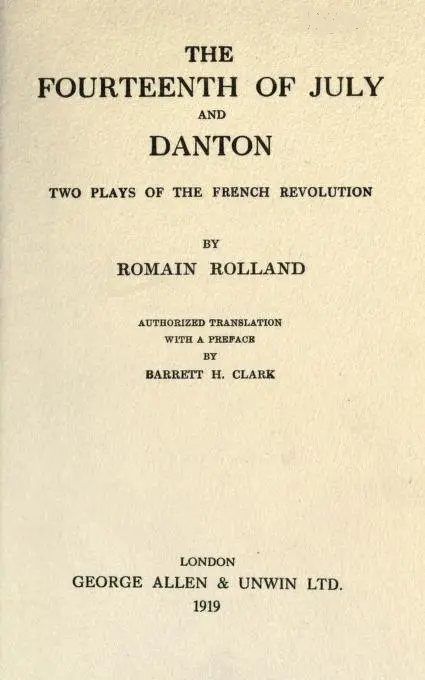
The Fourteenth of July, and Danton: Two Plays of the French Revolution
Romain Rolland
THE CLASSIC COLLECTION · 1922
"Pierre and Luce" by Romain Rolland is a novel published in 1920. Set during the First World War, it tells the story of two young lovers, Pierre and Luce, whose relationship unfolds against the backdrop of wartime Paris. As Pierre's older brother fights on the Western Front, the couple navigates the dangers and uncertainties of a city under siege. The novel depicts the tragic reality of the Paris Gun attack on the St-Gervais-et-St-Protais Church.
Introduction adapted from the source catalogue; source summaries may be automatically generated.
Free to read · English · 22,008 words · No account needed
MAKE TIME FOR A GOOD BOOK
On by default. Untick to stop anonymous reading totals. Each page counts after 10 seconds in view. How this works.
Anonymous counting is on unless you have switched it off.
"Why no!" (She was laughing in her sleeve.) "And there is no need at all why I should know. When one asks why something is, it means that one is not sure about it, that the thing is not good. Now that I do love, no more why! No more where or when or for, nor how either! My love is, my love is! All beside may exist if it cares to."
Their faces kissed each other. The rain took advantage of that, gliding under the awkward umbrella in order to brush with its fingers their hair and cheeks; between their lips they drank in a little cold drop.
Pierre remarked:
"But the others?"
"What others?" quoth Luce.
"The poor," answered Pierre. "All those who are not us?"
"Let them do as we do! Let them love!"
"And be loved? Luce, all the world can not do that."
"Why, yes!"
"Why, no. You don't realize the value of the gift you have made me."
"To give one's heart to love, one's lips to the beloved is to give one's eyes to the light; it isn't giving, it's taking."
"There are blind people."
"We cannot cure them, Pierrot. Let's do the seeing for them!"
Pierre remained silent.
"What are you thinking of?" asked she.
"I am thinking that on this day, very far from us, very near, He suffered the Passion, He who came on earth to cure the blind."
Luce took his hand:
"Do you believe in Him?"
"No, Luce, I believe no longer. But he remains always the friend of
those he has accepted, even once, at his table. And you, do you know
him?"
"Hardly," responded Luce. "They never talked to me about him. But without knowing him I love him.... For I know that he loved."
"Not as we do."
"Why not? We ourselves have a poor little heart that knows only how to love you, my love. But He; He loved all of us. But it's always the same love."
"Would you like we should go tomorrow," asked Pierre, much moved, "in honor of His death?... I was told that they will have fine music at Saint Gervais!"
"Yes, I would love well to go to church with you on that day. I am sure He will give us welcome. And being nearer to Him, one is nearer each to the other."
They fell silent.... Rain, rain, rain. The rain falls. The night falls.
"At this hour tomorrow," said she, "we shall be down there."
The fog was penetrating. She gave a little shudder.
"Darling, you are not cold?" he asked, disquieted.
She rose:
Your reading position is saved on this browser. Take it to another device with a library code. Reading pages adapt to text, rather than matching a printed edition.
BEHIND THE BOOK
This eBook is for the use of anyone anywhere in the United States and most other parts of the world at no cost and with almost no restrictions whatsoever. You may copy it, give it away or re-use it under the terms of the Project Gutenberg License included with this eBook or online at www.gutenberg.org. If you are not located in the United States, you will have to check the laws of the country where you are located before using this eBook. Read the source licence.
The original source file, including credits and licence, is retained by this library. Request an original-format copy at no charge. Please include the book title and Project Gutenberg identifier #31542.
KEEP YOUR CURIOSITY GOING
Cécile Tormay

Moritz Busch
Coulson Kernahan
John L. Ransom

Maurice Baring
Frances Wright