THE CLASSIC COLLECTION✦An outlaw’s diary: the CommuneCLASSIC FREE BOOKS
An outlaw’s diary: the Commune
Cécile Tormay
THE CLASSIC COLLECTION · 1888
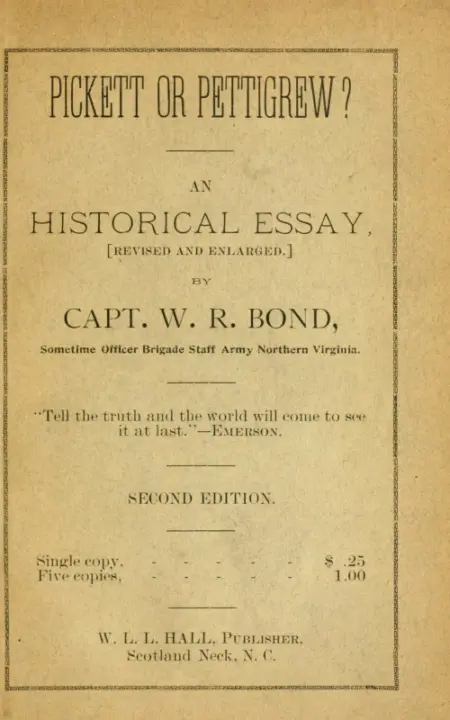
"Pickett or Pettigrew? An Historical Essay" by W. R. Bond is a historical account written in the late 19th century. The essay primarily discusses the events of the third day of the Battle of Gettysburg, particularly focusing on the often misrepresented roles of Brigadier Generals George Pickett and Johnston Pettigrew during the famous "Pickett's Charge." By analyzing the contributions and losses of different brigades, the author seeks to set the historical record straight regarding the valor and endurance of the troops involved, especially those from North Carolina. The opening of the essay sets the stage by outlining the dedication to the brave soldiers of Hill's Corps, who engaged in combat under General Longstreet's orders but have since been overshadowed by historical inaccuracies. In the preface, Bond reflects on the initial publication of his work, mentioning how it captured the interest of many who were unaware of the persistent slanders against Pettigrew’s contributions. He introduces General Pettigrew’s background and early military career, quickly establishing his expertise and reputation before delving into a critical examination of the myths that have developed around the infamous charge, ultimately striving to uphold the honor of Confederate soldiers who fought valiantly despite being disregarded by subsequent historical narratives.
Introduction adapted from the source catalogue; source summaries may be automatically generated.
Free to read · English · 26,349 words · No account needed
MAKE TIME FOR A GOOD BOOK
On by default. Untick to stop anonymous reading totals. Each page counts after 10 seconds in view. How this works.
Anonymous counting is on unless you have switched it off.
“There lived a knight, when knighthood was in flow’r, Who charm’d alike the tilt-yard and the bower.”
The family of Johnston Pettigrew was one of the oldest, wealthiest and most influential of Eastern Carolina. His grandfather, Rev. Chas. Pettigrew, was the first Bishop-elect of the Diocese of North Carolina. Be was born upon his father’s estate, Bonarva, Lake Scuppernong, Tyrrell county, North Carolina, on July 4th, 1828, and died near Bunker’s Hill, Va., July 17th, 1863, having been wounded three days before in a skirmish at Falling Waters. He graduated with the first distinction at the University of North Carolina in 1847. A few months after graduation, at the request of Commodore Maury, principal of the Naval Observatory at Washington, he accepted a professorship in that institution. Having remained thereabout eight months he resigned and went to Charleston, South Carolina, and became a student of law, in the office of his distinguished relative, Hon. Jas. L. Pettigru, obtaining a license in 1849. In 1850 he went to Europe to study the civil law in the German Universities. There also he became thoroughly acquainted with the German, French, Italian and Spanish languages. He became so well acquainted with Arabic as to read and appreciate it; also with Hebrew. He then traveled over the various countries of the Continent, also England, Scotland and Ireland. In 1852 he became Secretary of Legation to the U. S. Minister at the Court of Madrid. In the winter of 1861 he had printed in Charleston, for private circulation, an octavo volume of 430 pages, entitled “Spain and the Spaniards,” which has been very much admired by every one who has read it, for its learning, its research and the elegance of its style. Having remained in Madrid only a few months he returned to Charleston and entered upon the practice of law with Mr. James L. Pettigru. In December, 1856, and December, 1857, he was chosen a member of the Legislature from the city of Charleston. He rose to great distinction in that body, by his speech on the organization of the Supreme Court, and his report against the re-opening of the African Slave Trade. He failed to be re-elected in 1858. Again in 1859 he went to Europe with the intention of taking part in the war then in progress between Sardinia and Austria. His application to Count Cavour for a position in the Sardinian Army, under Gen’l Marmora, was favorably received. His rank would have been at least that of Colonel; but in consequence of the results of the battle of Solferino, which took place just before his arrival in Sardinia, the war was closed and he was thereby prevented from experiencing active military service and learning its lessons. In 1859 he became Colonel of a rifle regiment that was formed and that acted a conspicuous part around Charleston in the winter of 1860–61. With his regiment he took possession of Castle Pinkney, and was afterwards transferred to Morris Island, where he erected formidable batteries. He held himself in readiness to storm Fort Sumpter in case it had not been surrendered after bombardment. In the spring of 1861, his regiment growing impatient because it could not just then be incorporated in the Confederate Army, disbanded; Col. Pettigrew then joined Hampton’s Legion as a private, and went with that body to Virginia, where active service was to be met with. A few days afterwards, without any solicitation on his part, he was elected Colonel of the 22d North Carolina Troops. While at Evansport, he was offered promotion, but declined it, upon the ground, that it would separate him from his regiment. Late in the spring of 1862 an arrangement was made by which his regiment was embraced in the brigade. He then accepted the commission. He and his brigade were with Gen. Johnston at Yorktown and in the retreat up the peninsula. He was with his brigade in the sanguinary battle of Seven Pines, or Fair Oaks, where he was severely wounded, and left insensible upon the field and captured. He was in prison only about two months, and on being exchanged he returned to find that in his absence his beloved brigade had been given to General Pender. A new brigade was then made up for him. How well this body was disciplined and of what material it was made this essay has attempted to show. In the autumn of 1862, he was ordered with his brigade to Eastern North Carolina, where he was engaged in several affairs, which though brilliant have been overshadowed by the greater battles of the war. In May, 1863, his brigade was again ordered to Virginia, and ever after formed a part of the Army of Northern Virginia. While commanding Heth’s division, in Longstreet’s Assault, though his horse had been killed, and he had received a painful wound--a grapeshot shattering his left hand--he was within a few feet of his own brigade when the final repulse came. On his regaining our lines, his remark to Gen. Lee that he was responsible for his brigade, but not for the division, shows that he was satisfied with the conduct of a part, but not with that of all the troops under his command.
Your reading position is saved on this browser. Take it to another device with a library code. Reading pages adapt to text, rather than matching a printed edition.
BEHIND THE BOOK
This eBook is for the use of anyone anywhere in the United States and most other parts of the world at no cost and with almost no restrictions whatsoever. You may copy it, give it away or re-use it under the terms of the Project Gutenberg License included with this eBook or online at www.gutenberg.org. If you are not located in the United States, you will have to check the laws of the country where you are located before using this eBook. Read the source licence.
The original source file, including credits and licence, is retained by this library. Request an original-format copy at no charge. Please include the book title and Project Gutenberg identifier #57392.
KEEP YOUR CURIOSITY GOING
Cécile Tormay

Moritz Busch
John L. Ransom
Frances Wright
Cécile Tormay

Mabel Potter Daggett