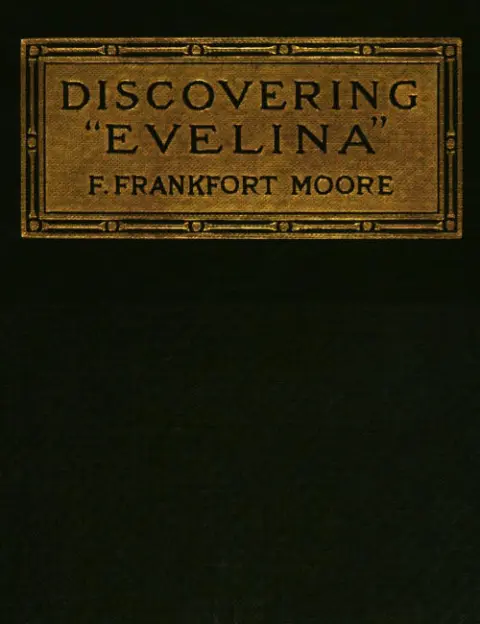
Discovering “Evelina”: An Old-fashioned Romance A Companion Book to “The Jessamy Bride”
Frank Frankfort Moore
THE CLASSIC COLLECTION · 1895
"Phyllis of Philistia" by Frank Frankfort Moore is a novel likely written during the late 19th century. The narrative centers around Phyllis Ayrton, a young woman caught in a conflict between societal expectations and her personal beliefs, particularly concerning her engagement to George Holland, a clergyman whose unorthodox views challenge her convictions. As discussions unfold between Phyllis and her father about marriage, morality, and faith, the stage is set for her inner turmoil regarding her betrothal and her struggle with fidelity to her principles. At the start of the book, we are introduced to Phyllis and her father, Mr. Ayrton, who engage in a philosophical discussion regarding marriage and the ramifications of George's controversial views on Biblical figures. Phyllis expresses her deep disappointment in George's perspective, asserting that he has abandoned key truths about the sacred texts. As she grapples with the implications of her feelings, particularly following the publication of George's provocative book, "Revised Versions," her struggle deepens, leading her towards a decision that could define her future. The opening sets a tone of introspection and societal critique, where Phyllis’s journey represents a broader commentary on the tensions between tradition and modern thought.
Introduction adapted from the source catalogue; source summaries may be automatically generated.
Free to read · English · 87,847 words · No account needed
MAKE TIME FOR A GOOD BOOK
On by default. Untick to stop anonymous reading totals. Each page counts after 10 seconds in view. How this works.
Anonymous counting is on unless you have switched it off.
“That toilet should not have been wasted,” said he. “It is
exquisite--ravissante!”
“It was an inspiration, your putting it on,” said Phyllis. “I wonder if she really had no subtle suggestion from her own heart that you were on your way to her, Mr. Linton,” she added, turning to the husband.
“I dare say it was some inward prompting of that mysterious nature, Miss Ayrton,” he replied. “A woman’s heart is barometric in its nature, it is not? Its sensitiveness is so great that it moves responsive to a suggestion of what is to come. Is a woman’s heart prophetic, I wonder?”
“It would be a rank heresy to doubt it, after the example we have had to-night,” said Mr. Ayrton. “Yes, a woman’s heart is a barometer suggesting what is coming to her, and her toilet is a thermometer indicating the degree of expectancy.”
“A charming phrase,” said Mr. Linton; “a charming principle, only one that demands some years of close study to be rendered practical. For instance, look at my wife’s toilet: it is bridal, and yet we have been married three years.”
“Quite so; and that toilet means that you are the luckiest fellow in the world,” said Mr. Ayrton.
“I admit the interpretation,” said her husband. “I told the hansom to wait for me. He is at the door now. You have had no opera to-night, my dear?”
“You would not expect me to go alone? Phyllis was dining at the Earlscourts’,” said the wife.
“You are the soul of discretion, my beloved,” said the husband. “Is your stock of phrases equal to a suggestion as to what instrument is the soul of a woman, Ayrton?” he added. “Her heart is a barometer, her toilet a thermometer, and her soul----”
“The soul of a woman is not an instrument, but a flower--a lily,” said
Mr. Ayrton.
“And my wife wears her soul upon her sleeve,” said Mr. Linton, touching the design on the lace that fell from her shoulders.
“But not for daws to peck at--that is the heart,” laughed Mr. Ayrton. “Talking of woman’s soul, how is Lady Earlscourt?” he added, to his daughter.
“I was so sorry that I was at that stupid dinner,” said Phyllis. “I might have enjoyed the music of ‘Romeo and Juliet.’ But I had engaged myself to Lady Earlscourt a fortnight ago.”
“You did not see Lord Earlscourt, at any rate,” said her father.
“No; he left us in the evening for Southampton,” said Phyllis.
Your reading position is saved on this browser. Take it to another device with a library code. Reading pages adapt to text, rather than matching a printed edition.
Frank Frankfort Moore
Frank Frankfort Moore
Frank Frankfort Moore
Frank Frankfort Moore
BEHIND THE BOOK
This eBook is for the use of anyone anywhere in the United States and most other parts of the world at no cost and with almost no restrictions whatsoever. You may copy it, give it away or re-use it under the terms of the Project Gutenberg License included with this eBook or online at www.gutenberg.org. If you are not located in the United States, you will have to check the laws of the country where you are located before using this eBook. Read the source licence.
The original source file, including credits and licence, is retained by this library. Request an original-format copy at no charge. Please include the book title and Project Gutenberg identifier #2155.
KEEP YOUR CURIOSITY GOING
Coulson Kernahan

Maurice Baring
Frances Wright
Cécile Tormay

Frederic Jesup Stimson

W. H. P. (William Henry Pope) Jarvis