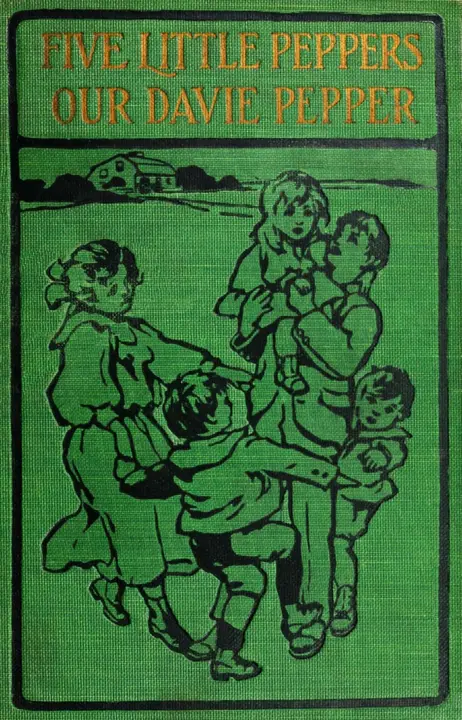
Our Davie Pepper
Margaret Sidney
THE CLASSIC COLLECTION · 1897
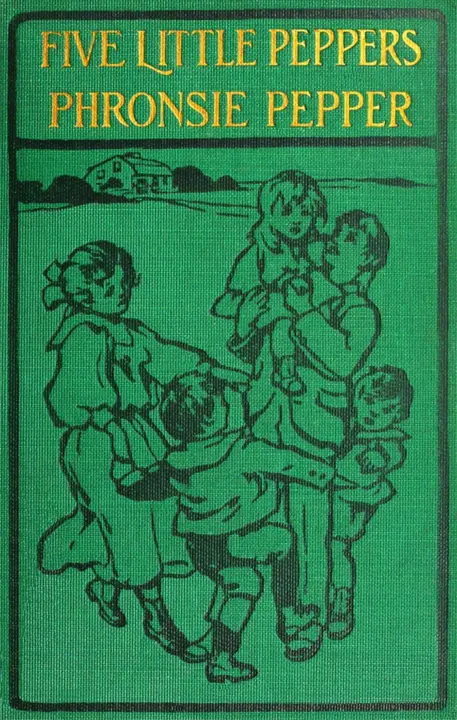
"Phronsie Pepper: The Youngest of the 'Five Little Peppers'" by Margaret Sidney is a children's novel written in the late 19th century. The story revolves around Phronsie Pepper, the youngest member of the Pepper family, who is beloved for her charm and innocence. This book continues the adventures of the Pepper family, providing insights into Phronsie's life as she navigates childhood through various escapades and interactions with her family and friends in their quaint little world. At the start of the novel, Phronsie is depicted engaging in a playful yet chaotic scene with her cousins, showcasing her caring nature as she tries to mediate a dispute among them. The narrative introduces the whimsical essence of their home life, filled with affection and lighthearted challenges, while hinting at deeper themes of family and friendship. As Phronsie interacts with her grandfather and her cousins, we see her personality bloom, setting the stage for her journey toward maturity and the adventures that await in Badgertown, where her family thrives on love and imagination.
Introduction adapted from the source catalogue; source summaries may be automatically generated.
Free to read · English · 74,972 words · No account needed
MAKE TIME FOR A GOOD BOOK
On by default. Untick to stop anonymous reading totals. Each page counts after 10 seconds in view. How this works.
Anonymous counting is on unless you have switched it off.
“And I hope we shall see much of each other on the voyage,” said Mrs. Bayley sweetly, with no eyes for any one but Phronsie.
“Thanks,” said Joel as they swept off.
“If you please, miss,” said the deck-steward, coming up and touching his cap respectfully to Phronsie, “there’s an old woman who says she wishes you would come to see her. She’s in her stateroom.”
“An old woman?” asked Phronsie wonderingly.
“Yes, miss. She didn’t give her name, but said she saw you come on board yesterday. And she’s very urgent, miss.”
“I’ll go with you to the door, and you can find out who she is,” said
Joel.
Phronsie moved off after the steward, and held out her hand to Joel. “You can wait for me outside.”
The stateroom, small and uncomfortable, into which she was ushered, while Joel paced up and down outside, was so dark, that at first Phronsie could not see distinctly its occupant.
“O miss!” cried an old lady, trying to rise in her berth, and brushing away the straying white hair from her cheek, “you don’t remember me. But I’ll never forget you nor your face.” It was Phronsie’s little old woman of the Berton electric car.
“What can I do for you?” asked Phronsie gently, and standing by the berth she smoothed the straying hair.
“O miss, I’m afraid I’m going to die, and I can’t when I’m just going
home.”
“I don’t think you will die,” said Phronsie, “and I am sorry you feel
ill.”
“It is just this way, miss. I’m all worn out with gladness to get home and put my feet on English ground,” said the little old woman hungrily. “But I must tell you about it; because if I should die, I want you to know all about it. You see, my husband and I came over because he didn’t want to live on his sons, and he fancied America, and being independent there in a new country. And so we came a good many years ago; and our sons felt dreadfully, for they wanted us to stay with them. But John, he’s my husband, said ‘no,’ and you couldn’t move him. Well, we were very happy living in a little home of our own, and my husband worked the ground to suit himself as best he could; and though I worried some, and I know he did, only he was always still like, to see the grandchildren, they were so cunning when we came away, we did pretty well. Only English ways of farming are different from yours, and John was too old to learn new ways, and so we began to get behind. And we didn’t care to make new friends, and we didn’t know how, and so when John was taken away there wasn’t any one to advise me, and the property was sold off for almost nothing. And after I’d got a letter, I had it in my pocket the day you were kind to me in the car, I was all so in a tremble I hadn’t read it, I just sat down and answered it when I got home. It was from one of my sons; and I told him the whole truth, and he sent me the money, and told me to come on this boat. But I’m trembling so, miss,” she held up her thin arm that shook like a leaf, “that I’m afraid I won’t last till I get there. And I want you to see my boy, who’ll be there to meet me, and tell him for me that his father said he was sorry we came away, before he died, and he sent his love to both of ’em, and he blessed all the grandchildren, and so do I;” and her voice sank to a whisper.
Your reading position is saved on this browser. Take it to another device with a library code. Reading pages adapt to text, rather than matching a printed edition.
Margaret Sidney
Margaret Sidney
Margaret Sidney
Margaret Sidney
BEHIND THE BOOK
This eBook is for the use of anyone anywhere in the United States and most other parts of the world at no cost and with almost no restrictions whatsoever. You may copy it, give it away or re-use it under the terms of the Project Gutenberg License included with this eBook or online at www.gutenberg.org. If you are not located in the United States, you will have to check the laws of the country where you are located before using this eBook. Read the source licence.
The original source file, including credits and licence, is retained by this library. Request an original-format copy at no charge. Please include the book title and Project Gutenberg identifier #71146.
KEEP YOUR CURIOSITY GOING
Coulson Kernahan

Maurice Baring
Frances Wright
Cécile Tormay

Frederic Jesup Stimson

W. H. P. (William Henry Pope) Jarvis