
Letters to a Friend, Written to Mrs. Ezra S. Carr, 1866-1879
John Muir
THE CLASSIC COLLECTION · 1859
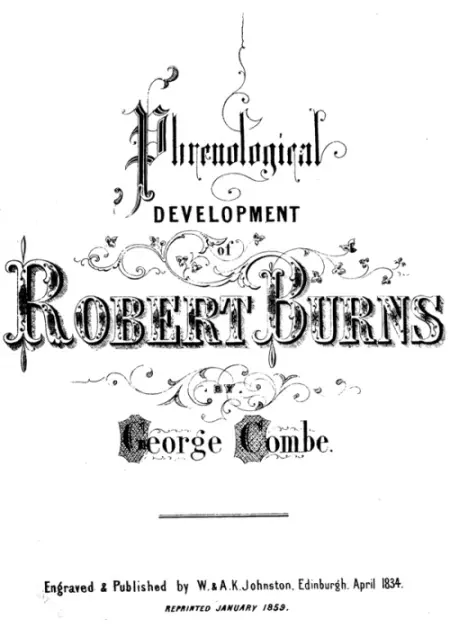
"Phrenological Development of Robert Burns" by George Combe is a scientific publication written in the early 19th century, specifically in the period surrounding the 1830s. The book explores the phrenological analysis of the celebrated Scottish poet Robert Burns, using a cast of his skull to delve into the relationships between physical cranial features and mental faculties, as proposed by phrenology. In this work, Combe presents a detailed analysis of Burns's skull dimensions and the corresponding implications for his character and faculties. He discusses various organs of the brain as they relate to Burns's personality traits, such as his strong passions, artistic talents, and complex emotional nature. The analysis indicates a unique blend of large emotional attachments and moral sentiments alongside notable animal propensities, suggesting a character capable of both significant good and great turmoil. Combe reflects on how Burns's circumstances likely affected the expression of these innate traits, ultimately pondering the potential outcomes had Burns been afforded a different status in life.
Introduction adapted from the source catalogue; source summaries may be automatically generated.
Free to read · English · 1,704 words · No account needed
MAKE TIME FOR A GOOD BOOK
On by default. Untick to stop anonymous reading totals. Each page counts after 10 seconds in view. How this works.
Anonymous counting is on unless you have switched it off.
"Having completed our intention, the Skull, securely enclosed in a leaden case, was again committed to the earth precisely where we found it.
"ARCHD. BLACKLOCK."
DUMFRIES, 1st April 1834.
Inches. Greatest circumference, 22-1/4 From Occipital Spine to Individuality, over the top of the head, 14 ... Ear to Ear vertically over the top of the head, 13 ... Philoprogenitiveness to Individuality (greatest length), 8 ... Concentrativeness to Comparison, 7-1/8 ... Ear to Philoprogenitiveness, 4-7/8 ... Ear to Individuality, 4-3/4 ... Ear to Benevolence, 5-1/2 ... Ear to Firmness, 5-1/2 ... Destructiveness to Destructiveness, 5-3/4 ... Secretiveness to Secretiveness, 5-7/8 ... Cautiousness to Cautiousness, 5-1/2 ... Ideality to Ideality, 4-5/8 ... Constructiveness to Constructiveness, 4-1/2 ... Mastoid process to Mastoid process, 4-3/4
Scale. 1. Amativeness, rather large, 16 2. Philoprogenitiveness, very large, 20 3. Concentrativeness, large, 18 4. Adhesiveness, very large, 20 5. Combativeness, very large, 20 6. Destructiveness, large, 18 7. Secretiveness, large, 19 8. Acquisitiveness, rather large, 16 9. Constructiveness, full, 15 10. Self-Esteem, large, 18 11. Love of Approbation, very large, 20 12. Cautiousness, large, 19 13. Benevolence, very large, 20 14. Veneration, large, 18 15. Firmness, full, 15 16. Conscientiousness, full, 15 17. Hope, full, 14 18. Wonder, large, 18 19. Ideality, large, 18 20. Wit, or Mirthfulness, full, 15 21. Imitation, large, 19 22. Individuality, large, 19 23. Form, rather large, 16 24. Size, rather large, 17 25. Weight, rather large, 16 26. Colouring, rather large, 16 27. Locality, large, 18 28. Number, rather full, 12 29. Order, full, 14 30. Eventuality, large, 18 31. Time, rather large, 16 32. Tune, full, 15 33. Language, uncertain, 34. Comparison, rather large, 17 35. Causality, large, 18
The scale of the organs indicates their relative proportions to each other; 2 is Idiotcy--10 Moderate--14 Full--18 Large--and 20 very Large.
The cast of a Skull does not show the temperament of the individual, but the portraits of Burns indicate the bilious and nervous temperaments--the sources of strength, activity, and susceptibility; and the descriptions given by his contemporaries of his beaming and energetic eye, and the rapidity and impetuosity of his manifestations, establish the inference that his brain was active and susceptible.
Size in the brain, other conditions being equal, is the measure of mental power. The Skull of Burns indicates a large brain. The length is 8, and the greatest breadth nearly 6 inches. The circumference is 22-1/4 inches. These measurements exceed the average of Scotch living heads, including the integuments, for which four-eighths of an inch may be allowed.
The brain of Burns, therefore, possessed the two elements of power and
activity.
The portions of the brain which manifest the animal propensities are uncommonly large, indicating strong passions, and great energy in action under their influence. The group of organs manifesting the domestic affections (Amativeness, Philoprogenitiveness, and Adhesiveness), is large; Philoprogenitiveness uncommonly so for a male head.
The organs of Combativeness and Destructiveness are large, bespeaking great heat of temper, impatience, and liability to irritation.
Secretiveness and Cautiousness are both large, and would confer considerable power of restraint, where he felt restraint to be necessary.
Your reading position is saved on this browser. Take it to another device with a library code. Reading pages adapt to text, rather than matching a printed edition.
BEHIND THE BOOK
This eBook is for the use of anyone anywhere in the United States and most other parts of the world at no cost and with almost no restrictions whatsoever. You may copy it, give it away or re-use it under the terms of the Project Gutenberg License included with this eBook or online at www.gutenberg.org. If you are not located in the United States, you will have to check the laws of the country where you are located before using this eBook. Read the source licence.
The original source file, including credits and licence, is retained by this library. Request an original-format copy at no charge. Please include the book title and Project Gutenberg identifier #30489.
KEEP YOUR CURIOSITY GOING
John Muir

Asa Gray
Asa Gray

Florence Nightingale
Elizabeth Robins Pennell
Denison Olmsted