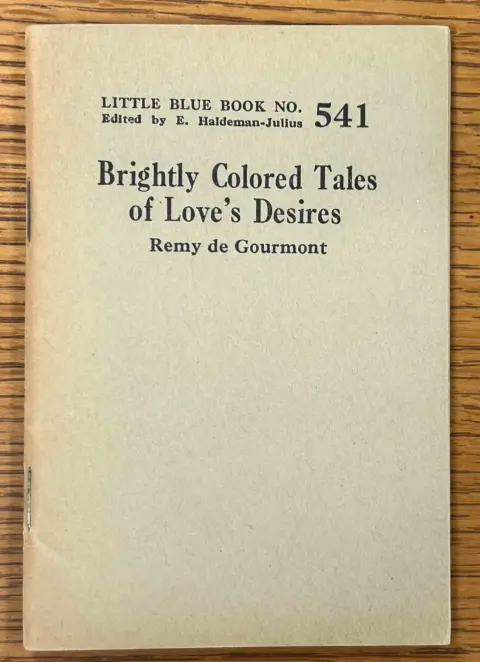
Stories in green, zinzolin, rose, purple, mauve, lilac and orange
Remy de Gourmont
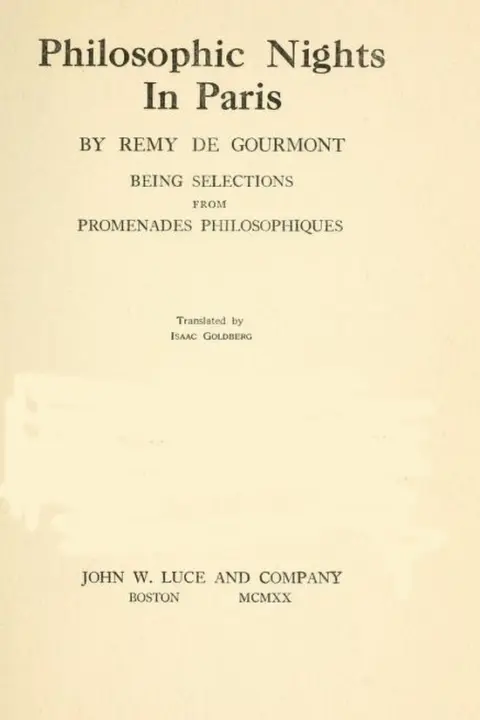
THE CLASSIC COLLECTION · 1920
"Philosophic Nights in Paris" by Remy de Gourmont is a collection of philosophical essays written in the early 20th century. The work showcases de Gourmont's thoughts on a range of topics, reflecting on happiness, free will, the nature of existence, and the significance of perception. As a member of the Symbolist movement, the author blends literary artistry with profound philosophical inquiry, offering readers insights into both the human condition and the complexities of modern life. The opening portion of "Philosophic Nights in Paris" introduces Remy de Gourmont's literary significance and philosophical approach. The text begins with an overview of de Gourmont's background, emphasizing his role as an interpreter of the Symbolist movement and his unique perspective on life and literature. It highlights key themes such as the struggle for happiness and the impact of perception on reality, while also setting the stage for the subsequent essays. The narrative captures de Gourmont's avant-garde spirit, as he navigates philosophical questions with a rich stylistic flair, inviting readers into his contemplative world.
Introduction adapted from the source catalogue; source summaries may be automatically generated.
Free to read · English · 23,776 words · No account needed
MAKE TIME FOR A GOOD BOOK
On by default. Untick to stop anonymous reading totals. Each page counts after 10 seconds in view. How this works.
Anonymous counting is on unless you have switched it off.
There are anti-clericals who are in reality somewhat excessive
Christians.
Is not the poet who recites his verses before an audience really the nightingale singing his song? Not quite. The instinct has gone astray: sexual mimicry, without actual application. The useful has become a game: and this is the whole history of civilization.
"How many contradictions!"
"Eh! If I loaded my wagon all on the same side, I'd tumble it over."
Persons full of morality preach. Everything that they judge criminal I either practise or think. And nevertheless....
Love ye one another. How do that, without knowing one another? No, no; a little modesty, a little dignity.
It is shameful to be ashamed of one's pleasures.
To be above everything. To scorn everything and love everything. To know that there is nothing, and that this nothing, none the less, contains everything.
In order to be true, a novel must be false.
To be impersonal is to be personal in a particular manner: for instance, Flaubert. In the literary jargon one would say: the objective is one of the forms of the subjective.
Proudhon said: "After the persecutors, I know nothing more hateful than the martyrs." Not having thought of this myself, I feel pleasure in copying it.
To be seen. The man of letters loves not only to be read but to be seen. Happy to be by himself, he would be happier still if people knew that he was happy to be by himself, working in solitude at night under his lamp; and he would be indeed happiest of all if, after he has closed his door, his servant should open it for a visitor and show to the importunate fellow, through the chink, the man of letters happy to be by himself.
Man begins by loving love and ends by loving a woman.
Woman begins by loving a man and ends by loving love.
Said a country vicar to a fanatically scrupulous devotee: "God is not
so silly as that."
He has known Claude Bernard, Flaubert, Barbey d'Aurevilly, Goncourt, Manet, Villiers de l'Isle-Adam, Renan, Taine, Pasteur, Verlaine, Tarde, Mallarmé, Puvis de Chavannes, Marey, Gauguin, Curie, Berthelot; he knows Rodin, Ribot, Renoir, France, Quinton, Monet, Poincaré,--and he complains! He bewails his country's decadence: The ingrate!
Nietzsche opened the gate. Now one may walk straight into the orchard of which, before him, it was necessary to scale the walls.
I am vexed that people should have thought so many things before me. I seem like a reflection. But perhaps some day I'll cause another man to repeat the same thing.
Your reading position is saved on this browser. Take it to another device with a library code. Reading pages adapt to text, rather than matching a printed edition.
Remy de Gourmont
Remy de Gourmont
Remy de Gourmont
BEHIND THE BOOK
This eBook is for the use of anyone anywhere in the United States and most other parts of the world at no cost and with almost no restrictions whatsoever. You may copy it, give it away or re-use it under the terms of the Project Gutenberg License included with this eBook or online at www.gutenberg.org. If you are not located in the United States, you will have to check the laws of the country where you are located before using this eBook. Read the source licence.
The original source file, including credits and licence, is retained by this library. Request an original-format copy at no charge. Please include the book title and Project Gutenberg identifier #46759.
KEEP YOUR CURIOSITY GOING

David Patterson (Spirit) Hatch

David Patterson (Spirit) Hatch

David Patterson (Spirit) Hatch
Coulson Kernahan

Ralph Waldo Emerson

Maurice Baring