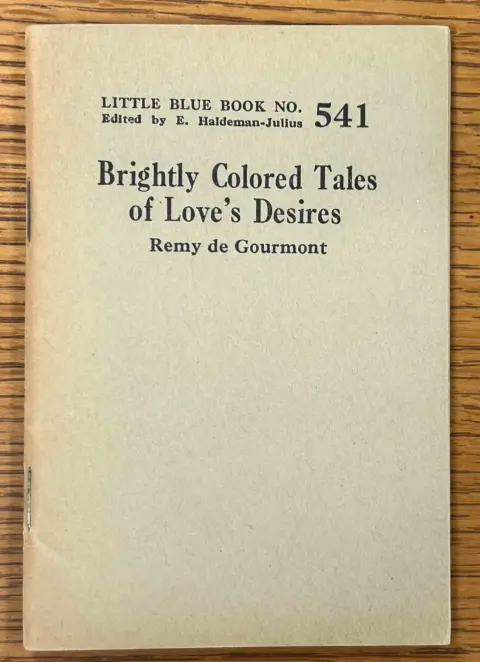
Stories in green, zinzolin, rose, purple, mauve, lilac and orange
Remy de Gourmont
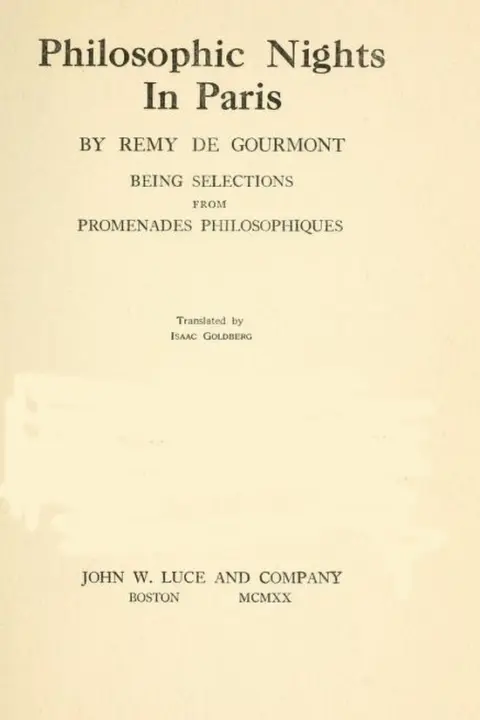
THE CLASSIC COLLECTION · 1920
"Philosophic Nights in Paris" by Remy de Gourmont is a collection of philosophical essays written in the early 20th century. The work showcases de Gourmont's thoughts on a range of topics, reflecting on happiness, free will, the nature of existence, and the significance of perception. As a member of the Symbolist movement, the author blends literary artistry with profound philosophical inquiry, offering readers insights into both the human condition and the complexities of modern life. The opening portion of "Philosophic Nights in Paris" introduces Remy de Gourmont's literary significance and philosophical approach. The text begins with an overview of de Gourmont's background, emphasizing his role as an interpreter of the Symbolist movement and his unique perspective on life and literature. It highlights key themes such as the struggle for happiness and the impact of perception on reality, while also setting the stage for the subsequent essays. The narrative captures de Gourmont's avant-garde spirit, as he navigates philosophical questions with a rich stylistic flair, inviting readers into his contemplative world.
Introduction adapted from the source catalogue; source summaries may be automatically generated.
Free to read · English · 23,776 words · No account needed
MAKE TIME FOR A GOOD BOOK
On by default. Untick to stop anonymous reading totals. Each page counts after 10 seconds in view. How this works.
Anonymous counting is on unless you have switched it off.
It is a singular thing: in literature, when the form is not new,
neither is the content.
Man is an animal that "arrived"; that is all.
It was an accident that endowed man with intelligence. He has made use of it: he invented stupidity.
Sexual modesty is an advance over the exhibitionism of monkeys.
Modesty is the delicate form of hypocrisy.
Nothing so softens the obduracy of chaste hearts as the certainty of
secrecy.
The notion that the dead are not dead assumes, in the crowd, comical forms. I read in a novel (1901): "Madeleine read the letter over again. M. Piot was dead, the poor man! How cold he must be in that north wind!" Men are stupid.
You have doubts? About what? About whom? About God? Why, that's a very simple matter: write to him.--I haven't his address.--Such, in fact, is the state of the question.
Revolutionary socialists make me think of the fellow who, having a piano that was out of tune, would say: "Let's smash this piano and throw the pieces into the fire; in its place we'll install an Aeolian harp."
Christianity has already won three great victories: Constantine, the Reform, the Revolution. A fourth is being awaited, Collectivism, after which it is probable that the Strong, wearied at last of being bullied, will revolt against the Weak and reduce them to slavery--once again.
Property is necessary; but it is not necessary that it should forever
remain in the same hands.
To ameliorate and raise the standard of the workingmen to the bourgeois level, is perhaps to create a race of slaves content with their lot,--a cast of comfortable Pariahs.
Thought harms the loins. One cannot at the same time carry burdens and
ideas.
Said Sixtus: "Believe in nothing, not even the trade you follow, not even the hand you caress, the eyes in which you are mirrored, not even yourself,--above all, not in yourself."
The true philosopher does not desire to see his ideas applied. He knows that they would be ill carried out, deformed, vulgarized. If need be, he would actually oppose such a course: this has happened.
Modesty is a timid confession of pride.
The ill are always optimistic. Perhaps optimism itself is an illness.
There is a simulation of intelligence, just as there is a simulation of
virtue.
Mr. X used to say: "Some people need a great deal in order to retain a little; as for me, I need a little to retain a great deal."
Science is worth what the scientist is worth.
Scholars spread the rumor that science is impersonal. Scholars? They are scholars as much as the masons are architects.
Your reading position is saved on this browser. Take it to another device with a library code. Reading pages adapt to text, rather than matching a printed edition.
Remy de Gourmont
Remy de Gourmont
Remy de Gourmont
BEHIND THE BOOK
This eBook is for the use of anyone anywhere in the United States and most other parts of the world at no cost and with almost no restrictions whatsoever. You may copy it, give it away or re-use it under the terms of the Project Gutenberg License included with this eBook or online at www.gutenberg.org. If you are not located in the United States, you will have to check the laws of the country where you are located before using this eBook. Read the source licence.
The original source file, including credits and licence, is retained by this library. Request an original-format copy at no charge. Please include the book title and Project Gutenberg identifier #46759.
KEEP YOUR CURIOSITY GOING

David Patterson (Spirit) Hatch

David Patterson (Spirit) Hatch

David Patterson (Spirit) Hatch
Coulson Kernahan

Ralph Waldo Emerson

Maurice Baring