THE CLASSIC COLLECTION✦Poems and translationsCLASSIC FREE BOOKS
Poems and translations
J. M. (John Millington) Synge & Francesco Petrarca
THE CLASSIC COLLECTION · 1835
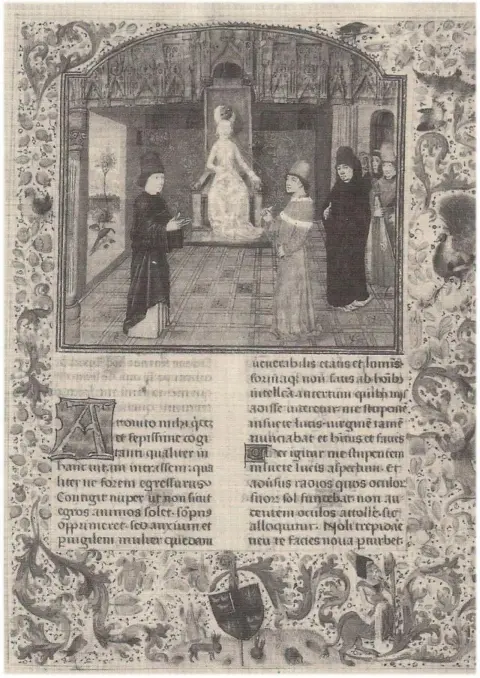
"Petrarch's Secret; or, the Soul's Conflict with Passion" by Francesco Petrarca is a trilogy of dialogues in Latin written between 1342 and 1353. In this deeply personal work, Petrarch examines his faith through imagined conversations with Saint Augustine, who challenges him on his devotion to earthly love and poetic fame. Augustine argues these passions bind Petrarch's will and prevent him from embracing God fully. The work reflects Petrarch's struggle to reconcile his Renaissance humanism with Christian faith.
Introduction adapted from the source catalogue; source summaries may be automatically generated.
Free to read · English · 50,916 words · No account needed
MAKE TIME FOR A GOOD BOOK
On by default. Untick to stop anonymous reading totals. Each page counts after 10 seconds in view. How this works.
Anonymous counting is on unless you have switched it off.
Petrarch. Yes, I am able, supposing always that there is any such thing as fortune at all. For I notice the two Greek and Latin Poets are so little of one mind on this point that the one has not deigned to mention the word even once in all his works, whereas the other mentions the name of fortune often and even reckons her Almighty.[47] And this opinion is shared by a celebrated historian and famous orator. Sallust has said of fortune that "all things are under her dominion."[48] And Cicero has not scrupled to affirm that "she is the mistress; of human affairs."[49] For myself, perhaps I will declare what I think on the subject at some other time and place. But so far as concerns the matter of our discussion, your admonitions have been of such service to me, that when I compare my lot with that of most other men it no longer seems so unhappy to me as once it did.
S. Augustine. I am glad indeed to have been of any service to you, and my desire is to do everything I can. But as our converse to-day has lasted a long while, are you willing that we should defer the rest for a third day, when we will bring it to a conclusion?
Petrarch. With my whole heart I adore the very number three itself, not so much because the three Graces are contained in it, as because it is held to be nearest of kin to the Deity; which is not only the persuasion of yourself and other professors of the true faith, who place all your faith in the Trinity, but also that of Gentile philosophers who have a traditional use of the same number in worshipping their own deities. And my beloved Virgil seems to have been conversant with this when he wrote--
"Uneven number to the gods is dear."[50]
For what goes before makes it clear that three is the number to which he alludes. I will therefore presently await from your hands the third part of this your threefold gift.
[1] Æneid, viii. 385-86.
[2] De bonis et malis, i. 3.
[3] Tusculan Orations, ii. 15. But Cicero's words are more guarded,
"inops interdum."
[4] Declamations, i.
[5] Juvenal, Sat. x. 172-73.
[6] Suetonius Domitian, xviii.
[7] Seneca, Epist., 65.
[8] Scipio is speaking of the souls admitted to heaven, freed from the
body. Africa, i. 329.
[9] Juvenal, i. 161 (not correctly quoted).
[10] Terence L'Audrienne, 68.
[11] Horace, Odes, i. 4, 15.
[12] Horace, Epist. i. 18, 109. Conington's translation.
[13] Horace, Odes, I. xxxi. 19, 20.
[14] Juvenal, Sat., xiv. 135.
[15] Æneid, iii. 629.
[16] Georgics, iv. 132.
[17] Georgics, i. 106.
[18] Juvenal, vi. 361.
[19] Seneca, Epist., xxv.
[20] Horace, Epist., i. 2, 56.
[21] De Senectute, xi.
[22] Horace, Epist. i. 2, 62-3.
Your reading position is saved on this browser. Take it to another device with a library code. Reading pages adapt to text, rather than matching a printed edition.
J. M. (John Millington) Synge & Francesco Petrarca
Francesco Petrarca
BEHIND THE BOOK
This eBook is for the use of anyone anywhere in the United States and most other parts of the world at no cost and with almost no restrictions whatsoever. You may copy it, give it away or re-use it under the terms of the Project Gutenberg License included with this eBook or online at www.gutenberg.org. If you are not located in the United States, you will have to check the laws of the country where you are located before using this eBook. Read the source licence.
The original source file, including credits and licence, is retained by this library. Request an original-format copy at no charge. Please include the book title and Project Gutenberg identifier #49450.
KEEP YOUR CURIOSITY GOING

David Patterson (Spirit) Hatch
Coulson Kernahan

Ralph Waldo Emerson

Maurice Baring
Frances Wright
Cécile Tormay