THE CLASSIC COLLECTION✦Poems and translationsCLASSIC FREE BOOKS
Poems and translations
J. M. (John Millington) Synge & Francesco Petrarca
THE CLASSIC COLLECTION · 1835
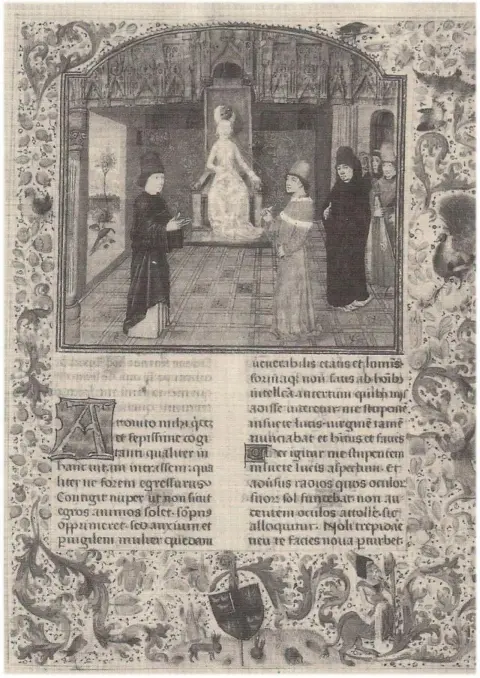
"Petrarch's Secret; or, the Soul's Conflict with Passion" by Francesco Petrarca is a trilogy of dialogues in Latin written between 1342 and 1353. In this deeply personal work, Petrarch examines his faith through imagined conversations with Saint Augustine, who challenges him on his devotion to earthly love and poetic fame. Augustine argues these passions bind Petrarch's will and prevent him from embracing God fully. The work reflects Petrarch's struggle to reconcile his Renaissance humanism with Christian faith.
Introduction adapted from the source catalogue; source summaries may be automatically generated.
Free to read · English · 50,916 words · No account needed
MAKE TIME FOR A GOOD BOOK
On by default. Untick to stop anonymous reading totals. Each page counts after 10 seconds in view. How this works.
Anonymous counting is on unless you have switched it off.
S. Augustine. We are falling into our old controversy. Want of will you call want of power. Well, so it must be, if it cannot be otherwise. I pray God that He will go with you where you go, and that He will order your steps, even though they wander, into the way of truth.
Petrarch. O may it indeed be as you have prayed! May God lead me safe and whole out of so many crooked ways; that I may follow the Voice that calls me; that I may raise up no cloud of dust before my eyes; and, with my mind calmed down and at peace, I may hear the world grow still and silent, and the winds of adversity die away.
Francis Petrarch, Poet, Most illustrious Orator; his Book, which he entitled Secretum; in which a Three days' Discussion concerning Contempt of the World is carried on. Finis.
[1] De Senectute, xxiii.
[2] Æneid, vi. 428-29.
[3] "Tarda sit illa dies et nostro serior ævo."--Met. xv. 868.
[4] This refers to the second Scipio Africanus, and the words alluded to are these: "It is his goodness that I loved, and that is not dead; it lives not alone for me, who have had it ever before my eyes, but it will go down in all its beauty to those who come after. Whenever a man is meditating some great undertaking, or shall be nourishing in his breast great hopes, his shall be the memory, and his the image that such a man shall take for a pattern."--Cicero, De Amicitiâ, xxvii.
[5] Æneid, i. 328-29.
[6] Cicero, Tusculan Orations, iv. 18.
[7] Quoted from Attilius in Cicero's Letters to Atticus, xiv.
[8] Ovid, Amores, I. x. 13.
[9] Æneid, vi. 540-43.
[10] Æneid, i. 613
[11] Seneca, De Beneficiis, vii. 8.
[12] Terence, Phormio, 949.
[13] Tusculan Orations, iv. 35
[14] Academica.
[15] Quoted from Tusculan Orations, iii. 26.
[16] Simone Martini, of Siena.
[17] A river in Thessaly.
[18] A town in Phocis, near Delphi.
[19] Terence, Eunuch, 59-63.
[20] Terence, Eunuch, 70-73.
[21] Ibid., 56.
[22] Ibid. 57, 58.
[23] Tusculan Orations, iv. 35.
[24] De Remediis Amoris, I. 162.
[25] Æneid, iii. 44.
[26] Tusculan Orations, iv. 35.
[27] Æneid, iv. 69-73.
[28] Seneca, Epist., xxviii.
[29] Horace, Epistles, Book I., Epist., xi. 27 (Conington).
[30] Horace, Epist., Book I., xi. 25-26 (Conington).
[31] Seneca's Epist., lxiv.
[32] Æneid, vi. 126-27.
[33] Georgics, ii. 136-39.
[34] Ildebrandino di Conte, Bishop of Padua, Epist. cxi. 25.
[35] Petrarch's Penitential Psalms, iii. (translated by George
Chapman).
[36] Ovid's De Remediis Amoris, 579-80.
[37] Petrarch's Epistles, i. 7.
[38] Quoted in Seneca's treatise, De Animæ tranquillitate, xv.
[39] Seneca's Epistles, ii.
[40] Tusculan Orations, iv. 35.
[41] The text here is obscure.
[42] Suetonius Domitian, xviii.
[43] Virgil, Eclogues, i. 29.
[44] Æneid, vi. 615-16.
[45] Ibid., ii. 265.
[47] Seneca, Epistles, iv.
[48] Petrarch's Africa, vii. 292.
[49] Seneca, De Natura Quæstiones, i. 17.
[50] Macrobius Saturnalia, ii 5.
[51] Horace, Epistles, i 4, 13.
[52] PS. cxxxi. 9.
[53] Cicero, Pro Marcello, viii.
[54] Seneca, Letters.
[55] De Senectute, xx.
[56] Ibid., xix.
Your reading position is saved on this browser. Take it to another device with a library code. Reading pages adapt to text, rather than matching a printed edition.
J. M. (John Millington) Synge & Francesco Petrarca
Francesco Petrarca
BEHIND THE BOOK
This eBook is for the use of anyone anywhere in the United States and most other parts of the world at no cost and with almost no restrictions whatsoever. You may copy it, give it away or re-use it under the terms of the Project Gutenberg License included with this eBook or online at www.gutenberg.org. If you are not located in the United States, you will have to check the laws of the country where you are located before using this eBook. Read the source licence.
The original source file, including credits and licence, is retained by this library. Request an original-format copy at no charge. Please include the book title and Project Gutenberg identifier #49450.
KEEP YOUR CURIOSITY GOING

David Patterson (Spirit) Hatch
Coulson Kernahan

Ralph Waldo Emerson

Maurice Baring
Frances Wright
Cécile Tormay