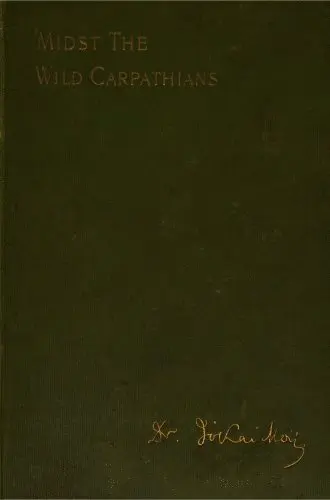
‘Midst the Wild Carpathians
Mór Jókai
THE CLASSIC COLLECTION · 1897
"Peter the Priest" by Mór Jókai is a novel written in the late 19th century. The story unfolds in a monastery where young Peter, a novice monk with a stern character, faces the daunting task of becoming the educator for the mischievous son of a powerful patroness. This narrative delves into themes of temptation, duty, and the complexities of human relationships, particularly through the eyes of Father Peter as he navigates his conflicting emotions towards his new role and the alluring patroness. At the start of the novel, we are introduced to a group of monks discussing a letter from their patroness, who seeks a tutor for her troublesome son. As they debate the qualifications of sending one of their own, they ultimately decide on Peter, despite his youth and relative inexperience. The surrounding dialogue reveals the monks' apprehensions about the patroness and her son, while Peter faces an internal struggle regarding his own inclination towards temptation. The first chapter sets the stage for Peter's upcoming trials as he embraces his new role, leaving behind the comfort of his monastery and stepping into a world filled with challenges and moral dilemmas.
Introduction adapted from the source catalogue; source summaries may be automatically generated.
Free to read · English · 46,676 words · No account needed
MAKE TIME FOR A GOOD BOOK
On by default. Untick to stop anonymous reading totals. Each page counts after 10 seconds in view. How this works.
Anonymous counting is on unless you have switched it off.
E-text prepared by Steven desJardins and the Project Gutenberg Online Distributed Proofreading Team (http://www.pgdp.net)
by
Author of "Black Diamonds," "Timar's Two Worlds,"
Translated by S. L. and A. V. Waite
New York
R. F. Fenno & Company
9 and 11 East 16th Street
Copyright, 1897 by R. F. Fenno & Company
Peter the Priest
There were six of them besides the Prior and Abbot. The seventh was away in the village, collecting the gifts of charity.
"Benedicite," began the Prior. "Here is a message from our most gracious patroness." With that he laid upon the table a sealed letter in Latin, which the others passed from hand to hand. All understood it, but it was evident that not one of them liked the letter, for they turned up their noses, pursed their lips and knit their eyebrows.
"One of us is bidden to the court of our most munificent patroness to
educate her only son."
"He is a little devil!" exclaimed the Abbot.
"He talks and whistles in church," cried another.
"He reviles the saints and the souls of the departed."
"He torments animals." Each one had something to say; especially the
last.
"He is the accursed child of a mad mother."
"She is the destruction of all men," continued the Abbot. "She sins against all the commandments."
"She tramples under foot all the sacraments."
"She is a raging fury and a sacrilegious witch."
"She sent her husband to his grave with a deadly drink."
The Prior met all these horrible comments with a stoical calm. "Still she is our gracious patroness, and her son also will one day be our patron. We must drink the bitter cup to its dregs. Let us choose."
Still all shook their heads.
"I have the fever in my bones," said one, rubbing his leg.
"I have trouble with my liver," said another, and as proof he put out his tongue to the opposite brother, who hastened to say:
"It is my vocation to heal the sick."
Now all three looked at the fourth, who felt very confident of having
the best excuse:
"And I am not acquainted with the Scythian speech, neither the Hungarian
nor the Slavic."
The fifth was embarrassed what excuse to give:
"I have taken a vow never to speak to a woman."
Evidently no one cared for the office.
"Then let us send Peter," said the Prior calmly.
At this all five cried out: "He is too young," said one.
"But he is stern of character," replied the Prior.
"He will meet with very great temptations," threw in a second.
"The greater will be his triumph," returned the Prior.
Your reading position is saved on this browser. Take it to another device with a library code. Reading pages adapt to text, rather than matching a printed edition.
Mór Jókai
Mór Jókai

Mór Jókai
Mór Jókai
BEHIND THE BOOK
This eBook is for the use of anyone anywhere in the United States and most other parts of the world at no cost and with almost no restrictions whatsoever. You may copy it, give it away or re-use it under the terms of the Project Gutenberg License included with this eBook or online at www.gutenberg.org. If you are not located in the United States, you will have to check the laws of the country where you are located before using this eBook. Read the source licence.
The original source file, including credits and licence, is retained by this library. Request an original-format copy at no charge. Please include the book title and Project Gutenberg identifier #23985.
KEEP YOUR CURIOSITY GOING
Coulson Kernahan

Maurice Baring
Frances Wright
Cécile Tormay

Frederic Jesup Stimson

W. H. P. (William Henry Pope) Jarvis