The Love-Story of Aliette Brunton
Gilbert Frankau
THE CLASSIC COLLECTION · 1920
"Peter Jameson: A Modern Romance" by Gilbert Frankau is a novel written in the early 20th century, specifically in the period around World War I. The story focuses on the life of Peter Jameson, a cigar importer, as he navigates both the business world and his personal relationships. The backdrop of London and a looming global conflict adds depth to Peter's journey of self-discovery, ambition, and love. The opening portion introduces Peter Jameson and his family lineage, illustrating his connection to the cigar industry and hinting at his professional aspirations and personal struggles. We see him reflecting on his work and relationships, particularly with his wife, Patricia, as they grapple with their roles in a changing society. The narrative sets the stage for exploring themes of ambition, love, and the impact of war, showcasing the nuanced dynamics of Peter's life as he intertwines his business endeavors with the complexities of marriage and parental responsibilities.
Introduction adapted from the source catalogue; source summaries may be automatically generated.
Free to read · English · 129,023 words · No account needed
MAKE TIME FOR A GOOD BOOK
On by default. Untick to stop anonymous reading totals. Each page counts after 10 seconds in view. How this works.
Anonymous counting is on unless you have switched it off.
All the time they were having their meal—the weir-man indicated a tiny arbour; boiled them hot water on the stove in his one-roomed cabin—thought of that tent obsessed their minds. To whom did that tent belong? Why shouldn’t they use that tent? River-inns were hot stuffy places, whereas a tent. . . .
Peter, balancing his third cup of tea on white-flannelled leg, approached the subject diffidently. “I say, Pat,” he began, “have you ever thought of camping-out? Rather jolly—camping-out. That tent reminded me. . . .”
“Oh, but we couldn’t possibly use that tent”—Patricia started packing-up the tea-things—“it’s sure to belong to somebody.”
“One might as well find out.” He rose from the rough bench of the tiny arbour; lounged away; came back in a few minutes, face a little flushed, eyes twinkling.
“The weir-man says that we can use it if we like. ‘The gentleman isn’t coming down till tomorrow evening.’”
“What gentleman?” asked Patricia.
“The gentleman who owns the tent, I suppose. I say, Pat, do let’s! It’d be a fearful lark. We could go into the town and buy our rations. . . .”
There and then, they settled the matter. The weir-man produced mattresses, blankets, a rug; unpacked the punt; directed them across the dyked pasturage towards Eynsham. And at Eynsham—which is the least interesting, ugliest village between Gravesend and Cricklade—they bought them eggs, and tinned foods, and a loaf of bread, and butter, and candles, and a huge basket of strawberries which Peter discovered hidden away in the dark of a greengrocer’s shop.
Evening began as they dawdled back, parcel-laden, along the high road; turned off from high road across the dyked pasturage. Now, willows screened the ugly village behind. They could see only the bridge, and the two hillocks beyond, and their tent—their very own tent—marking the river-bank. . . .
“It’ll be a frightful lark,” said Peter.
“Won’t it?” she answered.
Of the thing each had at heart, neither dared speech. . . .
Twilight had come in gold and gone in crimson: only faintest hints of greens and lilacs still lingered low down on the horizon. Eynsham Bridge was a humped black shadow across the dulled silver of the stream. Eynsham hills stood out in clear sepia against a turquoise sky.
“Good-night,” called the weir-man.
“Good-night,” they called back to him.
Now, they were utterly alone. The weir plunged and gurgled; a fish leaped in the pool. Darker it grew, and darker.
They could hardly see each other across the rug which had served them
for dinner-table.
“Shall I light the candles in the tent?” he asked.
“If you like, dear.”
Your reading position is saved on this browser. Take it to another device with a library code. Reading pages adapt to text, rather than matching a printed edition.
Gilbert Frankau
Gilbert Frankau
Gilbert Frankau
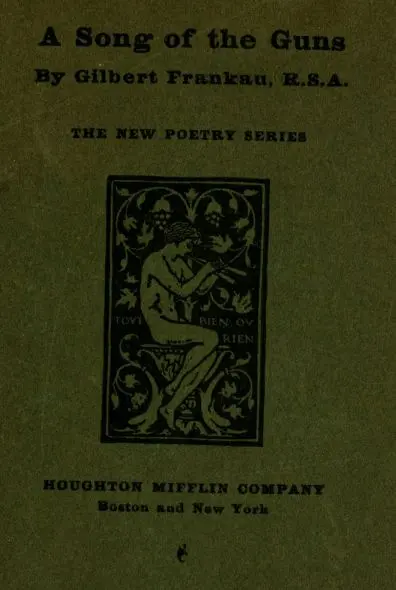
Gilbert Frankau
BEHIND THE BOOK
This eBook is for the use of anyone anywhere in the United States and most other parts of the world at no cost and with almost no restrictions whatsoever. You may copy it, give it away or re-use it under the terms of the Project Gutenberg License included with this eBook or online at www.gutenberg.org. If you are not located in the United States, you will have to check the laws of the country where you are located before using this eBook. Read the source licence.
The original source file, including credits and licence, is retained by this library. Request an original-format copy at no charge. Please include the book title and Project Gutenberg identifier #59936.
KEEP YOUR CURIOSITY GOING
Coulson Kernahan

Maurice Baring
Frances Wright
Cécile Tormay

Frederic Jesup Stimson

W. H. P. (William Henry Pope) Jarvis