The Love-Story of Aliette Brunton
Gilbert Frankau
THE CLASSIC COLLECTION · 1920
"Peter Jameson: A Modern Romance" by Gilbert Frankau is a novel written in the early 20th century, specifically in the period around World War I. The story focuses on the life of Peter Jameson, a cigar importer, as he navigates both the business world and his personal relationships. The backdrop of London and a looming global conflict adds depth to Peter's journey of self-discovery, ambition, and love. The opening portion introduces Peter Jameson and his family lineage, illustrating his connection to the cigar industry and hinting at his professional aspirations and personal struggles. We see him reflecting on his work and relationships, particularly with his wife, Patricia, as they grapple with their roles in a changing society. The narrative sets the stage for exploring themes of ambition, love, and the impact of war, showcasing the nuanced dynamics of Peter's life as he intertwines his business endeavors with the complexities of marriage and parental responsibilities.
Introduction adapted from the source catalogue; source summaries may be automatically generated.
Free to read · English · 129,023 words · No account needed
MAKE TIME FOR A GOOD BOOK
On by default. Untick to stop anonymous reading totals. Each page counts after 10 seconds in view. How this works.
Anonymous counting is on unless you have switched it off.
He used to lie there, hour after hour, screened from the world, thinking of her. His mind went back to days before the War, and he saw himself as he had been: the tango-dancing champagne-bibbing egotist, very proud of his little literary achievements, neither good nor bad, merely a drifter. He saw himself, ruined financially, miserable. And he met her again, in his dreams; sailed with her, once again, the tropic seas of their delight.
Beatrice, the Woman Denied! Surely that God who had once denied her to him, calling him unworthy, would not refuse her to him now. Surely, now, he might say to himself, in clean pride: “I have done my Work; paid full price for any happiness this world can offer me?” . . .
And then, five weeks after he had written, came her cable: “Am anxious,” she wired, “have you told me the truth about your wounds.” He spread the cablegram on his bed; read it again and again. Intuition, sounder than judgment, told him the truth. To this girl, five thousand miles removed from the cataclysm of Europe, he stood for “heroism”—a vague figure dowered with all the virtues of war. It needed only a word, a weak word, to make her love him.
The mere thought was a flaring temptation. Why not? If ever man had
earned woman. . . .
When the doctor made his midday visit, Francis—looking down at his swathed legs—asked one straight question.
“You mean,” said the doctor, “is there any reason, any physical reason, why you should not marry?”
“Exactly, doctor.”
“None whatever.”
“But I shall always be more or less a cripple?”
“You will walk with a limp—a slight limp. That isn’t being a cripple.”
Alone, he fought the problem out again: and decision came to him, clear-cut, obvious. She was twenty, rich, beautiful: he, a cripple—and a pauper cripple into the bargain. Leaving God out of the question, to take her in marriage would not be the act of a gentleman. . . . Chivalrous, stubborn, a fool if you will but no weakling, he traced the answer to her cablegram: “Much better thanks writing.”
In the middle of December, 1915, they shipped him—still a
“stretcher-case”—to England.
In those early days, the Endsleigh Gardens Hospital for officers was a place of easy discipline, comely V.A.D. nurses and frolicsome patients. Francis, still unable to walk, could not be frolicsome: but they gave him a room to himself, a tiny room, linoleum-carpeted, high up on the sixth floor; and in a funny introspective way, he was happy.
Your reading position is saved on this browser. Take it to another device with a library code. Reading pages adapt to text, rather than matching a printed edition.
Gilbert Frankau
Gilbert Frankau
Gilbert Frankau
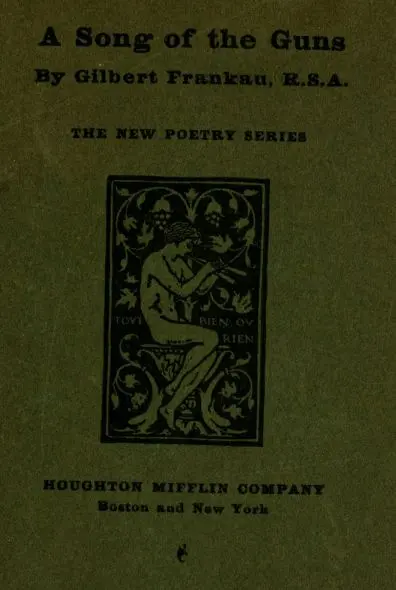
Gilbert Frankau
BEHIND THE BOOK
This eBook is for the use of anyone anywhere in the United States and most other parts of the world at no cost and with almost no restrictions whatsoever. You may copy it, give it away or re-use it under the terms of the Project Gutenberg License included with this eBook or online at www.gutenberg.org. If you are not located in the United States, you will have to check the laws of the country where you are located before using this eBook. Read the source licence.
The original source file, including credits and licence, is retained by this library. Request an original-format copy at no charge. Please include the book title and Project Gutenberg identifier #59936.
KEEP YOUR CURIOSITY GOING
Coulson Kernahan

Maurice Baring
Frances Wright
Cécile Tormay

Frederic Jesup Stimson

W. H. P. (William Henry Pope) Jarvis