The Love-Story of Aliette Brunton
Gilbert Frankau
THE CLASSIC COLLECTION · 1920
"Peter Jameson: A Modern Romance" by Gilbert Frankau is a novel written in the early 20th century, specifically in the period around World War I. The story focuses on the life of Peter Jameson, a cigar importer, as he navigates both the business world and his personal relationships. The backdrop of London and a looming global conflict adds depth to Peter's journey of self-discovery, ambition, and love. The opening portion introduces Peter Jameson and his family lineage, illustrating his connection to the cigar industry and hinting at his professional aspirations and personal struggles. We see him reflecting on his work and relationships, particularly with his wife, Patricia, as they grapple with their roles in a changing society. The narrative sets the stage for exploring themes of ambition, love, and the impact of war, showcasing the nuanced dynamics of Peter's life as he intertwines his business endeavors with the complexities of marriage and parental responsibilities.
Introduction adapted from the source catalogue; source summaries may be automatically generated.
Free to read · English · 129,023 words · No account needed
MAKE TIME FOR A GOOD BOOK
On by default. Untick to stop anonymous reading totals. Each page counts after 10 seconds in view. How this works.
Anonymous counting is on unless you have switched it off.
But Chips Bradley’s grandson, peering out over the empty plain, peering back towards Béthune—waiting, waiting, waiting, for the dust cloud on the road, the dust cloud that never came—thought of the words his Colonel had spoken the night before. And the heart in him was heavy, even in those early hours, with forebodings of disaster!
Light grew and grew. Fitful gleams of sunshine danced across the plain. More cavalry came, squadron after squadron, wheeling into line on the fields just below. But they made no movement forward, those wheeling squadrons. Peter saw them through his glasses—dismounting, loosening girths, fume of their cigarettes blue in the air.
Came one English aeroplane, drifting aimlessly across the sky.
Walking wounded came, trudging painfully across the fields, singly and two by two, arms dangling, heads bandaged. (There were no steel helmets in those early days.)
Came a gray company of prisoners, capless, weaponless; fell out; squatted on their hunkers among the root-fields. Came a dozen peasant-children, sprung somehow to life; wrenched up roots from the field; pelted the captives as they squatted. The company fell in again; trudged off towards Béthune; followed by the spitting, cursing children. (And there were many “gentlemen” in England still abed that morning!)
Came, towards noon, down the road from Sailly, long brown columns of infantry, guns and horses; marching towards Noyelles. The Northdown Division! Gun-range away behind the grimy remnants who were even then bombing out the cellars in Loos village beyond the skyline. . . . But from Beuvry to Annequin the roads were bare. And on the left of the attack, round the Hohenzollern Redoubt, in the Chalk Quarries, at the foot of Fosse Eight, men fought unsupported, died cursing the chance that was never taken, the help that never came.
“The situation with regard to the Southdown Division is still obscure at the time of drawing up my report,” reads official history of a fortnight later.
Peter, relieved by Purves, stumbled down from his eyrie at about two o’clock; found Colonel Stark and Doctor Carson sitting over the débris of lunch.
“Very sad,” the Irishman was saying.
“What is?” asked Peter, slipping off his gas-satchel, sitting down to
cold beef.
“Poor Halliday’s been killed,” answered the Weasel. “Doc’s just been up to Vermelles on a push-bike.”
“They nearly got me too. Bromley’s crowd have been having a pretty
rotten time.”
The casualty, first among their officers, cast a gloom over the three men. Soon, the Doctor went back to his impromptu surgery—a tiny room off the hall where his batman had set out from their wicker cases, bandages, shining instruments, bottles of disinfectants, boxes of tabloids.
Your reading position is saved on this browser. Take it to another device with a library code. Reading pages adapt to text, rather than matching a printed edition.
Gilbert Frankau
Gilbert Frankau
Gilbert Frankau
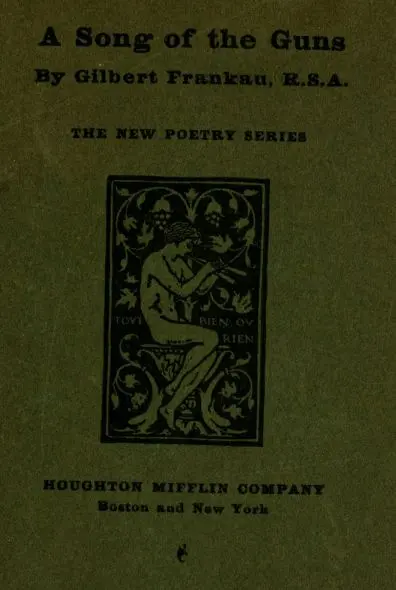
Gilbert Frankau
BEHIND THE BOOK
This eBook is for the use of anyone anywhere in the United States and most other parts of the world at no cost and with almost no restrictions whatsoever. You may copy it, give it away or re-use it under the terms of the Project Gutenberg License included with this eBook or online at www.gutenberg.org. If you are not located in the United States, you will have to check the laws of the country where you are located before using this eBook. Read the source licence.
The original source file, including credits and licence, is retained by this library. Request an original-format copy at no charge. Please include the book title and Project Gutenberg identifier #59936.
KEEP YOUR CURIOSITY GOING
Coulson Kernahan

Maurice Baring
Frances Wright
Cécile Tormay

Frederic Jesup Stimson

W. H. P. (William Henry Pope) Jarvis