THE CLASSIC COLLECTION✦An outlaw’s diary: the CommuneCLASSIC FREE BOOKS
An outlaw’s diary: the Commune
Cécile Tormay
THE CLASSIC COLLECTION · 1897
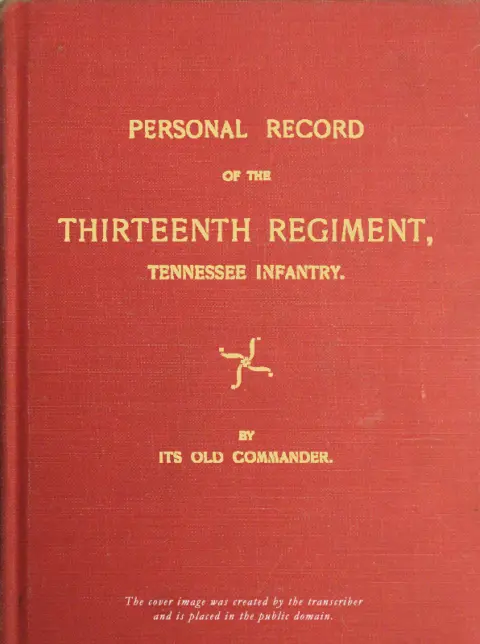
"Personal Record of the Thirteenth Regiment, Tennessee Infantry" by Alfred J. Vaughan is a historical account written in the late 19th century. The book presents an in-depth narrative of the experiences and battles faced by the Thirteenth Regiment during the American Civil War, offering a detailed account of the soldiers' bravery, hardships, and eventual fate. This account not only honors the memory of the soldiers who fought but also reflects on the emotions and sentiments surrounding the Confederate cause during and after the war. At the start of the memoir, Alfred J. Vaughan introduces the Thirteenth Regiment, detailing its formation in June 1861 and the composition of its companies, filled with young men eager to defend their beliefs. Vaughan shares personal reflections and memories of the war, acknowledging the sacrifices made by his comrades. He recounts how the regiment engaged in its first campaign, where soldiers displayed remarkable endurance despite the harsh conditions. His narrative continues with vivid descriptions of early battles, the courage of individual soldiers, and the continual evolution of the regiment as it faced numerous trials throughout the war, setting the stage for what will surely be a poignant reflection on their experiences and sacrifices.
Introduction adapted from the source catalogue; source summaries may be automatically generated.
Free to read · English · 21,682 words · No account needed
MAKE TIME FOR A GOOD BOOK
On by default. Untick to stop anonymous reading totals. Each page counts after 10 seconds in view. How this works.
Anonymous counting is on unless you have switched it off.
This was one of the regiments that made Cheatham's Division, and Smith's-Vaughan's and Gordon's Brigades so famous in the Army of Tennessee. It was organized and mustered into service on the third day of June, 1861, in answer to a call of Governor Isham G. Harris for seventy-five thousand volunteers. At that time it was the seventh infantry regiment organized in West Tennessee and the thirteenth in the State. It was made up of the "flower of the South" young men, most of whom were fresh from the best institutions of learning--aspiring, hopeful and ambitious--sons of men of education, wealth and influence--the very best material for volunteer service. It was composed of ten full companies--five from Fayette county, one from Shelby, one from Dyer, one from McNairy, one from Gibson, and one from Henderson, and were as follow:
Company A, Fayette Rifles, Captain William Burton of Somerville, Tenn.
Company B, Macon Grays, Captain J. L. Granberry, Macon, Tenn.
Company C, Secession Guards, organized at Germantown, Tenn., and composed of Mississippians and Tennesseeans, Captain John H. Morgan, Horn Lake, Miss.
Company D, Yorkville Rifles, Captain John Wilkins, Yorkville, Tenn.
Company E, Dixie Rifles, organized at Moscow, Tenn., and composed of Tennesseeans and Mississippians, Captain A. J. Vaughan, Marshall county, Miss.
Company F, Wright Boys, Captain Jno. V. Wright, Purdy, McNairy county,
Tenn.
Company G, Gaines Invincibles, Captain W. E. Winfield, LaGrange, Tenn.
Company H, Yancey Rifles, Captain Robert W. Pittman, Hickory Withe,
Tenn.
Company I, Forked Deer Volunteers, Captain G. S. Ross, Forked Deer,
Tenn.
Company K, Dyer Grays, Captain S. R. Latta, Dyersburg, Tenn.
On the following day, the 4th of June, the election of field officers was held, and resulted in the election of Captain Jno. V. Wright of Company F as Colonel, Captain A. J. Vaughan of Company E as Lieutenant-Colonel, and Captain W. E. Winfield of Company G as Major.
The regiment was ordered at once by way of Memphis to Randolph, on the Mississippi river, when the organization was completed by the appointment of Lieutenant W. E. Morgan, Company C, Adjutant; Dr. J. A. Forbes, Company E, Surgeon; Dr. B. F. Dickerson, Company I, Assistant Surgeon; W. E. Dyer, Company G, Commissary; L. B. Cabler, Company A, Regimental Quartermaster; Peter Cole, Company H, Sergeant-Major; and W. D. F. Hafford, Chaplain.
The regiment remained at Randolph engaged in drilling, camp duty, etc., until July 26th, when it was ordered to New Madrid, Mo., and placed in a brigade under command of Colonel J. P. McCown, who, under orders from General Gid. J. Pillow, was about to make a campaign into South-west Missouri to prevent reinforcements being sent to the Federal General Lyons, then operating in that section.
Your reading position is saved on this browser. Take it to another device with a library code. Reading pages adapt to text, rather than matching a printed edition.
BEHIND THE BOOK
This eBook is for the use of anyone anywhere in the United States and most other parts of the world at no cost and with almost no restrictions whatsoever. You may copy it, give it away or re-use it under the terms of the Project Gutenberg License included with this eBook or online at www.gutenberg.org. If you are not located in the United States, you will have to check the laws of the country where you are located before using this eBook. Read the source licence.
The original source file, including credits and licence, is retained by this library. Request an original-format copy at no charge. Please include the book title and Project Gutenberg identifier #49898.
KEEP YOUR CURIOSITY GOING
Cécile Tormay

Moritz Busch
John L. Ransom
Frances Wright
Cécile Tormay

Mabel Potter Daggett