
Last letters from the living dead man
David Patterson (Spirit) Hatch
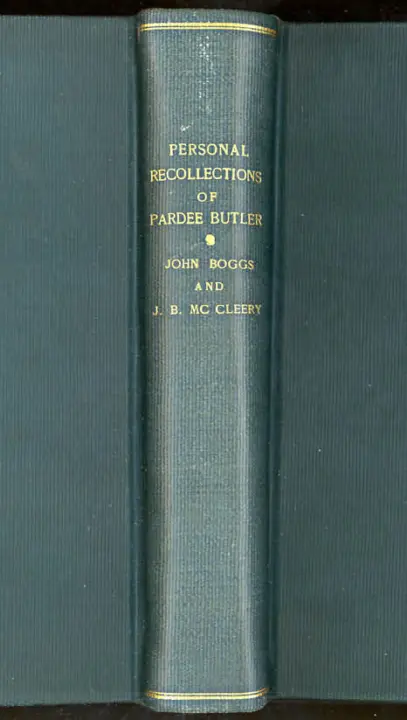
THE CLASSIC COLLECTION · 1889
"Personal Recollections of Pardee Butler" by Pardee Butler is a historical account written in the late 19th century that chronicles the life of Pardee Butler, a preacher, and community leader in early America. The narrative delves into his upbringing, family background, and the significant events that shaped his character and faith, highlighting his experiences against the backdrop of social and religious movements of the time. At the start of the work, the author’s daughter, Mrs. Rosetta B. Hastings, explains her intent to supplement her father's written recollections with her memories and insight into his life, underscoring his modesty and the challenges he faced. The opening chapters introduce the reader to Butler's family lineage, their migration patterns, and his formative years characterized by hardship, determination, and a commitment to religious principles. These personal details set the stage for a broader narrative about the religious fervor of the time, including the emergence of Christian movements and controversies surrounding slavery, as Butler navigated his roles as both a preacher and a community member amidst the tumultuous social landscape of 19th-century America.
Introduction adapted from the source catalogue; source summaries may be automatically generated.
Free to read · English · 98,569 words · No account needed
MAKE TIME FOR A GOOD BOOK
On by default. Untick to stop anonymous reading totals. Each page counts after 10 seconds in view. How this works.
Anonymous counting is on unless you have switched it off.
But we wait for a period of seventeen years, then Eld S. T. Dodd, of Topeka, is appointed by the Kansas Christian Missionary Society to write a history of the work of the Christian Church in Kansas, which he does in a tract of thirty-eight pages; and Bro. D., writing under date of 1882, makes the following summary of the work done:
From 1856 to 1865 anything like church work was as good as thrown away, except as affording temporary privileges.
Finally a time came when the clatter of arms and the clatter of raiders were ended; railroads were built, and emigration poured in from all States and nations, among which were many Disciples of Christ, who should have been builded into existing churches, or collected into new ones; but many were permitted to drift along in carelessness and irresponsibility until their identity as members has been lost.
During the past five years there has been a general awakening among our brethren, which has resulted in very many new organizations and the possession of Atchison, Topeka, Wichita, and several other strongholds.
Bro. Dodd makes report of the following State meetings as having been
held in Kansas:
In 1869, Grantville; in 1870, Le Roy; in 1871, St. George; in 1872, Emporia; in 1873, Topeka; in 1874, Olathe; in 1875, Ottawa, in 1876, Manhattan; in 1877, Emporia; in 1878, Gates Center; in 1879, Emporia; in 1880, Manhattan; in 1881, Salina; in 1832, Emporia.
To the above summary the writer will add the following list of the earlier Territorial and State meetings:
In 1860, Big Springs; in 1861, Prairie City; in 1862, Emporia; in 1863, Ottawa; in 1864, Tecumseh; in 1865, Prairie City; in 1866, Ottawa; in 1867, Olathe.
To the above statistics we will append the following reflections:
1. Among the preachers that prominently appear in the first seven years of our work, there are none remaining, save the writer of these Recollections, Some are fallen out by the way. Elders S. G. Brown, Wm. Gans, N. B. White, S. A. Marshal and Allen Crocker have died in the faith and hope of the gospel. The name of J. H. Bauserman does, indeed, appear, but he had only just begun his work; but having put the armor on, he has never laid it off. The name of J. B. McCleery does not yet appear on the minutes of our yearly meetings, still he was already an evangelist. He had been in Ohio the friend and companion of James A. Garfield, and soon came to be known as one of the first pulpit orators of the State. The government, like death, "loves a shining mark," and claimed Bro. McCleery for its service, and he is now an army chaplain. The churches will never cease to regret his choice, and yet he had a right to make it.
Your reading position is saved on this browser. Take it to another device with a library code. Reading pages adapt to text, rather than matching a printed edition.
BEHIND THE BOOK
This eBook is for the use of anyone anywhere in the United States and most other parts of the world at no cost and with almost no restrictions whatsoever. You may copy it, give it away or re-use it under the terms of the Project Gutenberg License included with this eBook or online at www.gutenberg.org. If you are not located in the United States, you will have to check the laws of the country where you are located before using this eBook. Read the source licence.
The original source file, including credits and licence, is retained by this library. Request an original-format copy at no charge. Please include the book title and Project Gutenberg identifier #12973.
KEEP YOUR CURIOSITY GOING
David Patterson (Spirit) Hatch

David Patterson (Spirit) Hatch

David Patterson (Spirit) Hatch
Cécile Tormay

Moritz Busch
John L. Ransom