THE CLASSIC COLLECTION✦Winefred: A Story of the Chalk CliffsCLASSIC FREE BOOKS
Winefred: A Story of the Chalk Cliffs
S. (Sabine) Baring-Gould
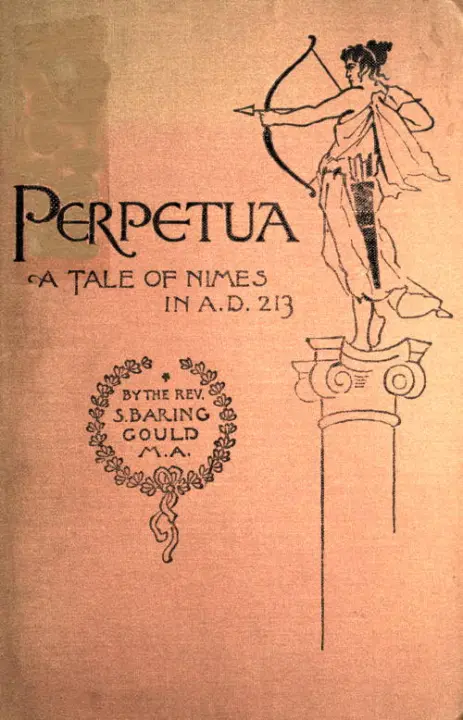
THE CLASSIC COLLECTION · 1897
"Perpetua. A Tale of Nîmes in A.D. 213" by S. Baring-Gould is a historical novel written in the late 19th century. The story revolves around Perpetua, a young woman in the ancient city of Nîmes, as she faces a harrowing fate during a sacred festival that demands the sacrifice of a girl to the god Nemausus. The narrative delves into themes of faith, sacrifice, and the conflicts between emerging Christianity and traditional pagan beliefs. The opening of the novel sets a vibrant scene in Nîmes on the first day of March, where crowds gather near a sacred fountain to celebrate an ancient festival. Amidst the joy, there is a palpable undercurrent of fear among the spectators, as the horrific lottery of selecting a sacrificial virgin begins. Perpetua's character emerges as both innocent and strong-willed, ultimately becoming the chosen victim, much to the distress of her mother. The narrative not only hints at her struggle against this cruel fate but also introduces the young man Æmilius, who is captivated by her beauty and courage, foreshadowing his future involvement in her plight.
Introduction adapted from the source catalogue; source summaries may be automatically generated.
Free to read · English · 56,190 words · No account needed
MAKE TIME FOR A GOOD BOOK
On by default. Untick to stop anonymous reading totals. Each page counts after 10 seconds in view. How this works.
Anonymous counting is on unless you have switched it off.
The proceedings were marked by the strictest propriety, the eating and drinking were in moderation, conversation was edifying, and general harmony prevailed. During the meal, a knocking was heard at the outer gate, and when the porter asked the name of the applicant for admission, the password was given, and he was admitted.
All rose to receive Castor, the bishop.
“Recline again, my friends,” said he. “I have come from the house of Flavillus, the timber merchant on the stagna; his wife’s mother has endured that which is human. She sleeps, and her spirit is with the Lord. I have been delayed. I was doing the work of my Master. One, a stranger to the faith, questioned me, and I tarried to converse with him, and disclose to his dark mind some ray of light. If the supper be ended, I will offer thanks.”
Then, standing at one of the tables, he made prayer to God, and thanked Him who had caused the corn to spring out of the earth, and had gathered the many grains into one bread; who had watered the vine from heaven, and had flushed the several grapes with generous juice, uniting the many into one bunch.
The thanksgiving ended, lights were introduced in considerable numbers. There is no twilight in southern climes; when night falls, it falls darkly. Now all who had eaten went to the impluvium, dipped their hands, and washed their lips, then wiped them on towels held by the deaconesses.
The tables were quickly removed, and the benches ranged in the triclinium, so as to accommodate all.
No sooner was the whole congregation assembled, than the president, Castor, invited all such as had a psalm, an interpretation, a vision, or an edifying narrative, to relate or recite it.
Then up started a little man, who held a lyre.
“Sir,” said he, “I have composed a poem in honor of Andeolus, the martyr
of Gentibus.”
He struck a chord on his instrument, and sang. The composition was devoid of poetry, the meter halting, the Latin full of provincialisms, and the place of poetic imagery was filled with extravagances of expression. When he had concluded, he perhaps inadvertently wound up with the words, “Generous audience, grant me your applause!”—the usual method of conclusion on the stage.
And the request met with favor—hands were clapped.
Then Bishop Castor rose, and with a grave face, said:
Your reading position is saved on this browser. Take it to another device with a library code. Reading pages adapt to text, rather than matching a printed edition.
S. (Sabine) Baring-Gould
S. (Sabine) Baring-Gould
S. (Sabine) Baring-Gould
S. (Sabine) Baring-Gould
BEHIND THE BOOK
This eBook is for the use of anyone anywhere in the United States and most other parts of the world at no cost and with almost no restrictions whatsoever. You may copy it, give it away or re-use it under the terms of the Project Gutenberg License included with this eBook or online at www.gutenberg.org. If you are not located in the United States, you will have to check the laws of the country where you are located before using this eBook. Read the source licence.
The original source file, including credits and licence, is retained by this library. Request an original-format copy at no charge. Please include the book title and Project Gutenberg identifier #47832.
KEEP YOUR CURIOSITY GOING
Cécile Tormay

Moritz Busch
Coulson Kernahan
John L. Ransom

Maurice Baring
Frances Wright