THE CLASSIC COLLECTION✦Winefred: A Story of the Chalk CliffsCLASSIC FREE BOOKS
Winefred: A Story of the Chalk Cliffs
S. (Sabine) Baring-Gould
THE CLASSIC COLLECTION · 1897
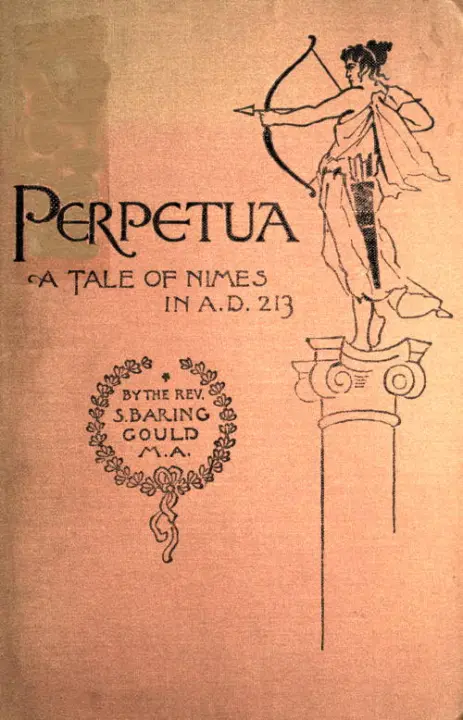
"Perpetua. A Tale of Nîmes in A.D. 213" by S. Baring-Gould is a historical novel written in the late 19th century. The story revolves around Perpetua, a young woman in the ancient city of Nîmes, as she faces a harrowing fate during a sacred festival that demands the sacrifice of a girl to the god Nemausus. The narrative delves into themes of faith, sacrifice, and the conflicts between emerging Christianity and traditional pagan beliefs. The opening of the novel sets a vibrant scene in Nîmes on the first day of March, where crowds gather near a sacred fountain to celebrate an ancient festival. Amidst the joy, there is a palpable undercurrent of fear among the spectators, as the horrific lottery of selecting a sacrificial virgin begins. Perpetua's character emerges as both innocent and strong-willed, ultimately becoming the chosen victim, much to the distress of her mother. The narrative not only hints at her struggle against this cruel fate but also introduces the young man Æmilius, who is captivated by her beauty and courage, foreshadowing his future involvement in her plight.
Introduction adapted from the source catalogue; source summaries may be automatically generated.
Free to read · English · 56,190 words · No account needed
MAKE TIME FOR A GOOD BOOK
On by default. Untick to stop anonymous reading totals. Each page counts after 10 seconds in view. How this works.
Anonymous counting is on unless you have switched it off.
“I cannot forswear Christ,” said Baudillas with a firmness that surprised none so much as himself. But, indeed, the fall of Marcianus, so far from drawing him along into the same apostasy, had caused a recoil in his soul. To hear his fellow‐ministrant deny Christ, to see him extend his hands for the incense—that inspired him with an indignation which gave immense force to his resolution. The Church had been dishonored, the ministry disgraced in Marcianus. Oh, that they might not be thus humbled in himself!
“Baudillas Macer,” said the magistrate, “take advice, and be speedy in making your election; your fellow, who has just furnished a breakfast to the wolves, hesitated a moment too long, and so lost his life. By the time he had resolved to act as a wise man and a good citizen, not the gods themselves could deliver him. Flamen, hand the shell with the grains to this sensible fellow.”
“I cannot offer sacrifice.”
“You are guilty of treason against Cæsar if you refuse to sacrifice to his genius. Never mind about Nemausus, whose image is there. Say—the genius of Cæsar, and you are quit.”
“I am his most obedient subject.”
“Then offer a libation or some frankincense.”
“I cannot. I pray daily to God for him.”
“A wilful man is like a stubborn ass. There is naught for him but the stick. I can do no more. I shall sentence you.”
“I am ready to die for Christ.”
“Then lead him away. The sword!”
The deacon bowed. “I am unworthy of shedding my blood for Christ,” he said, and his voice, though low, was firm.
Then he looked around and saw the Bishop Castor in the zone allotted to the citizens and knights. Baudillas crossed his arms on his breast and knelt on the sand, and the bishop, rising from his seat, extended his hand in benediction.
He, Castor, had not been called to sacrifice. He had not courted death, but he had not shrunk from it. He had not concealed himself, nevertheless he had been passed over.
Then the deacon, with firm step, walked into the center of the arena and
knelt down.
In another moment his head was severed from the body.
The attendants immediately removed every trace of the execution, and now arrived the moment for which all had looked with impatience.
The magistrate said: “Bring forward Perpetua, daughter of Aulus Harpinius Læto, that has lived.”
At once Æmilius sprang into the arena and advanced before Petronius.
“Suffer me to act as her advocate,” said he in an agitated voice. “You know me, I am Lentulus Varo.”
Your reading position is saved on this browser. Take it to another device with a library code. Reading pages adapt to text, rather than matching a printed edition.
S. (Sabine) Baring-Gould
S. (Sabine) Baring-Gould
S. (Sabine) Baring-Gould
S. (Sabine) Baring-Gould
BEHIND THE BOOK
This eBook is for the use of anyone anywhere in the United States and most other parts of the world at no cost and with almost no restrictions whatsoever. You may copy it, give it away or re-use it under the terms of the Project Gutenberg License included with this eBook or online at www.gutenberg.org. If you are not located in the United States, you will have to check the laws of the country where you are located before using this eBook. Read the source licence.
The original source file, including credits and licence, is retained by this library. Request an original-format copy at no charge. Please include the book title and Project Gutenberg identifier #47832.
KEEP YOUR CURIOSITY GOING
Cécile Tormay

Moritz Busch
Coulson Kernahan
John L. Ransom

Maurice Baring
Frances Wright