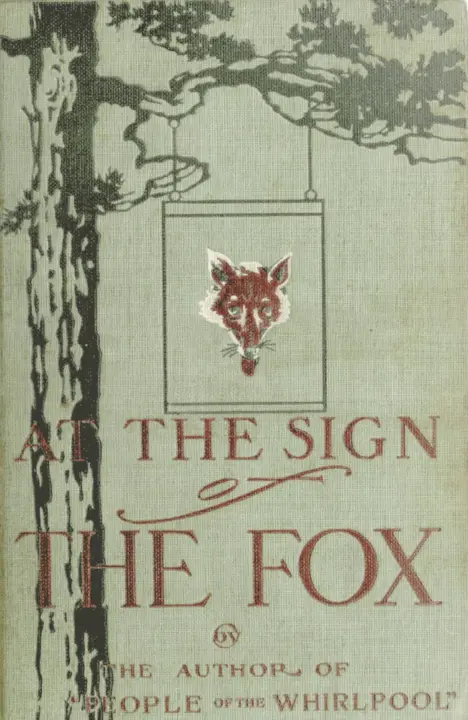
At the Sign of the Fox: A Romance
Mabel Osgood Wright
THE CLASSIC COLLECTION · 1903
"People of the Whirlpool" by Mabel Osgood Wright is a novel written during the early 20th century. The story is narrated by Barbara, who reflects on her life as a mother of twins and the evolving social dynamics in her community as it comes into contact with wealthier outsiders from New York. It explores the theme of motherhood, familial relationships, and the contrasts between old and new societal values. The opening of the novel introduces Barbara in her attic, where she organizes her thoughts and memories about her children, Richard and Ian, who are lively twin boys. As she reminisces, she also considers the changes brought about by the arrival of affluent newcomers to her once-peaceful town, which she refers to as "the Whirlpool." Through her reflections and observations about parenting, her children's unique personalities, and her friendships—particularly with Lavinia Dorman—Barbara reveals her concerns about the social shifts and their implications for her family's traditional lifestyle. The narrative balances humor with introspective moments, setting the stage for deeper explorations of identity and community throughout the book.
Introduction adapted from the source catalogue; source summaries may be automatically generated.
Free to read · English · 79,906 words · No account needed
MAKE TIME FOR A GOOD BOOK
On by default. Untick to stop anonymous reading totals. Each page counts after 10 seconds in view. How this works.
Anonymous counting is on unless you have switched it off.
Taking a few hasty steps forward, and dreading anything disagreeably
tragic, she said: "Mr. Bradford, I believe. What is it? What has
happened?"
"Only this, that Miss Sylvia has promised to be my wife, and that, as her mother, we have come to tell you of it before I go home to tell my own." Horace Bradford drew himself up to every inch of his full height as he spoke, bowed to Mrs. Latham, then led Sylvia to the foot of the stairs, saying, "Until to-morrow," and walked quietly out of the house.
No one spoke. Then Mrs. Latham, choking with rage, feeling herself helplessly at bay (Sylvia was of age, and she could not even assume authority under the circumstances), collapsed on a divan in modified hysterics, and Monty Bell, completely thunderstruck, finally broke the silence by his characteristic exclamation, "I'll be damned!"
After their belated supper, when Esther Nichols had gone over to a neighbour's, Horace, sitting by his mother's side, out in the honeysuckled porch, where the sphinx moths whirred like humming-birds of night, holding her hands in his, told her all. And she, stifling the mother pain that, like a birth pang, expected yet dreaded, must come at first when the other woman, no matter how welcome, steps between, folded his hands close, as if she held him again a baby in her arms, and said, smiling through vague tears, "To-morrow we will go together to her, my blessed son."
"I cannot ask you to do that; there are reasons--I will bring Sylvia to you later, when her mother has gone," he answered hastily, resolving that he would do anything to shield her self-respect from the possible shock of meeting that other mother.
"Horace, you forget yourself, and your father too," she said almost sternly. "I am country bred, but still I know the world's ways. Your father's wife will go first to greet her who will be yours; you need not fear for me," and he sat silent.
That next afternoon, when Horace's first and last love met, they looked into each other's hearts and saw the same image there, while Mrs. Latham lay on the lounge in her room, raging within, that again her tongue had failed her in her own house, and realizing that, woman of the world as she aimed to be, the "egg woman" had rendered her helpless by mere force of homely courtesy. Presently she rose, and railing and scolding the bewildered maid, sent a message to New York to transfer her passage, if possible, to an earlier steamer.
Your reading position is saved on this browser. Take it to another device with a library code. Reading pages adapt to text, rather than matching a printed edition.
Mabel Osgood Wright
Mabel Osgood Wright
Mabel Osgood Wright
Mabel Osgood Wright
BEHIND THE BOOK
This eBook is for the use of anyone anywhere in the United States and most other parts of the world at no cost and with almost no restrictions whatsoever. You may copy it, give it away or re-use it under the terms of the Project Gutenberg License included with this eBook or online at www.gutenberg.org. If you are not located in the United States, you will have to check the laws of the country where you are located before using this eBook. Read the source licence.
The original source file, including credits and licence, is retained by this library. Request an original-format copy at no charge. Please include the book title and Project Gutenberg identifier #11561.
KEEP YOUR CURIOSITY GOING
Coulson Kernahan

Maurice Baring
Frances Wright
Cécile Tormay

Frederic Jesup Stimson

W. H. P. (William Henry Pope) Jarvis