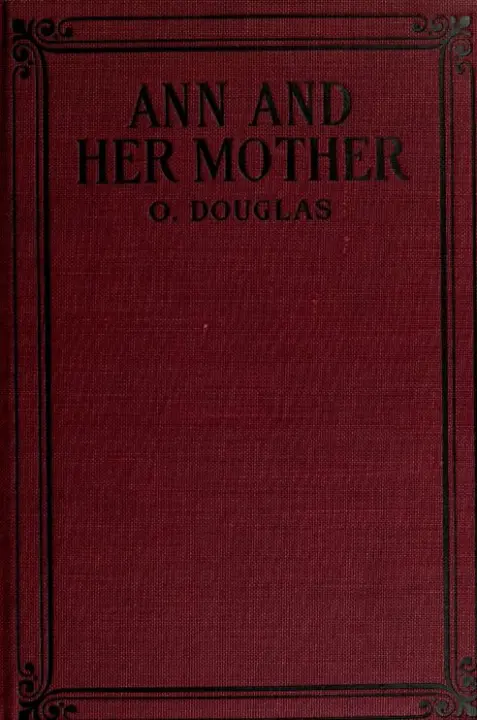
Ann and Her Mother
O. Douglas
THE CLASSIC COLLECTION · 1920
"Penny Plain" by O. Douglas is a novel set in the early 20th century that explores themes of family, community, and the simplicity of life. The story revolves around the Jardine family, particularly Jean Jardine, who is responsible for her two younger brothers, David and Jock, as well as Gervase "Mhor" Taunton, a charming young boy they have taken in. It delves into the everyday life of this small town in Scotland, highlighting their relationships, aspirations, and the challenges they face as they navigate life together. The opening of "Penny Plain" introduces the reader to the quaint town of Priorsford on a chilly October afternoon, setting a vivid scene that paints a picture of both the landscape and the societal dynamics at play. Inside the Jardine's modest home, we meet the family gathering for tea, a poignant moment of connection and nostalgia as they prepare for David's departure to Oxford. Jean's mixed emotions of joy and sorrow as she supports her brother's endeavors, along with the playful antics of the younger siblings, set a warm, familial tone. The narrative hints at their financial struggles and the deeper bonds that hold them together amid uncertainty, emphasizing the value of love and support in difficult times.
Introduction adapted from the source catalogue; source summaries may be automatically generated.
Free to read · English · 92,662 words · No account needed
MAKE TIME FOR A GOOD BOOK
On by default. Untick to stop anonymous reading totals. Each page counts after 10 seconds in view. How this works.
Anonymous counting is on unless you have switched it off.
Pamela waited for further information before she spoke, while Mrs. Jowett said, "Don't you consider it a suitable match?"
"Oh, well," said Miss Watson, "I just meant that it was awful unexpected. He's been a bachelor so long, and then to marry a girl twenty years younger than himself and a 'Piscipalian into the bargain."
"But how sporting of him," Pamela said.
"Sporting?" said Miss Watson doubtfully, vague thoughts of guns and rabbits floating through her mind. "Of course you're a 'Piscipalian too, Miss Reston, so is Mrs. Jowett: I shouldn't have mentioned it."
"I'm afraid I'm not much of anything," Pamela confessed, "but Jean Jardine has great hopes of making me a Presbyterian. I have been going with her to hear her own most delightful parson--Mr. Macdonald."
"A dear old man," said Mrs. Jowett; "he does preach so beautifully."
"Mr. Macdonald's church is the old Free Kirk, now U.F., you know," said Miss Watson in an instructive tone. "The Jardines are great Free Kirk people, like the Hopes of Hopetoun--but the Parish is far more class, you know what I mean? You've more society there."
"What a delightful reason for worshipping in a church!" Pamela said. "But please tell me more about your minister's bride--does she belong to Priorsford?"
"English," said Miss Teenie, "and smokes, and plays golf, and wears skirts near to her knees. What in the world she'll look like at the missionary work party or attending the prayer meeting--I cannot think. Poor Mr. Morrison must be demented, and he is such a good preacher."
"She will settle down," said Miss Dawson in her slow, sensible way. "She's really a very likeable girl; and if she puts all the energy she uses to play games into church-work she will be a great success. And it will be an interest having a young wife at the manse."
"I don't know," said Miss Watson doubtfully. "I always think a minister's wife should have a little money and a strong constitution and be able to play the harmonium."
Miss Watson had not intended to be funny, and was rather surprised at the laughter of her hostess.
"It seems to me," she said, "that the poor woman would need a strong
constitution."
"Well, anyway," said Miss Teenie, "she would need the money; ministers have so many claims on them. And they've a position to keep up. Here, of course, they have manses, but in Glasgow they sometimes live in flats. I don't think that's right. ... A minister should always live in a villa, or at least in a 'front door.'"
"Is your minister's bride pretty?" Pamela asked.
Your reading position is saved on this browser. Take it to another device with a library code. Reading pages adapt to text, rather than matching a printed edition.
BEHIND THE BOOK
This eBook is for the use of anyone anywhere in the United States and most other parts of the world at no cost and with almost no restrictions whatsoever. You may copy it, give it away or re-use it under the terms of the Project Gutenberg License included with this eBook or online at www.gutenberg.org. If you are not located in the United States, you will have to check the laws of the country where you are located before using this eBook. Read the source licence.
The original source file, including credits and licence, is retained by this library. Request an original-format copy at no charge. Please include the book title and Project Gutenberg identifier #12768.
KEEP YOUR CURIOSITY GOING
Coulson Kernahan

Maurice Baring
Frances Wright
Cécile Tormay

Frederic Jesup Stimson

W. H. P. (William Henry Pope) Jarvis