
Last letters from the living dead man
David Patterson (Spirit) Hatch
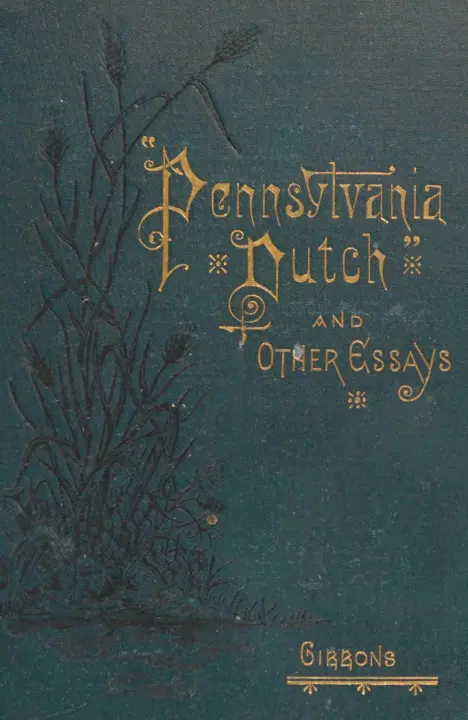
THE CLASSIC COLLECTION · 1882
"Pennsylvania Dutch" by Phebe Earle Gibbons is a collection of essays written in the late 19th century. The book offers a detailed exploration of the lives, customs, and beliefs of the Pennsylvania Dutch, a cultural group descended from German-speaking immigrants who settled in Pennsylvania. Gibbons aims to illuminate their language, religion, and daily practices, providing readers an insight into a community that may be unfamiliar to many. The opening of the book introduces Gibbons's long-term residence in Lancaster County, highlighting her personal observations of the Pennsylvania Dutch people. She describes their unique German dialect, emphasizing how it has evolved over time and become intertwined with English. Gibbons then transitions into a discussion of their religious practices, detailing a visit to a Mennonite meeting and covering the various sects within this community. The rich tapestry of their lives, including their farming practices, festivals, and social interactions, begins to emerge against the backdrop of her anecdotes and reflections. Overall, the beginning sets the stage for a multifaceted portrayal of the Pennsylvania Dutch lifestyle as observed by the author.
Introduction adapted from the source catalogue; source summaries may be automatically generated.
Free to read · English · 120,588 words · No account needed
MAKE TIME FOR A GOOD BOOK
On by default. Untick to stop anonymous reading totals. Each page counts after 10 seconds in view. How this works.
Anonymous counting is on unless you have switched it off.
“What is it?” said I.
“It’s too mean to tell,” she answered.
I surmise that the Dunker brethren had gone down and left these youths. Although a baby was crying, I lay still until two girls in Dunker caps—one ten years old, the other twelve—came with a candle, looking at us, smiling, and making remarks, perhaps thinking that it was time for us to be up.
I asked the eldest what o’clock it was.
She did not know.
“What made you get up, then?”
“I got up when the others did.”
Then some one explained that there were a good many dishes left unwashed
the evening before.
I was surprised to see such young persons members of the meeting, for I supposed that the Dunkers, like the Mennonites, are opposed to infant baptism. The former explained to me, however, that they thought such persons as these old enough to distinguish right from wrong. I was told, too, of one girl, still younger, who had insisted on wearing the cap. The Mennonites baptize persons as young as fifteen. Both sects seem to hold peculiar views upon original sin.
A Dunker preacher once said to me,—
“We believe that, after Adam, all were born in sin; but, after Christ, all were born without sin.”
And a Mennist neighbor says,—
“Children have no sin; the kingdom of heaven is of little children.”
I continued to lie still, looking at the rafters and roof, and speculating as to their being so clean, and clear of cobwebs, and whether they had been laboriously swept; and then, gathering my wardrobe together with some little trouble, I was at last ready to go down. As I went to a window, I saw Orion and Sirius, and the coming day.
Going down to wash at the pump, in the morning gloaming, while the landscape still lay in shade, I found two or three lads at the pump, and one of them pumped for me. I was so ignorant of pump-washing as to wonder why he pumped so small a stream, and to suspect that he was making fun; but thus it seems it is proper to do, to avoid wetting the sleeves.
Here I met a pretty young sister, from Cumberland County,—fat and fair,—whose acquaintance I had made the day before. Her cap was of lace, and not so plain as the rest. There was with her at the pump one of the world’s people, a young girl in a blue dress.
“Is that your sister?” I asked.
“It’s the daughter of the woman I live with,” she replied. “I have no sister. I am hired with her mother.”
Your reading position is saved on this browser. Take it to another device with a library code. Reading pages adapt to text, rather than matching a printed edition.
BEHIND THE BOOK
This eBook is for the use of anyone anywhere in the United States and most other parts of the world at no cost and with almost no restrictions whatsoever. You may copy it, give it away or re-use it under the terms of the Project Gutenberg License included with this eBook or online at www.gutenberg.org. If you are not located in the United States, you will have to check the laws of the country where you are located before using this eBook. Read the source licence.
The original source file, including credits and licence, is retained by this library. Request an original-format copy at no charge. Please include the book title and Project Gutenberg identifier #66277.
KEEP YOUR CURIOSITY GOING
David Patterson (Spirit) Hatch

David Patterson (Spirit) Hatch

David Patterson (Spirit) Hatch
Cécile Tormay

Moritz Busch
John L. Ransom