
Last letters from the living dead man
David Patterson (Spirit) Hatch
THE CLASSIC COLLECTION · 1882
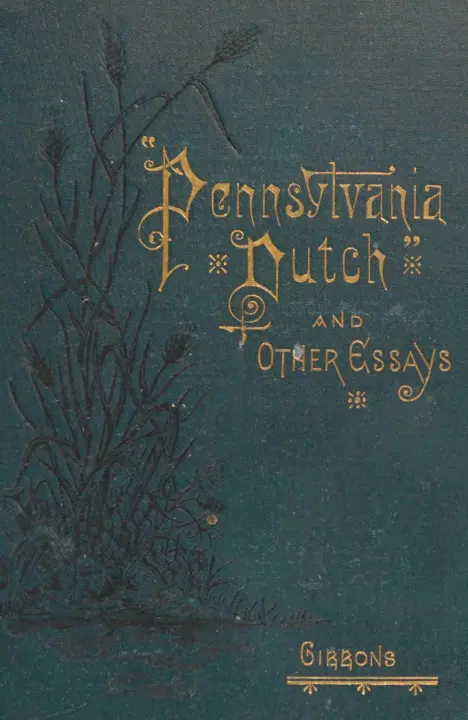
"Pennsylvania Dutch" by Phebe Earle Gibbons is a collection of essays written in the late 19th century. The book offers a detailed exploration of the lives, customs, and beliefs of the Pennsylvania Dutch, a cultural group descended from German-speaking immigrants who settled in Pennsylvania. Gibbons aims to illuminate their language, religion, and daily practices, providing readers an insight into a community that may be unfamiliar to many. The opening of the book introduces Gibbons's long-term residence in Lancaster County, highlighting her personal observations of the Pennsylvania Dutch people. She describes their unique German dialect, emphasizing how it has evolved over time and become intertwined with English. Gibbons then transitions into a discussion of their religious practices, detailing a visit to a Mennonite meeting and covering the various sects within this community. The rich tapestry of their lives, including their farming practices, festivals, and social interactions, begins to emerge against the backdrop of her anecdotes and reflections. Overall, the beginning sets the stage for a multifaceted portrayal of the Pennsylvania Dutch lifestyle as observed by the author.
Introduction adapted from the source catalogue; source summaries may be automatically generated.
Free to read · English · 120,588 words · No account needed
MAKE TIME FOR A GOOD BOOK
On by default. Untick to stop anonymous reading totals. Each page counts after 10 seconds in view. How this works.
Anonymous counting is on unless you have switched it off.
This narrative might apply to those Silesians who were buried upon the cow-paths (Mr. Weiser says, taken to the carrion pit or bone commons), but does it apply to them after they had taken refuge at Gorlitz?
[147] It has been estimated that ninety-five in one hundred of the
Schwenkfelders are farmers.
[148] In the Rules and Ordinances of the Schwenkfelder community may be found this passage: “Yet a Christian places no holiness in wearing the oldest fashioned clothes; he also takes care not quickly to ape all new fashions, much less does he make it his business to bring up new ones.”
[149] Mr. Weiser speaks as if the singing was in the dialect. The following is a copy of some lines which were sung at their meeting-house when I attended, from which the student of German may observe the quality of the language, and the theologian may notice, as it seems to me, two or three of their peculiar doctrines:
“Jehovah, Vater, Sohn, und Geist!
O Segens Bronn, der ewig fleuszt!
Durchfleusz Herz, Sinn, und Wandel wohl;
Mach uns dein’s Lob’s und Segens voll!”
Jehovah, Father, Son, and Spirit! Oh, spring of blessing, forever flowing! Flow through heart, thought, and life; make us full of thy praise and blessing!
[150] Wheat bread is now used. At a Schwenkfelder house I ate apple-butter, sweet, because made from sweet apples, and seasoned with fennel, of which the taste resembles anise.
[151] It may be observed that I have used Mr. Weiser’s language.
[152] Before public schools were established the Schwenkfelders had a fund for the education of their poorer members.
[153] “Which these ordered back into our fund, to supply the wants of the poor, when we should arrive at Philadelphia.”
[154] It is probable that baptism will be introduced, but only optionally.
[155] Mr. Weiser tells us that a mother whose adult daughter entered the Reformed Church, by baptism, earnestly protested against the performing of the sacrament over her, on the ground that “prayers were had for their child in the meeting-house.”
[156] All Quakers do not teach the inferiority of the written word. Mr. Weiser says, “In general terms it may be said that Caspar Schwenkfeld has been the George Fox of Silesia, or the veritable George Fox, perhaps somewhat educated and sublimated.”
Although some of the doctrines taught by George Fox seem to have been given before him by Schwenkfeld, yet were these not previously taught among the Anabaptists, and possibly among the Waldenses?
It has been said that the better classes of Anabaptists claimed a descent from the Waldenses, the Wickliffites, and the Hussites, who had struggled for a church separated from the world and distinguished by the holiness of its members.
Your reading position is saved on this browser. Take it to another device with a library code. Reading pages adapt to text, rather than matching a printed edition.
BEHIND THE BOOK
This eBook is for the use of anyone anywhere in the United States and most other parts of the world at no cost and with almost no restrictions whatsoever. You may copy it, give it away or re-use it under the terms of the Project Gutenberg License included with this eBook or online at www.gutenberg.org. If you are not located in the United States, you will have to check the laws of the country where you are located before using this eBook. Read the source licence.
The original source file, including credits and licence, is retained by this library. Request an original-format copy at no charge. Please include the book title and Project Gutenberg identifier #66277.
KEEP YOUR CURIOSITY GOING
David Patterson (Spirit) Hatch

David Patterson (Spirit) Hatch

David Patterson (Spirit) Hatch
Cécile Tormay

Moritz Busch
John L. Ransom