
Last letters from the living dead man
David Patterson (Spirit) Hatch
THE CLASSIC COLLECTION · 1882
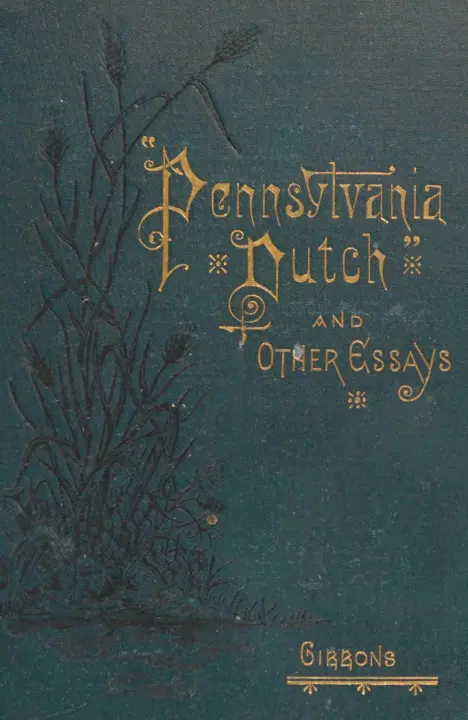
"Pennsylvania Dutch" by Phebe Earle Gibbons is a collection of essays written in the late 19th century. The book offers a detailed exploration of the lives, customs, and beliefs of the Pennsylvania Dutch, a cultural group descended from German-speaking immigrants who settled in Pennsylvania. Gibbons aims to illuminate their language, religion, and daily practices, providing readers an insight into a community that may be unfamiliar to many. The opening of the book introduces Gibbons's long-term residence in Lancaster County, highlighting her personal observations of the Pennsylvania Dutch people. She describes their unique German dialect, emphasizing how it has evolved over time and become intertwined with English. Gibbons then transitions into a discussion of their religious practices, detailing a visit to a Mennonite meeting and covering the various sects within this community. The rich tapestry of their lives, including their farming practices, festivals, and social interactions, begins to emerge against the backdrop of her anecdotes and reflections. Overall, the beginning sets the stage for a multifaceted portrayal of the Pennsylvania Dutch lifestyle as observed by the author.
Introduction adapted from the source catalogue; source summaries may be automatically generated.
Free to read · English · 120,588 words · No account needed
MAKE TIME FOR A GOOD BOOK
On by default. Untick to stop anonymous reading totals. Each page counts after 10 seconds in view. How this works.
Anonymous counting is on unless you have switched it off.
[103] This perhaps occurred during Zinzendorf’s banishment from Saxony. See note at close of this article.
[104] This building, Ephrata, was once a “nursery,” where as many as fifty-six young children were placed at one time. Some were removed from their mothers at as early an age as eighteen months, and placed under the common charge. See Transactions of Moravian Historical Society, 1857-58.
[105] A friend adds: “These Christmas dialogues are still to be heard in Moravian towns, in their parochial schools.”
[106] The tendency to pronounce s like sh will be observed.
[107] A friend says, “Schmaus” is a vulgar term,—use “Fest.”
[108] The corpse is sent to the corpse-house by some families, to this
day.
[109] Another person says, that if a man had no proposal to make, he left it to the authorities to suggest a woman; but the authorities never forced a woman upon him against his will.
[110] A lady whom I met at Nazareth spoke of the visits that she used to make in the widow-house, when they went at one, had vesper of coffee and sugar-cake at two, and left at five.
[111] Upon this passage, a friend makes the following remark: “Not regular occupants, but Moravian missionaries or strangers who might arrive in large bodies; twenty, I think, would be a large number.”
[112] Ayfrahtaw I heard this word pronounced.
[113] There were two log houses, says a friend.
[114] They not only receive tuition here, but board and clothing, and a similar privilege is extended to the sons of preachers.
[115] During the period of the anti-slavery agitation, preceding the war, the Moravians as a body did not take an anti-slavery stand. Their members were allowed to hold slaves, like those of almost all the other sects in this country. Their European brethren did not agree with them on this subject.
[116] A recent writer tells us that the upper, middle, and lower parts of Montgomery County, the lower end of Berks, and the south corner of Lehigh contain the only settlement of Schwenkfelders in the wide world. He adds that it is no misnomer to call these people the Pennsylvania German Quakers. It will be seen, however, that they are more ancient than George Fox.
[117] Phlox subulata.
[118] This feminine termination has not disappeared from the dialect. Mr. Rauch speaks of “de olt Lawbucksy,” which is rendered, old Mrs. Lawbucks.
[119] The decline in the severity of the cap seems to have reached its lowest point among the Moravians, where but few women in this country wear caps in church. See “Bethlehem and the Moravians.”
[120] At Flourtown, or Chestnut Hill, the English language is used, and there is no instruction in German.
[121] See article “Ephrata.”
Your reading position is saved on this browser. Take it to another device with a library code. Reading pages adapt to text, rather than matching a printed edition.
BEHIND THE BOOK
This eBook is for the use of anyone anywhere in the United States and most other parts of the world at no cost and with almost no restrictions whatsoever. You may copy it, give it away or re-use it under the terms of the Project Gutenberg License included with this eBook or online at www.gutenberg.org. If you are not located in the United States, you will have to check the laws of the country where you are located before using this eBook. Read the source licence.
The original source file, including credits and licence, is retained by this library. Request an original-format copy at no charge. Please include the book title and Project Gutenberg identifier #66277.
KEEP YOUR CURIOSITY GOING
David Patterson (Spirit) Hatch

David Patterson (Spirit) Hatch

David Patterson (Spirit) Hatch
Cécile Tormay

Moritz Busch
John L. Ransom