
Last letters from the living dead man
David Patterson (Spirit) Hatch
THE CLASSIC COLLECTION · 1882
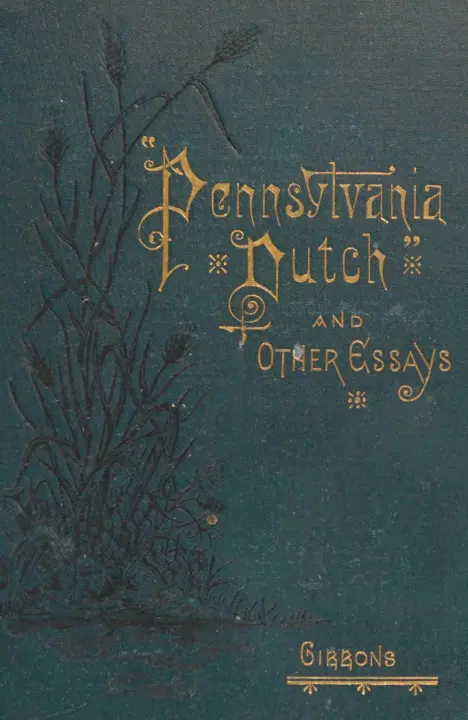
"Pennsylvania Dutch" by Phebe Earle Gibbons is a collection of essays written in the late 19th century. The book offers a detailed exploration of the lives, customs, and beliefs of the Pennsylvania Dutch, a cultural group descended from German-speaking immigrants who settled in Pennsylvania. Gibbons aims to illuminate their language, religion, and daily practices, providing readers an insight into a community that may be unfamiliar to many. The opening of the book introduces Gibbons's long-term residence in Lancaster County, highlighting her personal observations of the Pennsylvania Dutch people. She describes their unique German dialect, emphasizing how it has evolved over time and become intertwined with English. Gibbons then transitions into a discussion of their religious practices, detailing a visit to a Mennonite meeting and covering the various sects within this community. The rich tapestry of their lives, including their farming practices, festivals, and social interactions, begins to emerge against the backdrop of her anecdotes and reflections. Overall, the beginning sets the stage for a multifaceted portrayal of the Pennsylvania Dutch lifestyle as observed by the author.
Introduction adapted from the source catalogue; source summaries may be automatically generated.
Free to read · English · 120,588 words · No account needed
MAKE TIME FOR A GOOD BOOK
On by default. Untick to stop anonymous reading totals. Each page counts after 10 seconds in view. How this works.
Anonymous counting is on unless you have switched it off.
This volume does not endeavor to describe the manners and ways of living of all Pennsylvania Germans, but only of the majority. People of wealth and education resemble each other in most civilized lands. And although the Pennsylvania Germans are principally devoted to agriculture, yet about twenty per cent., as I estimate, have gone into cities and into other employments. Among those who have aided less or more in the publication of this volume are ministers, lawyers, physicians, editors, bankers, merchants, and teachers of Pennsylvania German origin. Many persons of note in Pennsylvania have been of German descent, from Peter Muhlenberg, a Lutheran preacher, who commanded a regiment in the Revolution, to a number of governors of this State,—Snyder, Hiester, Shulze, Wolf, Ritner, Shunk, and Hartranft. Governor Hartranft’s ancestor, then called Hertteranfft, came in with the Schwenkfelders in 1734.
To these distinguished Pennsylvania Germans I may add Dr. Gross, the eminent surgeon. The German blood is also found in a great number of families in our country. It is stated that Simon Cameron is of Scottish descent on the father’s side; and on the mother’s is descended from Conrad Pfoutz. The Hon. Jeremiah S. Black and William D. Howells, the well-known author, have told me that they are partly of Pennsylvania German origin.
[1] An acquaintance, who lives in Bucks County, tells me that his father, a Mennonite preacher, voted “pretty much always.”
[2] The rule against judgment bonds is not universal.
[3] For another estimate, see Appendix.
[4] Kohl-slaw (i.e., kohl-salat or cabbage-salad) is shredded cabbage, dressed with vinegar, etc. A rich dressing is sometimes made of milk or cream, egg, vinegar, etc. It may be eaten either as warm slaw or cold slaw.
[5] Some account of Peltz-nickel in Germany will be found in the Appendix.
[6] Written about 1868.
[7] Amish is pronounced Ommish, the a being very broad, like aw. This article was first published some years ago.
[8] I learn, 1882, that the Amish feet-washing is public.
[9] Our German Baptists are more decidedly non-resistant than the Quakers. Some of them refuse to vote for civil officers.
The term Anabaptist is from the Greek, and signifies one who baptizes again. All Baptists baptize anew those who were baptized in infancy. The term Anabaptist, in the present essay, is used indifferently with Baptist, and, in a degree, with Mennonite.
[10] Of the heretics executed by Alva in the Spanish Netherlands, a large proportion were Anabaptists.—Encyclopædia Americana.
[11] Zschokke, in his History of Switzerland, accuses the Anabaptists of causing great trouble and scandal. Some account of the furious or warlike Anabaptists of Holland may be found in Appleton’s Cyclopædia.
[12] This must not be understood as aid in bearing arms.
Your reading position is saved on this browser. Take it to another device with a library code. Reading pages adapt to text, rather than matching a printed edition.
BEHIND THE BOOK
This eBook is for the use of anyone anywhere in the United States and most other parts of the world at no cost and with almost no restrictions whatsoever. You may copy it, give it away or re-use it under the terms of the Project Gutenberg License included with this eBook or online at www.gutenberg.org. If you are not located in the United States, you will have to check the laws of the country where you are located before using this eBook. Read the source licence.
The original source file, including credits and licence, is retained by this library. Request an original-format copy at no charge. Please include the book title and Project Gutenberg identifier #66277.
KEEP YOUR CURIOSITY GOING
David Patterson (Spirit) Hatch

David Patterson (Spirit) Hatch

David Patterson (Spirit) Hatch
Cécile Tormay

Moritz Busch
John L. Ransom