
Last letters from the living dead man
David Patterson (Spirit) Hatch
THE CLASSIC COLLECTION · 1882
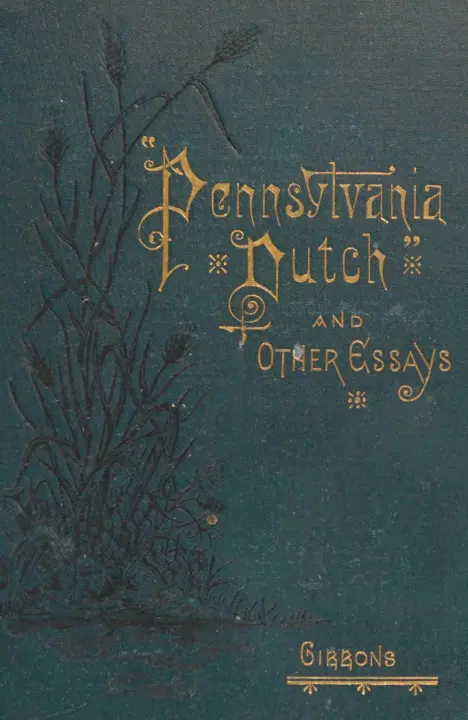
"Pennsylvania Dutch" by Phebe Earle Gibbons is a collection of essays written in the late 19th century. The book offers a detailed exploration of the lives, customs, and beliefs of the Pennsylvania Dutch, a cultural group descended from German-speaking immigrants who settled in Pennsylvania. Gibbons aims to illuminate their language, religion, and daily practices, providing readers an insight into a community that may be unfamiliar to many. The opening of the book introduces Gibbons's long-term residence in Lancaster County, highlighting her personal observations of the Pennsylvania Dutch people. She describes their unique German dialect, emphasizing how it has evolved over time and become intertwined with English. Gibbons then transitions into a discussion of their religious practices, detailing a visit to a Mennonite meeting and covering the various sects within this community. The rich tapestry of their lives, including their farming practices, festivals, and social interactions, begins to emerge against the backdrop of her anecdotes and reflections. Overall, the beginning sets the stage for a multifaceted portrayal of the Pennsylvania Dutch lifestyle as observed by the author.
Introduction adapted from the source catalogue; source summaries may be automatically generated.
Free to read · English · 120,588 words · No account needed
MAKE TIME FOR A GOOD BOOK
On by default. Untick to stop anonymous reading totals. Each page counts after 10 seconds in view. How this works.
Anonymous counting is on unless you have switched it off.
Mr. Weiser, of the Reformed Church, finds differences in adjoining counties. Thus, in Berks a set of bars in a fence is en Falder; in Montgomery, E’fahrt (or a place to drive through). In Lehigh they say of a drunken man, “Er hat e Kischt ah” (he carries a chest); but this is not heard in the near parts of Montgomery. Tomatoes are sometimes, I think, called Goomeranze in Allentown, and in Bucks County Boomeranze (from Pomeranze, an orange); but this is not heard in Lancaster County.
A learned German in Philadelphia says that several different dialects have flowed like streams into Pennsylvania,—one the Palatinate, another the Suabian, a third Allemanian, a fourth Swiss; and Prof. Dubbs, of Franklin and Marshall College, Lancaster, but born in Allentown, finds in the region with which he is familiar, east of the Susquehanna, three plainly marked sub-dialects. The one east of the Schuylkill is marked by the diminutive chen in the place of lein. In that district a little pig is called Säuche, and west of the Schuylkill Säulie (for Säulein). A third sub-dialect, he says, is peculiar to some of the sects of Lancaster County. It is probably of Swiss origin, and is marked by a broad drawl. (The late Prof. Haldeman remarked that in our dialect the perfect is used for the imperfect tense, as in Swiss; so that for “ich sagte” (I said) we have “ich hab ksaat” (gesagt), and for “ich hatte” (I had) we have “ich hab kat” (gehabt)).
(The following excellent remarks on the Pennsylvania dialect are taken from an article in the Mercersburg Review by Prof. Stahr, now also of Franklin and Marshall College, Lancaster. I have made some trifling alterations, mostly in parenthesis.)
“It is of course impossible in our present limits to specify all the peculiarities of Pennsylvania German, so as to give an adequate idea of its form to those who are not familiar with it. We may, however, state a few general principles, which will enable any one conversant with High German to read and understand the dialect without difficulty. In the first place it must be borne in mind that the letters have the South German sound: a has the broad sound like the English aw; st and sp whenever they occur sound broad, like scht and schp, etc. Secondly, letters are commuted or changed. Instead of the proper sound of the modified vowel or Umlaut ō, we find the sound of the German ē or the English ā, and instead of ü we find ie or i, equivalent to the English i in machine, or the same shortened as in pin. Instead of the proper sound of eu, we have the German ei or the English ī. Instead of au, particularly when it undergoes modification in inflections, we have broad a or aa in the unmodified, and ä or āā in the modified, form. Thus we have Baam for Baum, and Bääm’ for Baüme; laafe’ for laufen, and laaft or lääft for laüft. The diphthong ei is often changed into long e or ee. Thus for Stein we have Stee’ (pronounced Shtay), for Bein, Bee’, for Eid we have Eed, for Leid, Leed. A is often changed into o, as Johr for Jahr, Hoor for Haar; i is changed into e, as werd for wird (Es wird Schlimm is spoken Schvate schlimm), Hert for Hirt, etc. Consonants are also frequently changed; b into w (Bievel is heard for Bibel), p into b, t into d, etc. Thirdly, words are shortened by dropping the terminations, especially n of the infinitive or generally after e. Prefixes are frequently contracted, so also compound words. Thus instead of werden, folgen, fangen, we have werre’, folge’, fange’; einmal becomes emol; nicht mehr, nimme, etc. Fourthly, the Pennsylvania dialect uses High German words in a different sense. Thus for Pferd, horse, we have Gaul, which in High German means a heavy farm-horse or an old horse; gleiche, from the High German gleichen, to resemble, means in the Pennsylvania dialect, to like; gucke’, from High German gucken, to peep, to pry, means to look. Finally, we find English words introduced in their full form, either with or without German prefixes and modifications; e.g., Store (Schtore), Rüles, Cäpers, Circumstänces, trävele, stärte, fixe, fighte.
Your reading position is saved on this browser. Take it to another device with a library code. Reading pages adapt to text, rather than matching a printed edition.
BEHIND THE BOOK
This eBook is for the use of anyone anywhere in the United States and most other parts of the world at no cost and with almost no restrictions whatsoever. You may copy it, give it away or re-use it under the terms of the Project Gutenberg License included with this eBook or online at www.gutenberg.org. If you are not located in the United States, you will have to check the laws of the country where you are located before using this eBook. Read the source licence.
The original source file, including credits and licence, is retained by this library. Request an original-format copy at no charge. Please include the book title and Project Gutenberg identifier #66277.
KEEP YOUR CURIOSITY GOING
David Patterson (Spirit) Hatch

David Patterson (Spirit) Hatch

David Patterson (Spirit) Hatch
Cécile Tormay

Moritz Busch
John L. Ransom