
Last letters from the living dead man
David Patterson (Spirit) Hatch
THE CLASSIC COLLECTION · 1882
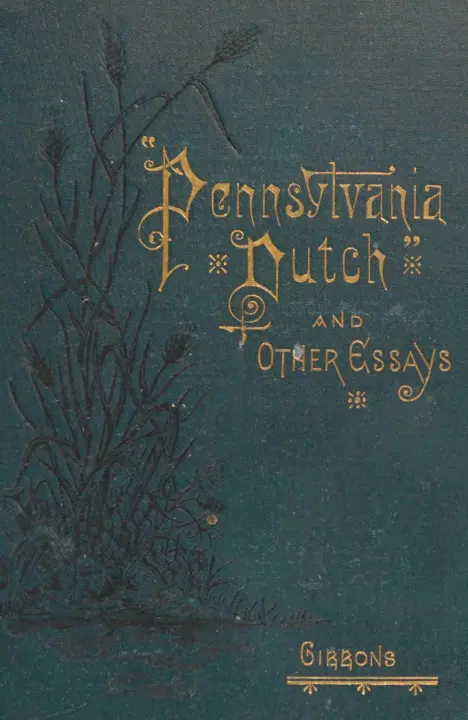
"Pennsylvania Dutch" by Phebe Earle Gibbons is a collection of essays written in the late 19th century. The book offers a detailed exploration of the lives, customs, and beliefs of the Pennsylvania Dutch, a cultural group descended from German-speaking immigrants who settled in Pennsylvania. Gibbons aims to illuminate their language, religion, and daily practices, providing readers an insight into a community that may be unfamiliar to many. The opening of the book introduces Gibbons's long-term residence in Lancaster County, highlighting her personal observations of the Pennsylvania Dutch people. She describes their unique German dialect, emphasizing how it has evolved over time and become intertwined with English. Gibbons then transitions into a discussion of their religious practices, detailing a visit to a Mennonite meeting and covering the various sects within this community. The rich tapestry of their lives, including their farming practices, festivals, and social interactions, begins to emerge against the backdrop of her anecdotes and reflections. Overall, the beginning sets the stage for a multifaceted portrayal of the Pennsylvania Dutch lifestyle as observed by the author.
Introduction adapted from the source catalogue; source summaries may be automatically generated.
Free to read · English · 120,588 words · No account needed
MAKE TIME FOR A GOOD BOOK
On by default. Untick to stop anonymous reading totals. Each page counts after 10 seconds in view. How this works.
Anonymous counting is on unless you have switched it off.
Our national holiday, July 4, is kept with great zeal by the Irish. It is an outlet for the expression of their animosity to England. In 1874 there was a great parade of several thousand persons, about two-thirds of whom were foreigners.
The Welsh have only one national holiday,—St. David’s Day, March 1. On this day, in Wales, they form processions and carry the leek, the national emblem. I saw it growing at Scranton, very much like the onion when standing. On this day in Wales they also have meetings for literary pursuits and for vocal music, being a great singing nation. St. David’s Day is still observed in some American cities, but among the people at large the celebration has died out here. Christmas is a great day among the Welsh, and is observed by meetings of the Eisteddfod, a very ancient national gathering, which can be traced back for nine hundred years. The word means an assembly, and is pronounced Ice-teth-vod, the dd being like th in thee.
These gatherings are literary and musical. At Hyde Park it is announced in the Welsh paper, in the spring of the year, that the Philosophical Society will, at the ensuing Christmas, give prizes for the best essay or the best poem on given subjects, and the best piece of original music for given words, also for singing and recitation. But although, as I have stated, these meetings are generally held on Christmas, yet sometimes a neighboring town may prefer to fix upon New Year, thus enabling parties to attend both; and St. David’s Day is sometimes celebrated by an eisteddfod. From the exercises of these gatherings women are not excluded. The eisteddfods are very generally attended by the Welsh, and are held in some large public hall, the greater part of the performances being in the Welsh language. Some of the observances are described to me in simple language by one who has been a miner. He says that church choirs attend the eisteddfods, and some very difficult piece is selected for them to sing, the prize being about sixty to eighty dollars. Then there are singers alone, and in parties of three. “They get their poets there; they meet on Christmas morning about ten, and adjourn about twelve, and then give out subjects for the poets,—likely the Lackawanna River, or some subject they had never thought of before. At two o’clock these poets will be called upon to recite their verses,—two, perhaps,—and a small prize is given (about a dollar), principally for amusement. Again, they call for compositions in music on some given subject. They must be sent in beforehand, about two weeks before the eisteddfod, with the proper name under a seal, the judges being allowed only to see the fictitious name. Also they read, and the best reader gets a small prize, the piece being given out at the meeting where it is read. Another thing causes a good deal of laughter,—they ask who will volunteer to sing a musical composition from the notes; some half-dozen will throw in their names (fictitious), and then one will be called out,—perhaps ‘Greenhorn;’ the other five will retire from the room, while he picks up the difficult piece, and begins to clear his throat and show his embarrassment, which is a subject of amusement to the spectators; then the second comes on, perhaps equally unskilful; and when all have finished, the remarks of the judge upon each performance are also very amusing, the prize being only about fifty cents. In order to avoid the singers being previously acquainted with the piece, sometimes a person may be sent out half an hour beforehand to compose one. The piece chosen is generally one very difficult to sing. They hold these eisteddfods in Wales. The Welsh bards have for centuries back been accustomed to poetry, and so forth. In London they invited, I think, nearly all the musicians in Europe to sing on a certain day, all nationalities, for a prize of one thousand pounds,—a silver cup. There came a choir of singers from Wales to compete with the best talent they had in England. The lords and members of Parliament were there. The English selected some of their most cultivated people, and the Welsh singers were miners and men of very little education, and they had to go from their own country; but they won the prize by a great distance, and then sang through different towns and cities in England. There was money raised here in Hyde Park to support them while they were training, and to take them up to London.”
Your reading position is saved on this browser. Take it to another device with a library code. Reading pages adapt to text, rather than matching a printed edition.
BEHIND THE BOOK
This eBook is for the use of anyone anywhere in the United States and most other parts of the world at no cost and with almost no restrictions whatsoever. You may copy it, give it away or re-use it under the terms of the Project Gutenberg License included with this eBook or online at www.gutenberg.org. If you are not located in the United States, you will have to check the laws of the country where you are located before using this eBook. Read the source licence.
The original source file, including credits and licence, is retained by this library. Request an original-format copy at no charge. Please include the book title and Project Gutenberg identifier #66277.
KEEP YOUR CURIOSITY GOING
David Patterson (Spirit) Hatch

David Patterson (Spirit) Hatch

David Patterson (Spirit) Hatch
Cécile Tormay

Moritz Busch
John L. Ransom