
Last letters from the living dead man
David Patterson (Spirit) Hatch
THE CLASSIC COLLECTION · 1882
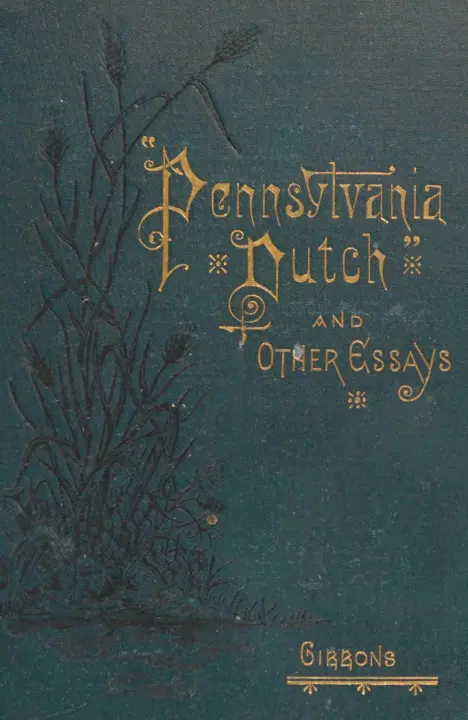
"Pennsylvania Dutch" by Phebe Earle Gibbons is a collection of essays written in the late 19th century. The book offers a detailed exploration of the lives, customs, and beliefs of the Pennsylvania Dutch, a cultural group descended from German-speaking immigrants who settled in Pennsylvania. Gibbons aims to illuminate their language, religion, and daily practices, providing readers an insight into a community that may be unfamiliar to many. The opening of the book introduces Gibbons's long-term residence in Lancaster County, highlighting her personal observations of the Pennsylvania Dutch people. She describes their unique German dialect, emphasizing how it has evolved over time and become intertwined with English. Gibbons then transitions into a discussion of their religious practices, detailing a visit to a Mennonite meeting and covering the various sects within this community. The rich tapestry of their lives, including their farming practices, festivals, and social interactions, begins to emerge against the backdrop of her anecdotes and reflections. Overall, the beginning sets the stage for a multifaceted portrayal of the Pennsylvania Dutch lifestyle as observed by the author.
Introduction adapted from the source catalogue; source summaries may be automatically generated.
Free to read · English · 120,588 words · No account needed
MAKE TIME FOR A GOOD BOOK
On by default. Untick to stop anonymous reading totals. Each page counts after 10 seconds in view. How this works.
Anonymous counting is on unless you have switched it off.
The twelfth chapter of the Explanation, containing nearly eighty pages, is devoted to Schwenkfeld’s peculiar doctrine, of which I shall content myself with the heading of the chapter, as follows: “Of the divine Sonship and glory of the Manhood of Jesus Christ, that the same is no creature, but extinguished in the Transfiguration, and changed into the Godhead.”
To one passage in the Catechism I would like to call attention:
Question.—How did God reveal himself in an external manner?
Answer.—First, when God, by his almighty word, framed the universe, by which he has shown how great, almighty, wise, and good he is.[162]
And now may we not also rest our souls upon these expressions from the constitution of the Schwenkfelder society, translated almost literally?
In the nature of God, we first perceive love as that noble and outflowing power which binds God and men together.... If the society build upon this fundamental part of the divine nature, namely, love, then their only immovable aim will be, first, the glory of God, and second, the promotion of the common weal of every member.
The preceding article is published nearly as it appeared in the second edition of this work, which was issued late in 1873, with the date 1874. Almost as soon as the edition appeared, I learned that baptism had been introduced among the Schwenkfelders at a meeting held a few months before; and that perhaps in two cases it had also been administered at the approach of death.
In the spring of the present year, 1882, I visited a Schwenkfelder settlement in the upper part of Montgomery County, and was hospitably entertained at the house of one of their preachers. German or the Pennsylvania dialect was the language of the family. On Sunday I attended church, where, as before in another locality, the services were in German, as were nearly all the proceedings in the Sunday-school. Here I learned that the rite of the Supper has also been introduced among the Schwenkfelders, though not without opposition. I inquired on what grounds the opposition was brought, but received no satisfactory reply.
At the house of my entertainer I was shown a volume, published in 1879, containing a genealogical record of the descendants of the Schwenkfelders in this country, to which is prefixed a historical sketch by C. Heydrick, a lawyer of Franklin, Pennsylvania.
Herein it is stated that Schwenkfeld differed with Luther on several points; chiefly on the eucharist, the efficacy of the divine word, the human nature of Christ, and baptism.
Schwenkfeld held, says the writer, that the penitent believer partakes of the bread and the body of the Lord, not only at the sacramental altar, but elsewhere.
Your reading position is saved on this browser. Take it to another device with a library code. Reading pages adapt to text, rather than matching a printed edition.
BEHIND THE BOOK
This eBook is for the use of anyone anywhere in the United States and most other parts of the world at no cost and with almost no restrictions whatsoever. You may copy it, give it away or re-use it under the terms of the Project Gutenberg License included with this eBook or online at www.gutenberg.org. If you are not located in the United States, you will have to check the laws of the country where you are located before using this eBook. Read the source licence.
The original source file, including credits and licence, is retained by this library. Request an original-format copy at no charge. Please include the book title and Project Gutenberg identifier #66277.
KEEP YOUR CURIOSITY GOING
David Patterson (Spirit) Hatch

David Patterson (Spirit) Hatch

David Patterson (Spirit) Hatch
Cécile Tormay

Moritz Busch
John L. Ransom