
Last letters from the living dead man
David Patterson (Spirit) Hatch
THE CLASSIC COLLECTION · 1882
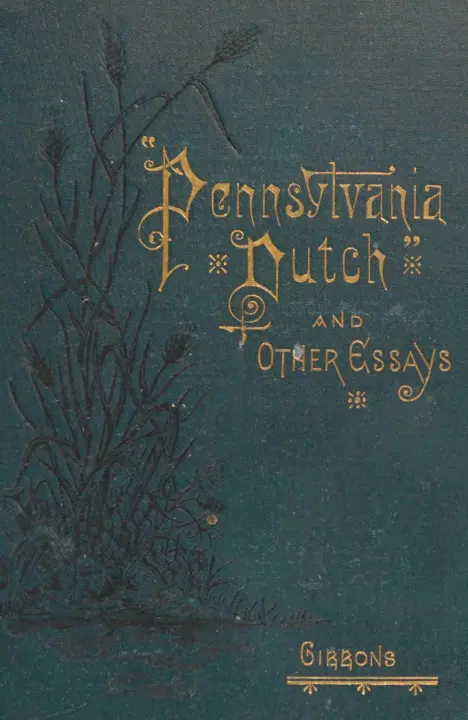
"Pennsylvania Dutch" by Phebe Earle Gibbons is a collection of essays written in the late 19th century. The book offers a detailed exploration of the lives, customs, and beliefs of the Pennsylvania Dutch, a cultural group descended from German-speaking immigrants who settled in Pennsylvania. Gibbons aims to illuminate their language, religion, and daily practices, providing readers an insight into a community that may be unfamiliar to many. The opening of the book introduces Gibbons's long-term residence in Lancaster County, highlighting her personal observations of the Pennsylvania Dutch people. She describes their unique German dialect, emphasizing how it has evolved over time and become intertwined with English. Gibbons then transitions into a discussion of their religious practices, detailing a visit to a Mennonite meeting and covering the various sects within this community. The rich tapestry of their lives, including their farming practices, festivals, and social interactions, begins to emerge against the backdrop of her anecdotes and reflections. Overall, the beginning sets the stage for a multifaceted portrayal of the Pennsylvania Dutch lifestyle as observed by the author.
Introduction adapted from the source catalogue; source summaries may be automatically generated.
Free to read · English · 120,588 words · No account needed
MAKE TIME FOR A GOOD BOOK
On by default. Untick to stop anonymous reading totals. Each page counts after 10 seconds in view. How this works.
Anonymous counting is on unless you have switched it off.
When a death occurs in the Moravian congregation at Bethlehem, the choir of trombonists plays several tunes from the steeple of the large church. Any Moravian can tell from the tunes played to which choir or band the deceased belonged, whether to the married men’s or married women’s, to the young men’s or young women’s, to the children’s, or to any other of the bands into which the congregation is divided,—divisions which were formerly of more importance than now.
At funerals the same choir of trombones heads the procession.
Walking in the street at Bethlehem, I saw a large, shaded, and grassy enclosure with seats in it, and a number of girls and children, children’s carriages, etc. I said to a working man, “What do you call this,—a square?”
It was the graveyard or old burial-place, but there were no monuments visible, from the Moravian custom of laying stones, called breast-stones, flat upon spots of interment.
If you enter this yard from the northwest corner, from Market Street, you come immediately upon the graves of three bishops, in no way more conspicuous than the others which bear breast-stones. One says, “Johannes Etwein, Episcopus Fratrum (or Bishop of the Brethren); born June 29th, 1721, at Freudenstadt in Germany, departed Jan. 2d, 1802.
“Here he rests in peace.”
The graves of the Indians and negroes, who were buried here, are not in an especial corner or division, but are indiscriminately mingled with those of the other Moravians. But on the outer edge are buried some persons of disreputable life.
One stone bears the following inscription:
“In memory of Tschoop, a Mohican Indian, who in holy baptism, Ap. 16, 1742, received the name of John: one of the first fruits of the mission at Shekomeko, N.Y., and a remarkable instance of the power of Divine Grace, whereby he became a distinguished teacher among his nation. He departed this life in full assurance of faith at Bethlehem, Aug. 27, 1746.
“There shall be one fold, and one Shepherd.—John x. 6.”
About sixty-two Indians are buried here. A daughter of Heckewelder (the distinguished missionary) furnished new gravestones for some of these Indian remains.
The largest stone in the enclosure rests upon the grave of one of mixed blood, not a Moravian, and I may be allowed to give a portion of the inscription as it is:
“In Memory to my dearest Son, James McDonald Ross, eldest son of John Ross, principal Chief of the Cherokee Nation ... died in St. Louis, Nov. 9th, 1864. His Corps transported by Adams Express to Bethlehem, and interred at this sacred spot Nov. 22d, 1864, aged 50 years 29 days.”
Your reading position is saved on this browser. Take it to another device with a library code. Reading pages adapt to text, rather than matching a printed edition.
BEHIND THE BOOK
This eBook is for the use of anyone anywhere in the United States and most other parts of the world at no cost and with almost no restrictions whatsoever. You may copy it, give it away or re-use it under the terms of the Project Gutenberg License included with this eBook or online at www.gutenberg.org. If you are not located in the United States, you will have to check the laws of the country where you are located before using this eBook. Read the source licence.
The original source file, including credits and licence, is retained by this library. Request an original-format copy at no charge. Please include the book title and Project Gutenberg identifier #66277.
KEEP YOUR CURIOSITY GOING
David Patterson (Spirit) Hatch

David Patterson (Spirit) Hatch

David Patterson (Spirit) Hatch
Cécile Tormay

Moritz Busch
John L. Ransom