
The Diary of a Goose Girl
Kate Douglas Smith Wiggin
THE CLASSIC COLLECTION · 1901
"Penelope's Irish Experiences" by Kate Douglas Smith Wiggin is a charming novel likely set in the early 20th century. It follows the journey of three women—Penelope, Salemina, and Francesca—as they adventure through Ireland, exploring its landscapes, culture, and their own identities in the process. Their experiences intertwine both humor and heartfelt observations reflecting the ties of friendship and personal growth. At the start of the book, we meet the three spinsters in a hotel in Dublin, where they are hilariously aware of their unusual situation—traveling together as three unmarried women when societal expectations dictate otherwise. As they navigate the city, their conversation reveals the dynamics of their friendships and the underlying contemplations about love and marriage, which Penelope finds herself reflecting on more now that her own marital status has changed. The narrative sets up their whimsical travels through Ireland, hinting at comedic misadventures and meaningful encounters that will shape their journey. The opening portion establishes their personalities and foreshadows the experiences they will share in their exploration of both Ireland and themselves.
Introduction adapted from the source catalogue; source summaries may be automatically generated.
Free to read · English · 71,983 words · No account needed
MAKE TIME FOR A GOOD BOOK
On by default. Untick to stop anonymous reading totals. Each page counts after 10 seconds in view. How this works.
Anonymous counting is on unless you have switched it off.
When I was always painting in those other days before I met Himself, one might think my eyes would have been even keener to see beauty than now, when my brushes are more seldom used; but it is not so. There is something, deep hidden in my consciousness, that makes all loveliness lovelier, that helps me to interpret it in a different and in a larger sense. I have a feeling that I have been lifted out of the individual and given my true place in the general scheme of the universe, and, in some subtle way that I can hardly explain, I am more nearly related to all things good, beautiful, and true than I was when I was wholly an artist, and therefore less a woman. The bursting of the leaf-buds brings me a tender thought of the one dear heart that gives me all its spring; and whenever I see the smile of a child, a generous look, the flash of sympathy in an eye, it makes me warm with swift remembrance of the one I love the best of all, just 'as a lamplight will set a linnet singing for the sun.'
Love is doing the same thing for Francesca; for the smaller feelings merge themselves in the larger ones, as little streams lose themselves in oceans. Whenever we talk quietly together of that strange, new, difficult life that she is going so bravely and so joyously to meet, I know by her expression that Ronald's noble face, a little shy, a little proud, but altogether adoring, serves her for courage and for inspiration, and she feels that his hand is holding hers across the distance, in a clasp that promises strength.
At five o'clock we longed to ring for hot water, but did not dare. Even at six there was no sound of life in the cosy inn which we have named The Cromwell Arms ['Mrs. Duddy, Manageress; Comfort, Cleanliness, Courtesy; Night Porter; Cycling Shed'). From seven to half-past we read pages and pages of delicious history and legend, and decided to go from Cappoquin to Youghal by steamer, if we could possibly reach the place of departure in time. At half-past seven we pulled the bell energetically. Nothing happened, and we pulled again and again, discovering at last that the connection between the bell-rope and the bell-wire had long since disappeared, though it had been more than once established with bits of twine, fishing-line, and shoe laces. Francesca then went across the hall to examine her methods of communication, and presently I heard a welcome tinkle, and another, and another, followed in due season by a cheerful voice, saying, “Don't desthroy it intirely, ma'am; I'll be coming direckly.” We ordered jugs of hot water, and were told that it would be some time before it could be had, as ladies were not in the habit of calling for it before nine in the morning, and as the damper of the kitchen-range was out of order. Did we wish it in a little canteen with whisky and a bit of lemon-peel, or were we afther wantin' it in a jug? We replied promptly that it was not the hour for toddy, but the hour for baths, with us, and the decrepit and very sleepy night porter departed to wake the cook and build the fire; advising me first, in a friendly way, to take the hearth brush that was 'kapin' the windy up, and rap on the wall if I needed annything more.' At eight o'clock we heard the porter's shuffling step in the hall, followed by a howl and a polite objurgation. A strange dog had passed the night under Francesca's bed, and the porter was giving him what he called 'a good hand and fut downstairs.' He had put down the hot water for this operation, and on taking up the burden again we heard him exclaim: “Arrah! look at that now! May the divil fly away with the excommunicated ould jug!” It was past saving, the jug, and leaked so freely that one had to be exceedingly nimble to put to use any of the smoky water in it. “Thim fools o' turf do nothing but smoke on me,” apologised the venerable servitor, who then asked, “would we be pleased to order breakquist.” We were wise in our generation, and asked for nothing but bacon, eggs, and tea; and after a smoky bath and a change of raiment we seated at our repast in the coffee-room, feeling wonderfully fresh and cheerful. By looking directly at each other most of the time, and making experimental journeys from plate to mouth, thus barring out any intimate knowledge of the tablecloth and the waiter's linen, we managed to make a breakfast. Francesca is enough to give any one a good appetite. Ronald Macdonald will be a lucky fellow, I think, to begin his day by sitting opposite her, for her eyes shine like those of a child, and one's gaze lingers fondly on the cool freshness of her cheek. Breakfast over and the bill settled, we speedily shook off as much of the dust of Mrs. Duddy's hotel as could be shaken off, and departed on the most decrepit sidecar that ever rolled on two wheels, being wished a safe journey by a slatternly maid who stood in the doorway, by the wide Mrs. Duddy herself, who realised in her capacious person the picturesque Irish phrase, 'the full-of-the-door of a woman,' and by our friend the head waiter, who leaned against Mrs. Duddy's ancestral pillars in such a way that the morning sun shone full upon his costume and revealed its weaknesses to our reluctant gaze.
Your reading position is saved on this browser. Take it to another device with a library code. Reading pages adapt to text, rather than matching a printed edition.
Kate Douglas Smith Wiggin
Kate Douglas Smith Wiggin
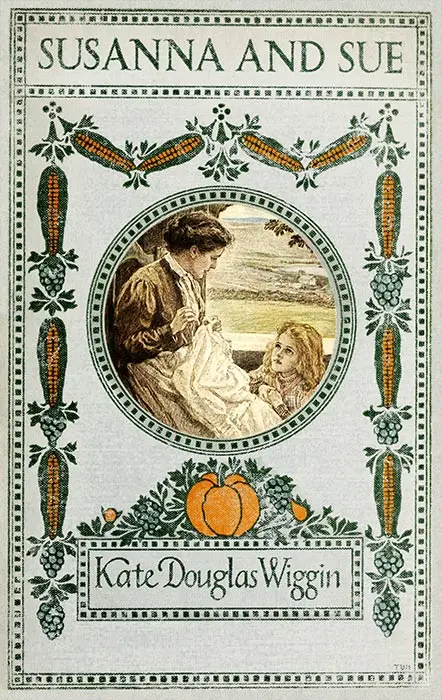
Kate Douglas Smith Wiggin
Kate Douglas Smith Wiggin & Nora Archibald Smith
BEHIND THE BOOK
This eBook is for the use of anyone anywhere in the United States and most other parts of the world at no cost and with almost no restrictions whatsoever. You may copy it, give it away or re-use it under the terms of the Project Gutenberg License included with this eBook or online at www.gutenberg.org. If you are not located in the United States, you will have to check the laws of the country where you are located before using this eBook. Read the source licence.
The original source file, including credits and licence, is retained by this library. Request an original-format copy at no charge. Please include the book title and Project Gutenberg identifier #1391.
KEEP YOUR CURIOSITY GOING
Wilfrid Scawen Blunt
Wilfrid Scawen Blunt

E. W. (Edgar Watson) Howe
Coulson Kernahan

Maurice Baring
Frances Wright