
The Diary of a Goose Girl
Kate Douglas Smith Wiggin
THE CLASSIC COLLECTION · 1900
"Penelope's English Experiences" by Kate Douglas Smith Wiggin is a humorous travelogue written in the late 19th century. The work presents the experiences of Penelope Hamilton, an American woman navigating English society alongside her friends, Salemina and Francesca, during their time in London and the countryside. The book delves into cultural observations, social interactions, and the humorous trials of adapting to British customs. The opening of "Penelope's English Experiences" introduces us to the main character, Penelope, and her companions as they settle into Smith's Hotel in London. The setting establishes their dynamic: Penelope as a struggling artist, Salemina as a philanthropist, and Francesca as a carefree young woman enamored with the lavishness of their surroundings. Their initial focus on deciphering the hotel's weekly bill highlights their cultural misunderstandings, particularly in relation to British currency. Through witty observations and a light-hearted tone, the narrative sets the stage for Penelope's humorous critique of English society, her own internal struggles, and the endearing quirks of her companions and the people they encounter.
Introduction adapted from the source catalogue; source summaries may be automatically generated.
Free to read · English · 31,137 words · No account needed
MAKE TIME FOR A GOOD BOOK
On by default. Untick to stop anonymous reading totals. Each page counts after 10 seconds in view. How this works.
Anonymous counting is on unless you have switched it off.
Then at one o'clock came supper. Francesca and I had secretly provided for that contingency, and curling up on a sofa we drew toward us a little table which Dawson had spread with a galantine of chicken, some cress sandwiches, and a jug of milk.
At one-thirty we were quite overcome with sleep, and retired to our beds, where of course we speedily grew wakeful.
“It is giving a ball, not going to one, that is so exhausting!” yawned Francesca. “How many times have I danced all night with half the fatigue that I am feeling now!”
The sound of music came across the street through the closed door of our sitting-room. Waltz after waltz, a polka, a galop, then waltzes again, until our brains reeled with the rhythm. As if this were not enough, when our windows at the back were opened wide we were quite within reach of Lady Durden's small dance, where another Hungarian band discoursed more waltzes and galops.
“Dancing, dancing everywhere, and not a turn for us!” grumbled Francesca. “I simply cannot sleep, can you?”
“We must make a determined effort,” I advised; “don't speak again, and perhaps drowsiness will overtake us.”
It finally did overtake Francesca, but I had too much to think about--my own problems as well as Patricia's. After what seemed to be hours of tossing I was helplessly drawn back into the sitting-room, just to see if anything had happened, and if the affair was ever likely to come to an end.
It was half-past two, and yes, the ball was decidedly 'thinning out.'
The attendants in the lower hall, when they were not calling carriages, yawned behind their hands, and stood first on one foot, and then on the other.
Women in beautiful wraps, their heads flashing with jewels, descended the staircase, and drove, or even walked, away into the summer night.
Lady Brighthelmston began to look tired, although all the world, as it said good night, was telling her that it was one of the most delightful balls of the season.
The English nosegay had lost its white flower, for Patricia was not in the family group. I looked everywhere for the gleam of her silvery scarf, everywhere for Terence, while, the waltz music having ceased, the Spanish students played 'Love's Young Dream.'
I hummed the words as the sweet old tune, strummed by the tinkling mandolins, vibrated clearly in the maze of other sounds:--
Your reading position is saved on this browser. Take it to another device with a library code. Reading pages adapt to text, rather than matching a printed edition.
Kate Douglas Smith Wiggin
Kate Douglas Smith Wiggin
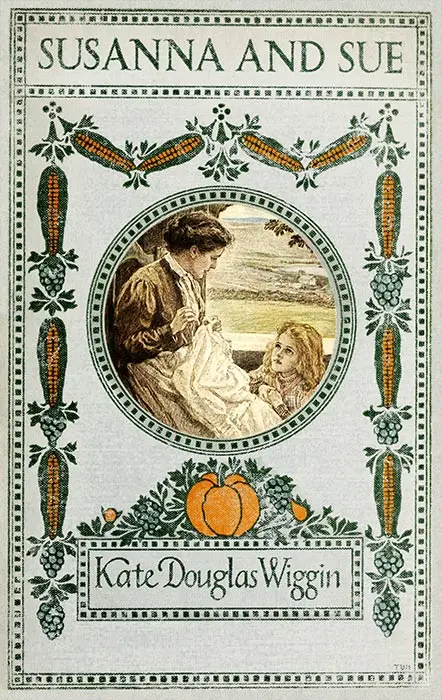
Kate Douglas Smith Wiggin
Kate Douglas Smith Wiggin & Nora Archibald Smith
BEHIND THE BOOK
This eBook is for the use of anyone anywhere in the United States and most other parts of the world at no cost and with almost no restrictions whatsoever. You may copy it, give it away or re-use it under the terms of the Project Gutenberg License included with this eBook or online at www.gutenberg.org. If you are not located in the United States, you will have to check the laws of the country where you are located before using this eBook. Read the source licence.
The original source file, including credits and licence, is retained by this library. Request an original-format copy at no charge. Please include the book title and Project Gutenberg identifier #1278.
KEEP YOUR CURIOSITY GOING
Wilfrid Scawen Blunt
Wilfrid Scawen Blunt

E. W. (Edgar Watson) Howe
Coulson Kernahan

Maurice Baring
Frances Wright