THE CLASSIC COLLECTION✦Unwritten Literature of Hawaii: The Sacred Songs of the HulaCLASSIC FREE BOOKS
Unwritten Literature of Hawaii: The Sacred Songs of the Hula
Nathaniel Bright Emerson
THE CLASSIC COLLECTION · 1915
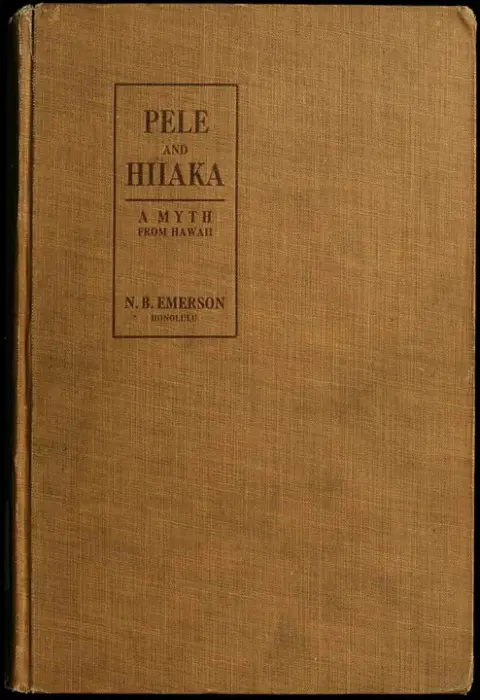
"Pele and Hiiaka: A Myth From Hawaii" by Nathaniel Bright Emerson is a collection of Hawaiian myths and folklore written in the early 20th century. The narrative centers around the volcanic goddess Pele and her sister Hiiaka, delving into their familial relationships and adventures as they traverse the islands of Hawaii. This rich tapestry of myth captures not only the essence of Hawaiian culture and beliefs but also highlights the complexities of love, duty, and rivalry among its characters. The opening of the work introduces us to the world of Pele, the fire goddess, and her kin, particularly focusing on Hiiaka, who becomes a central figure in the unfolding narrative. It begins with Pele awakening in the crater of Kilauea, suggesting her dominance and connection to the land. As she ventures with her sisters to enjoy the ocean, Hiiaka impresses everyone with her talent in song and dance, gaining crucial attention from Pele. The chapter sets the stage for Hiiaka's eventual mission to retrieve her beloved Lohiau, showcasing the themes of loyalty and the trials that will follow in their mythical journey. The rich language and vivid descriptions draw the reader into a captivating narrative infused with the spirit of Hawaiian mythology.
Introduction adapted from the source catalogue; source summaries may be automatically generated.
Free to read · English · 79,938 words · No account needed
MAKE TIME FOR A GOOD BOOK
On by default. Untick to stop anonymous reading totals. Each page counts after 10 seconds in view. How this works.
Anonymous counting is on unless you have switched it off.
[456] Kai-a-ka-hulu-manu, literally, the sea of the bird feathers. Some claim this as being the same as the Kai-a-ka-hinali'i; others, and I think rightly, claim that it was a distinct flood that occurred at a later period and that destroyed all birds and flying things.
[457] Opiopi. The waves of the sea in the season of Makali'i are compared to the wrinkles in a mat, the contrast with those of the Kai-a-ka-hulu-manu, and the kai a ka pohaku.
[458] Noho, a seat, or to sit. Here used for the people there living.
[459] Kua o ka makani (literally, at the back of the wind). Koolau, the windward side of an island, was its kua, back. The whole line contains an ingenious reference to the manner of fire-lighting. When the smouldering spark from the fire-sticks has been received on a bunch of dry grass, it is waved to and fro to make it ignite. To the old-fashioned Hawaiian familiar with this manner of fire-making this figure is full of meaning.
[460] Ulu o ka La, the figure of the Sun as it touched the horizon,
or its glare.
[461] Akua, literally, a god. This is a generic term and includes beings that we would call heroes, as well as devils and demons.
[462] Ka-wai-hoa, the southern point of Niihau.
[463] Hoaka-lei, a hill on Niihau.
[464] Kiu, the name of a wind.
[465] Makalii, Kaelo and Ka-ulua are cold months. Lohiau found them
hot enough.
[466] Ha'aha'a, literally, hanging low. I am reminded of an old song uttered, it is said, by a hero from the top of Kauwiki hill, in Hana, Maui: "Aina ua, lani ha'aha'a." Land of rain, where the heavens hang (ever) low.
[467] Wai-wela-wela, a hot lake in lower Puna.
[468] Ko'olau, a term applied generally to the windward side of an island, which was, of course, the stormy side. The expression au Ko'olau, or Ko'olau weather, is one of great significance.
[469] E ki'i mai oe ia'u; eia au la i ke au a ka hewahewa.
[470] Lawakua, an intimate companion, a friend.
[471] Ua a ka lipoa, a fine, cold rain; a Scotch mist.
[472] Lala, to bask in the sunlight.
[473] Oma'o-lala, a place in upper Ola'a, named from the bird oma'o.
[474] Aina i ka houpu a Kane, a proverbial expression applied to Puna, signifying the affection in which Puna was held.
[475] A'aka, an ocean cave (definition not given in the dictionary).
Your reading position is saved on this browser. Take it to another device with a library code. Reading pages adapt to text, rather than matching a printed edition.
BEHIND THE BOOK
This eBook is for the use of anyone anywhere in the United States and most other parts of the world at no cost and with almost no restrictions whatsoever. You may copy it, give it away or re-use it under the terms of the Project Gutenberg License included with this eBook or online at www.gutenberg.org. If you are not located in the United States, you will have to check the laws of the country where you are located before using this eBook. Read the source licence.
The original source file, including credits and licence, is retained by this library. Request an original-format copy at no charge. Please include the book title and Project Gutenberg identifier #60279.
KEEP YOUR CURIOSITY GOING

Maurice Baring
Francis Greenleaf Allinson & Anne C. E. (Anne Crosby Emery) Allinson
Stuart Dodgson Collingwood
Percy Keese Fitzhugh
Mary Macleod & Edmund Spenser

Cooke Don-Carlos