THE CLASSIC COLLECTION✦Unwritten Literature of Hawaii: The Sacred Songs of the HulaCLASSIC FREE BOOKS
Unwritten Literature of Hawaii: The Sacred Songs of the Hula
Nathaniel Bright Emerson
THE CLASSIC COLLECTION · 1915
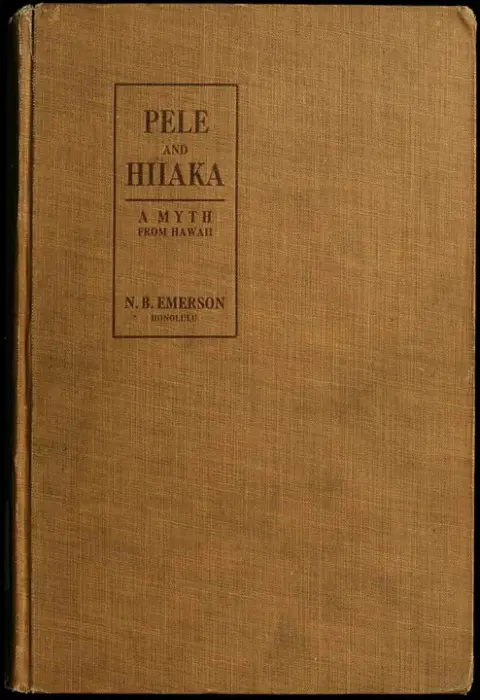
"Pele and Hiiaka: A Myth From Hawaii" by Nathaniel Bright Emerson is a collection of Hawaiian myths and folklore written in the early 20th century. The narrative centers around the volcanic goddess Pele and her sister Hiiaka, delving into their familial relationships and adventures as they traverse the islands of Hawaii. This rich tapestry of myth captures not only the essence of Hawaiian culture and beliefs but also highlights the complexities of love, duty, and rivalry among its characters. The opening of the work introduces us to the world of Pele, the fire goddess, and her kin, particularly focusing on Hiiaka, who becomes a central figure in the unfolding narrative. It begins with Pele awakening in the crater of Kilauea, suggesting her dominance and connection to the land. As she ventures with her sisters to enjoy the ocean, Hiiaka impresses everyone with her talent in song and dance, gaining crucial attention from Pele. The chapter sets the stage for Hiiaka's eventual mission to retrieve her beloved Lohiau, showcasing the themes of loyalty and the trials that will follow in their mythical journey. The rich language and vivid descriptions draw the reader into a captivating narrative infused with the spirit of Hawaiian mythology.
Introduction adapted from the source catalogue; source summaries may be automatically generated.
Free to read · English · 79,938 words · No account needed
MAKE TIME FOR A GOOD BOOK
On by default. Untick to stop anonymous reading totals. Each page counts after 10 seconds in view. How this works.
Anonymous counting is on unless you have switched it off.
[273] Hala-aniani, a small lake of fresh water in a cave at Haena, in which the writer has bathed.
[274] Koa maka-iwa, idols with eyes of mother o' pearl. To this class belonged Ku-kaili-moku, the famous war god of Kamehameha.
[275] Halawa, the largest valley on Moloka'i, a stronghold of priestcraft and sorcery. "Ua o'o na pule o Moloka'i," the incantations of Moloka'i are ripe, became a proverbial expression.
[276] Hea, a stream near Haena.
[277] Hana-ia-ka-malama, a benevolent goddess who presided over the tabus that were the birthright of certain chiefs. The rules and observances that etiquette prescribed in the life and conduct of such a chief were intricate and burdensome to the last degree. It was, for instance, required that an infant who inherited this sort of a tabu must not be placed in such a position that the sun's rays could shine on its vertex.
[278] Mai-u'u, Ma-a'a, two goddesses (of the wilderness) whose function it was to string or twine leis and wreaths for the decoration of the superior gods. All the gods here mentioned were sometimes grouped under the appellation Akua o ka wa po--gods of the night-time--the fact being, however, that they worked as much by day as by night.
[279] Nahinahi-ana, another name for the goddess Hina-ulu-ohi'a, under which appelation her function was to make the dyes used in coloring and printing the tapas.
[280] Kuhulu ma. The particle-affix ma indicates that this name, or cognomen rather, comprises a group--in this case a family group--of deities. Under the family cognomen Ku were ranged a large and important group of deities, to whom were given individual appelations appropriate to their functions. Thus, Ku-huluhulu and Ku-ka-ohi'a-laka were deities worshipped by the canoe-makers. Ku-hulu and his set (ma) exercised a function akin to that of the water-carrier. They had charge of the fabled, life-giving water of Kane, Wai a Kane, and served it out according to the needs of men.
[281] Hanau a Kane, offspring of Kane. This appellation is intended, apparently, to cover the whole list of names already mentioned and, perhaps, some to be mentioned later in the mele.
[282] Wahine. Who these women, goddesses, were is brought out in
what follows.
[283] Na Wahine i ka pa'ipa'i, literally, the women who clapped, or applauded; but more closely specified as:
[284] Pa'i-kua, the goddess who slapped the back, as was done in
the hula.
[285] Pa'i-alo, the goddess who slapped the chest, as was also done
in the hula.
[286] Pa'i-kauhale, she who knocked at the doors of the village, i.e., who roused the people generally.
[287] Aha, the charm of a pule, its ceremonial correctness, its power
as an incantation.
[288] Lele wale, to get off the track; to go astray; to fail to hit
the point.
Your reading position is saved on this browser. Take it to another device with a library code. Reading pages adapt to text, rather than matching a printed edition.
BEHIND THE BOOK
This eBook is for the use of anyone anywhere in the United States and most other parts of the world at no cost and with almost no restrictions whatsoever. You may copy it, give it away or re-use it under the terms of the Project Gutenberg License included with this eBook or online at www.gutenberg.org. If you are not located in the United States, you will have to check the laws of the country where you are located before using this eBook. Read the source licence.
The original source file, including credits and licence, is retained by this library. Request an original-format copy at no charge. Please include the book title and Project Gutenberg identifier #60279.
KEEP YOUR CURIOSITY GOING

Maurice Baring
Francis Greenleaf Allinson & Anne C. E. (Anne Crosby Emery) Allinson
Stuart Dodgson Collingwood
Percy Keese Fitzhugh
Mary Macleod & Edmund Spenser

Cooke Don-Carlos