THE CLASSIC COLLECTION✦Unwritten Literature of Hawaii: The Sacred Songs of the HulaCLASSIC FREE BOOKS
Unwritten Literature of Hawaii: The Sacred Songs of the Hula
Nathaniel Bright Emerson
THE CLASSIC COLLECTION · 1915
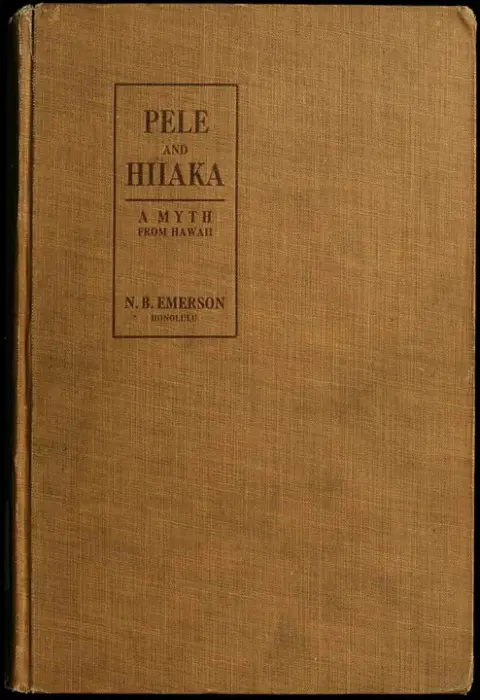
"Pele and Hiiaka: A Myth From Hawaii" by Nathaniel Bright Emerson is a collection of Hawaiian myths and folklore written in the early 20th century. The narrative centers around the volcanic goddess Pele and her sister Hiiaka, delving into their familial relationships and adventures as they traverse the islands of Hawaii. This rich tapestry of myth captures not only the essence of Hawaiian culture and beliefs but also highlights the complexities of love, duty, and rivalry among its characters. The opening of the work introduces us to the world of Pele, the fire goddess, and her kin, particularly focusing on Hiiaka, who becomes a central figure in the unfolding narrative. It begins with Pele awakening in the crater of Kilauea, suggesting her dominance and connection to the land. As she ventures with her sisters to enjoy the ocean, Hiiaka impresses everyone with her talent in song and dance, gaining crucial attention from Pele. The chapter sets the stage for Hiiaka's eventual mission to retrieve her beloved Lohiau, showcasing the themes of loyalty and the trials that will follow in their mythical journey. The rich language and vivid descriptions draw the reader into a captivating narrative infused with the spirit of Hawaiian mythology.
Introduction adapted from the source catalogue; source summaries may be automatically generated.
Free to read · English · 79,938 words · No account needed
MAKE TIME FOR A GOOD BOOK
On by default. Untick to stop anonymous reading totals. Each page counts after 10 seconds in view. How this works.
Anonymous counting is on unless you have switched it off.
[233] Paiea, a species of crab that resembles the a'ama. The background color of the paiea is black; this is strewn with spots and markings of dark red, producing a highly artistic effect. The specimen I examined was found in the Honolulu fish market and came from Kona, Hawaii. In spite of mutilation, it still retained a formidable claw.
[234] Maunu paiea. The Hawaiian fisherman often prepared his bait by chewing it fine, after which he blew it into the water to attract the fish. The poet finds a parallel between this action of the fisherman and the discharge of venomous words by an angered person.
[235] Nie, an elided form of niele, to question.
[236] Ea, the sea-turtle.
[237] Honu, the land-turtle.
[238] Kukuau, a hairy, spotted crab, said to be poisonous.
[239] Hinalea, a name applied to fish of several different species, among which one that is rare is the Hinalea akilolo (Macropharyngodon geoffroy, Quoy and Gaimard). Another less rare, though beautiful, species is the Hinalea i'iwi (Gomphosus tricolor, Quoy and Gaimard).
[240] Apuhihi.
[241] Hihi-wai, a bivalve shell that is found clinging to rocks or reeds in fresh or brackish water streams. Its dorsum is jetty black, its front white, shading into yellow.
[242] Loli-pua, loli-koko and loli-ka'e, different species of holothuriae, or sea-slugs, some of which are esteemed as food by the Hawaiians. They were, nevertheless, looked upon as kupua.
[243] Lelea, a marine creature that is said to be slimy and adheres
to the rocks.
[244] Kahi-kona, said to be a god of the fishermen.
[245] Leo hokiki, an imperfect tone caused by a torn drumhead.
[246] Kua a. The penalty of approaching Pele from behind was death: she is said to have had a consuming back.
[247] Kai oki'a, an engulfing abyss.
[248] Ala muku, the rainbow. (For further comments on these difficult passages, see notes 11, 12, and 13, on page 114.)
[249] Ho'o-nou o ka lani. This must be Pele. The word ho-onou is used of a person striving to accomplish some physical task, as of a woman straining in labor.
[250] Ku-walu, literally, eighth in order of succession.
[251] Ulu-po, said to be the name of a heiau at Kailua, Oahu.
[252] Iku-wa, the name of a month in the Hawaiian year, corresponding, according to one account, pretty closely to October; according to another nomenclature it corresponds pretty nearly to our April. The name etymologically connoted thunder and reverberations.
[253] Eka mua, literally, the first blast of a storm; here used figuratively to mean the first sexual ecstacy.
[254] Hoaka, a setting forth in figures. (Hoakaka).
Your reading position is saved on this browser. Take it to another device with a library code. Reading pages adapt to text, rather than matching a printed edition.
BEHIND THE BOOK
This eBook is for the use of anyone anywhere in the United States and most other parts of the world at no cost and with almost no restrictions whatsoever. You may copy it, give it away or re-use it under the terms of the Project Gutenberg License included with this eBook or online at www.gutenberg.org. If you are not located in the United States, you will have to check the laws of the country where you are located before using this eBook. Read the source licence.
The original source file, including credits and licence, is retained by this library. Request an original-format copy at no charge. Please include the book title and Project Gutenberg identifier #60279.
KEEP YOUR CURIOSITY GOING

Maurice Baring
Francis Greenleaf Allinson & Anne C. E. (Anne Crosby Emery) Allinson
Stuart Dodgson Collingwood
Percy Keese Fitzhugh
Mary Macleod & Edmund Spenser

Cooke Don-Carlos