THE CLASSIC COLLECTION✦Unwritten Literature of Hawaii: The Sacred Songs of the HulaCLASSIC FREE BOOKS
Unwritten Literature of Hawaii: The Sacred Songs of the Hula
Nathaniel Bright Emerson
THE CLASSIC COLLECTION · 1915
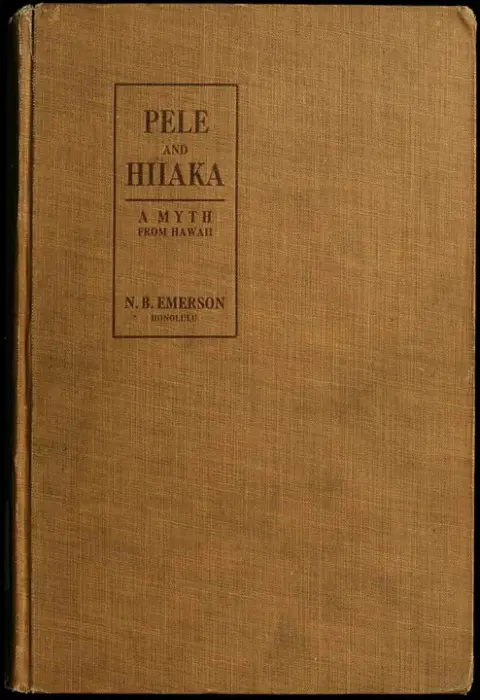
"Pele and Hiiaka: A Myth From Hawaii" by Nathaniel Bright Emerson is a collection of Hawaiian myths and folklore written in the early 20th century. The narrative centers around the volcanic goddess Pele and her sister Hiiaka, delving into their familial relationships and adventures as they traverse the islands of Hawaii. This rich tapestry of myth captures not only the essence of Hawaiian culture and beliefs but also highlights the complexities of love, duty, and rivalry among its characters. The opening of the work introduces us to the world of Pele, the fire goddess, and her kin, particularly focusing on Hiiaka, who becomes a central figure in the unfolding narrative. It begins with Pele awakening in the crater of Kilauea, suggesting her dominance and connection to the land. As she ventures with her sisters to enjoy the ocean, Hiiaka impresses everyone with her talent in song and dance, gaining crucial attention from Pele. The chapter sets the stage for Hiiaka's eventual mission to retrieve her beloved Lohiau, showcasing the themes of loyalty and the trials that will follow in their mythical journey. The rich language and vivid descriptions draw the reader into a captivating narrative infused with the spirit of Hawaiian mythology.
Introduction adapted from the source catalogue; source summaries may be automatically generated.
Free to read · English · 79,938 words · No account needed
MAKE TIME FOR A GOOD BOOK
On by default. Untick to stop anonymous reading totals. Each page counts after 10 seconds in view. How this works.
Anonymous counting is on unless you have switched it off.
[188] Niheu, a mythological hero who is always spoken of as kalohe, mischievous, because of his restlessness and stirring energy. His mother, Hina, had been abducted by a pirate chief who lived on the high bluff of Haupu, on Moloka'i. Niheu and his brother Kana, whose body was a rope of immense length, went to their mother's rescue, in which they succeeded, after many adventures. The eyes of Niheu were a marked feature in his appearance, being described as large and searching.
[189] Hina, the goddess with whom Wakea consorted after he had divorced his wife Papa by spitting in her face. Hina became the mother of the island of Moloka'i. From such a distinguished parentage arose the proverbial saying "Moloka'i nui a Hina."
[190] Kaunu-ohua, a hill on Moloka'i between Halawa valley and Puko'o, where is said to repose the body of Pele.
[191] Haupu, a hill on Moloka'i.
[192] Okaoka, said to be the flame-body of Pele, or the small stones, iliili, that entered into the composition of her body.
[193] Nana'i, an archaic form of Lana'i.
[194] Ka-ula-hea, a goddess with whom Wakea consorted after his divorce of Papa. The name also of a historic king of Lana'i, as well as of a kaula--prophet--attached to the disreputable set of gods that infested Lana'i at one time.
[195] Poli-hua, a sandy cape on Lana'i famous for its sea-turtles.
[196] Wai-li'u, full form, wai-li'u-la, mirage.
[197] Hoopa'apa'a Pele ilaila. Pele had planted a spring at this place, near Wai-lua, Kaua'i. Kama-pua'a, in company with two dragon-goddesses, Ka-la-mai-nu'u and Kilioe, who will find mention later in the story, took possession and moved the spring to another spot. When Pele came that way again, after a wordy contention with the two dragons, she slew them.
[198] Ulu, to guard, to farm, to protect. The kahu was the one who offered the sacrifices and prayers that were necessary to the maintenance of power and life in an artificial divinity, such as many of the Hawaiian deities were.
[199] Mo'o-kini, literally, the multitude (40,000) of dragons; the name of a heiau in Puna. There is also a heiau in Kohala called by the same name.
[200] Ko'i, said to be a kupua who had to do with carving and finishing the canoe. Pua seems to be epithet applied to the group of workmen who assisted him.
[201] Lele-iwi, a cape on the Puna side of Hilo bay.
[202] Mokau-lele, the name of a little land in Hilo situated near the point where the eruption of 1881-1882 came to a stand-still.
Your reading position is saved on this browser. Take it to another device with a library code. Reading pages adapt to text, rather than matching a printed edition.
BEHIND THE BOOK
This eBook is for the use of anyone anywhere in the United States and most other parts of the world at no cost and with almost no restrictions whatsoever. You may copy it, give it away or re-use it under the terms of the Project Gutenberg License included with this eBook or online at www.gutenberg.org. If you are not located in the United States, you will have to check the laws of the country where you are located before using this eBook. Read the source licence.
The original source file, including credits and licence, is retained by this library. Request an original-format copy at no charge. Please include the book title and Project Gutenberg identifier #60279.
KEEP YOUR CURIOSITY GOING

Maurice Baring
Francis Greenleaf Allinson & Anne C. E. (Anne Crosby Emery) Allinson
Stuart Dodgson Collingwood
Percy Keese Fitzhugh
Mary Macleod & Edmund Spenser

Cooke Don-Carlos