THE CLASSIC COLLECTION✦Unwritten Literature of Hawaii: The Sacred Songs of the HulaCLASSIC FREE BOOKS
Unwritten Literature of Hawaii: The Sacred Songs of the Hula
Nathaniel Bright Emerson
THE CLASSIC COLLECTION · 1915
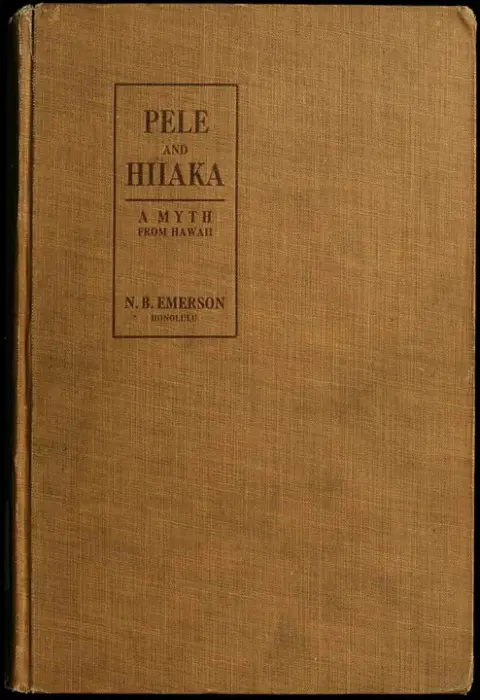
"Pele and Hiiaka: A Myth From Hawaii" by Nathaniel Bright Emerson is a collection of Hawaiian myths and folklore written in the early 20th century. The narrative centers around the volcanic goddess Pele and her sister Hiiaka, delving into their familial relationships and adventures as they traverse the islands of Hawaii. This rich tapestry of myth captures not only the essence of Hawaiian culture and beliefs but also highlights the complexities of love, duty, and rivalry among its characters. The opening of the work introduces us to the world of Pele, the fire goddess, and her kin, particularly focusing on Hiiaka, who becomes a central figure in the unfolding narrative. It begins with Pele awakening in the crater of Kilauea, suggesting her dominance and connection to the land. As she ventures with her sisters to enjoy the ocean, Hiiaka impresses everyone with her talent in song and dance, gaining crucial attention from Pele. The chapter sets the stage for Hiiaka's eventual mission to retrieve her beloved Lohiau, showcasing the themes of loyalty and the trials that will follow in their mythical journey. The rich language and vivid descriptions draw the reader into a captivating narrative infused with the spirit of Hawaiian mythology.
Introduction adapted from the source catalogue; source summaries may be automatically generated.
Free to read · English · 79,938 words · No account needed
MAKE TIME FOR A GOOD BOOK
On by default. Untick to stop anonymous reading totals. Each page counts after 10 seconds in view. How this works.
Anonymous counting is on unless you have switched it off.
[148] Ho'o-ilo, or Ho-ilo, the cool or rainy season of the year, covering six months according to the Hawaiians. There was no such month (mahina) as Ho'o-ilo, or Ho-ilo.
[149] Ka-hulu-manu. The kai o Ka-hulu-manu is, as reported to me by a well-informed Hawaiian, a flood that submerged the land in mythological times, distinct from Kai-a-ka-hina-alii.
[150] Hoohaehae, to chase, to irritate, to tease.
[151] Lae-o-ka-laau, (literally, Cape of the Trees), the south-western cape of Moloka'i, on which the United States have established a first-class lighthouse.
[152] Kihe, to sneeze; to spatter; to wet with spray.
[153] Wawalu, a cove.
[154] Owaewae, gullied. This is an instance of the adjective being
placed before its noun.
[155] Huna i ka wai. The people of the region concealed the holes where water dripped, as it was very scarce.
[156] Muli-wai, literally a river, a poetical exaggeration.
[157] Wa'a-wa'a, simple-minded; unsophisticated; "green;" the name of two youths mentioned in tradition, one of whom committed blunder after blunder from his soft-hearted stupidity.
[158] Pohaku o Kaua'i. The most audacious terrestrial undertaking of the demigod Mawi was his attempt to rearrange the islands of the group and assemble them into one solid mass. Having chosen his station at Kaena Point, the western extremity of Oahu, from which the island of Kaua'i is clearly visible on a bright day, he cast his wonderful hook, Mana-ia-ka-lani, far out into the ocean that it might engage itself in the foundations of Kaua'i. When he felt that it had taken a good hold, he gave a mighty tug at the line. A huge bowlder, the Pohaku o Kaua'i, fell at his feet. The mystic hook, having freed itself from its entanglement, dropped into Palolo Valley and hollowed out the crater, that is its grave. This failure to move the whole mass of the island argues no engineering miscalculation on Mawi's part. It was due to the underhand working of spiritual forces. Had Mawi been more politic, more observant of spiritual etiquette, more diplomatic in his dealings with the heavenly powers, his ambitious plans would, no doubt, have met with better success.
[159] Kua-o-ka-La (the back of the sun), a personification and
deification of that orb.
[160] Kowelowelo, to sink into; to be submerged.
[161] Haupu, a famous hill on Kauai, visible from Oahu. When it was capped with a cloud, Hawaiians said, "Ua kau mai ka pua'a i Haupu; e ua ana." If that occurred in the rainy season, they said it was about to clear.
[162] Waha, the same as haawe, i.e., a load for the back. In this case it was a bank of mist or clouds.
[163] Ke-olewa, a hill, smaller than Haupu, on the side towards
Kipu-kai. The word also applied to the floating clouds about the
mountain.
Your reading position is saved on this browser. Take it to another device with a library code. Reading pages adapt to text, rather than matching a printed edition.
BEHIND THE BOOK
This eBook is for the use of anyone anywhere in the United States and most other parts of the world at no cost and with almost no restrictions whatsoever. You may copy it, give it away or re-use it under the terms of the Project Gutenberg License included with this eBook or online at www.gutenberg.org. If you are not located in the United States, you will have to check the laws of the country where you are located before using this eBook. Read the source licence.
The original source file, including credits and licence, is retained by this library. Request an original-format copy at no charge. Please include the book title and Project Gutenberg identifier #60279.
KEEP YOUR CURIOSITY GOING

Maurice Baring
Francis Greenleaf Allinson & Anne C. E. (Anne Crosby Emery) Allinson
Stuart Dodgson Collingwood
Percy Keese Fitzhugh
Mary Macleod & Edmund Spenser

Cooke Don-Carlos