THE CLASSIC COLLECTION✦Unwritten Literature of Hawaii: The Sacred Songs of the HulaCLASSIC FREE BOOKS
Unwritten Literature of Hawaii: The Sacred Songs of the Hula
Nathaniel Bright Emerson
THE CLASSIC COLLECTION · 1915
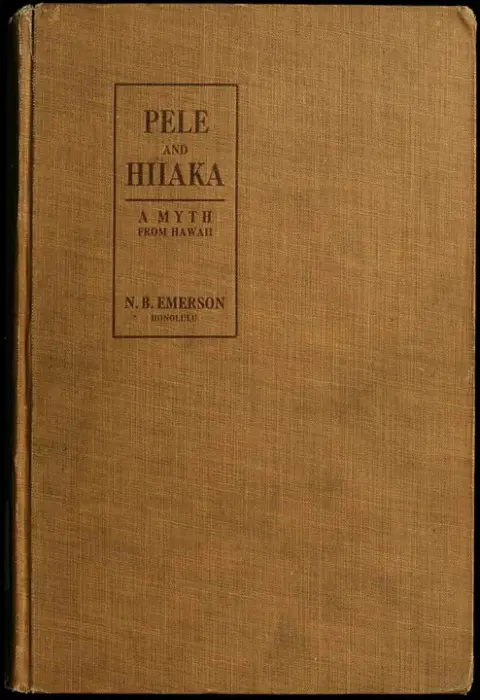
"Pele and Hiiaka: A Myth From Hawaii" by Nathaniel Bright Emerson is a collection of Hawaiian myths and folklore written in the early 20th century. The narrative centers around the volcanic goddess Pele and her sister Hiiaka, delving into their familial relationships and adventures as they traverse the islands of Hawaii. This rich tapestry of myth captures not only the essence of Hawaiian culture and beliefs but also highlights the complexities of love, duty, and rivalry among its characters. The opening of the work introduces us to the world of Pele, the fire goddess, and her kin, particularly focusing on Hiiaka, who becomes a central figure in the unfolding narrative. It begins with Pele awakening in the crater of Kilauea, suggesting her dominance and connection to the land. As she ventures with her sisters to enjoy the ocean, Hiiaka impresses everyone with her talent in song and dance, gaining crucial attention from Pele. The chapter sets the stage for Hiiaka's eventual mission to retrieve her beloved Lohiau, showcasing the themes of loyalty and the trials that will follow in their mythical journey. The rich language and vivid descriptions draw the reader into a captivating narrative infused with the spirit of Hawaiian mythology.
Introduction adapted from the source catalogue; source summaries may be automatically generated.
Free to read · English · 79,938 words · No account needed
MAKE TIME FOR A GOOD BOOK
On by default. Untick to stop anonymous reading totals. Each page counts after 10 seconds in view. How this works.
Anonymous counting is on unless you have switched it off.
Aha, my will has snared the bird,
And you are my captive, yes you:
Your purpose is foiled, ah, foiled!
With another prelude of song, Lohiau offered himself for another trial,
kilu in hand:
A makani pahele--hala kou Maile-húna;
Ke wáhi mai la Malama-iki;
Nohá Wai-lua, [394] pau ka pua.
Pau no me ke kino o Kalehua-wehe, [395] e-e.
The volant breath of the maile
Has the strength of the fruiter's crook;
It opens a trail in the jungle.
Wai-lua breaks bar; the small fry are out,
The complots, too, of Lehua-wehe.
This attempt was a failure like those that had gone before. Lohiau, thereupon, sought relief for his artistic disappointment in song:
Wehe'a iho nei loko o ka moe;
Malamalama no me he ahi lele la,
No lalo, e; auwé ho'i au, e!
Failed, failed in my choicest ambition!--
Heralded, like a shooting star!--
Fallen, fallen, alas and alas!
The game has by this time resolved itself into a contest of wits as well as of skill, and the two chief antagonists are--strange to relate--Lohiau, the man who was called back from the grave and the woman to whom he owes his life, Hiiaka.
As a prelude to her next play Hiiaka gave this song:
I uka kaua i Moe-awakea, [396]
I ka nahele o Ka-li'u, la.
Auwé ho'i, e-e!
You shall bed with me in open day
In the twilight groves of Ka-li'u--
Woe is me! I've uttered it now!
Hiiaka's play this time as before was a marvellous show of skill. The kilu seemed possessed with an instinct of attraction for the block that stood as her target. Like a bee that has found a rich honey-flower it returned again and yet again, as if to drain the last particle of sweetness.
Before venturing on his last play, Lohiau discarded the kilu he had been using and chose another, thinking thus to change his luck. He also changed the style of his song, adopting the more sensuous form called ami honua, [397] or ku'u pau:
Ke lei mai la Ka-ula i ke kai, e;
Ka malamalama o Niihau i ka malie.
A malama ke kaao o kou aloha--
Kou aloha ho'i, e-e!
In the first line of this little song, Lohiau, skilfully playing on the name Pele-ula, which he turns into Ka-ula, under the figure of the ocean tossing about that little island, banters the woman for her display of passion. In the second line, using a similar word-play, by which he turns his own name into Niihau, he contrasts the calm of the latter island with the agitation of the former.
Your reading position is saved on this browser. Take it to another device with a library code. Reading pages adapt to text, rather than matching a printed edition.
BEHIND THE BOOK
This eBook is for the use of anyone anywhere in the United States and most other parts of the world at no cost and with almost no restrictions whatsoever. You may copy it, give it away or re-use it under the terms of the Project Gutenberg License included with this eBook or online at www.gutenberg.org. If you are not located in the United States, you will have to check the laws of the country where you are located before using this eBook. Read the source licence.
The original source file, including credits and licence, is retained by this library. Request an original-format copy at no charge. Please include the book title and Project Gutenberg identifier #60279.
KEEP YOUR CURIOSITY GOING

Maurice Baring
Francis Greenleaf Allinson & Anne C. E. (Anne Crosby Emery) Allinson
Stuart Dodgson Collingwood
Percy Keese Fitzhugh
Mary Macleod & Edmund Spenser

Cooke Don-Carlos