THE CLASSIC COLLECTION✦The Montessori Elementary Material The Advanced Montessori MethodCLASSIC FREE BOOKS
The Montessori Elementary Material The Advanced Montessori Method
Maria Montessori
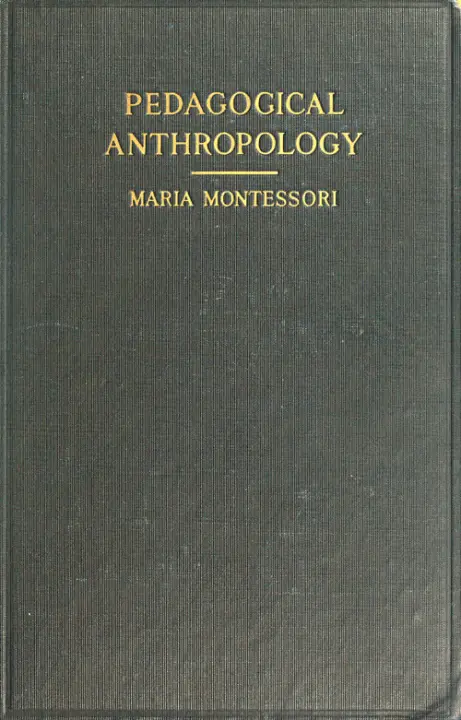
THE CLASSIC COLLECTION · 1913
"Pedagogical Anthropology" by Maria Montessori is a scientific publication written in the early 20th century. This work delves into the intersection of anthropology and pedagogy, aiming to establish a new educational philosophy based on the scientific study of human development. The text suggests a methodical approach to understanding individuals in an educational context, focusing on their physiological, psychological, and social characteristics. The beginning of the volume outlines Montessori's intent to define a new domain within anthropology that directly serves educational purposes. She emphasizes the importance of understanding human biology and variations to enhance pedagogical methods and improve education systems. In the preface, Montessori describes her lectures at the University of Rome, which form the foundation of the work, highlighting the crucial connection between scientific discovery and educational reform. She underscores the necessity of developing a science that can foster the improvement and moral evolution of humanity, thus framing education as an essential tool for societal transformation.
Introduction adapted from the source catalogue; source summaries may be automatically generated.
Free to read · English · 175,121 words · No account needed
MAKE TIME FOR A GOOD BOOK
On by default. Untick to stop anonymous reading totals. Each page counts after 10 seconds in view. How this works.
Anonymous counting is on unless you have switched it off.
In the anthropological examination it is customary to begin by taking the principal measurements (total stature, sitting stature, weight, thoracic perimeter, perimeter of the head, and its two maximum diameters) which furnish the data needed to give a fundamental idea of the child's physiological constitution and racial type, and to determine the normality of his growth. Many other measurements may be taken (spirometry, dynamometry), according to the custom of the school, and, in private schools, according to the object which the Principal has in view, in the way of contributions to science. For instance, in a school for defectives the examinations as to general sensibility, speech, muscular strength have an importance of the first order, and equally important is the accurate and minute inspection of the different organs, for the purpose of discovering possible malformations. There are various special objects to be attained by gathering anthropological data, and accordingly every school based upon modern scientific principles has its own "Biographical Chart" drawn up according to special forms containing the necessary measurements and observations, and the examiner has only to follow the directions of this guide and to fill in the required information obtained from the individual pupil.
---------------------------------------------------------------------- General Information Regarding Pupil's Family ---------------------------------------------------------------------- NAME AND SURNAME OF PARENTS
Father.........................................................
Mother.........................................................
What degree of relationship, if any, exists between the parents? ......................................................................
At what age did the parents contract marriage?.................
How old were the parents at the time of the child's birth?.....
Father.........................................................
Mother.........................................................
From what diseases have the relatives of the pupil died? ......................................................................
Have there been any predominant diseases in the family? ......................................................................
Father.........................................................
Mother.........................................................
Father.........................................................
Mother.........................................................
Father.........................................................
Mother.........................................................
Is the family interested in the education of the children? ......................................................................
FAMILY HABITS, ECCENTRICITIES AND VICES ......................................................................
Here, for instance, is the anthropological form used in the great
orphan asylum in New York:
NEW YORK JUVENILE ASYLUM
ANTHROPOLOGICAL EXAMINATION AND MEASUREMENTS.--No. of page
------------------------------------
Date of entrance
Sex
Age
Date of birth
Name
Total stature
Sitting stature
Total spread of arms
Weight
Prehensile strength, right hand
Prehensile strength, left hand
Power of traction
{Antero-posterior diameter
Thorax {Transverse diameter
Maximum circumference of head
Maximum antero-posterior diameter
Maximum transverse diameter
Minimum frontal diameter
Height of head
Inspection: cranium
Face
Eyes
Ears
Gums
Teeth
Palate
Uvula
Strabismus
Limbs
Body
Genitals
Lung
Heart
Special notes
-------------------------
Your reading position is saved on this browser. Take it to another device with a library code. Reading pages adapt to text, rather than matching a printed edition.
Maria Montessori
Maria Montessori
Maria Montessori
BEHIND THE BOOK
This eBook is for the use of anyone anywhere in the United States and most other parts of the world at no cost and with almost no restrictions whatsoever. You may copy it, give it away or re-use it under the terms of the Project Gutenberg License included with this eBook or online at www.gutenberg.org. If you are not located in the United States, you will have to check the laws of the country where you are located before using this eBook. Read the source licence.
The original source file, including credits and licence, is retained by this library. Request an original-format copy at no charge. Please include the book title and Project Gutenberg identifier #46643.
KEEP YOUR CURIOSITY GOING

Charles G. (Charles Griffith) Ross
Hannah Webster Foster

Emily Lawless
Edwin Hamlin Carr

Charles De Lano Hine
Andrew Ure