THE CLASSIC COLLECTION✦The Montessori Elementary Material The Advanced Montessori MethodCLASSIC FREE BOOKS
The Montessori Elementary Material The Advanced Montessori Method
Maria Montessori
THE CLASSIC COLLECTION · 1913
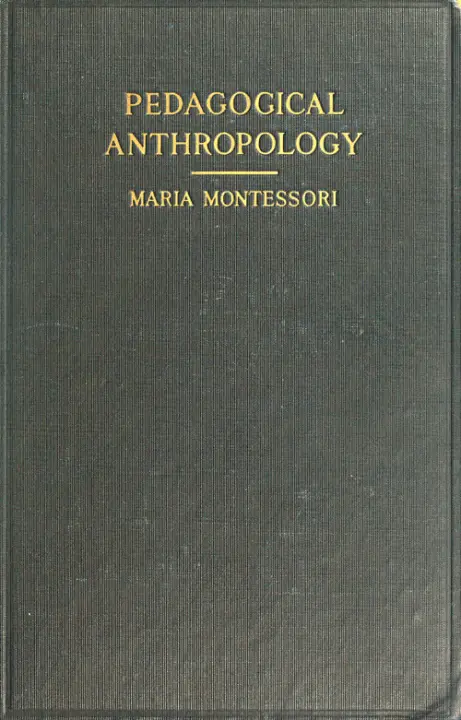
"Pedagogical Anthropology" by Maria Montessori is a scientific publication written in the early 20th century. This work delves into the intersection of anthropology and pedagogy, aiming to establish a new educational philosophy based on the scientific study of human development. The text suggests a methodical approach to understanding individuals in an educational context, focusing on their physiological, psychological, and social characteristics. The beginning of the volume outlines Montessori's intent to define a new domain within anthropology that directly serves educational purposes. She emphasizes the importance of understanding human biology and variations to enhance pedagogical methods and improve education systems. In the preface, Montessori describes her lectures at the University of Rome, which form the foundation of the work, highlighting the crucial connection between scientific discovery and educational reform. She underscores the necessity of developing a science that can foster the improvement and moral evolution of humanity, thus framing education as an essential tool for societal transformation.
Introduction adapted from the source catalogue; source summaries may be automatically generated.
Free to read · English · 175,121 words · No account needed
MAKE TIME FOR A GOOD BOOK
On by default. Untick to stop anonymous reading totals. Each page counts after 10 seconds in view. How this works.
Anonymous counting is on unless you have switched it off.
This fact is further confirmed by Wagner's figures, cited by Broca:
MEAN WEIGHT OF THE BRAIN
(According TO WAGNER)
--------------------------------------
Age | Men | Women
--------------------+--------+--------
Under 10 years | 985 | 1,033
From 11 to 20 years | 1,465 | 1,285
From 21 to 30 years | 1,341 | 1,249
From 31 to 40 years | 1,410 | 1,262
From 41 to 50 years | 1,391 | 1,261
From 51 to 60 years | 1,341 | 1,236
Above 60 years | 1,326 | 1,203
Here again we have a false maximum at twenty, which nature subsequently corrects through mortality.
From such knowledge we obtain certain important rules of hygiene.
The normal brain which exceeds the common limits of volume is not, in an absolute sense, incompatible with life. We need only to call to mind certain men of genius who had the brains of a giant.
Accordingly a brain which exceeds the limits demands of the individual who possesses it that he shall live according to certain special rules of hygiene. Children and young people who are too intelligent, too good, in other words, children of the elite class demand a special treatment, just as much as any other class of beings that pass beyond the bounds of average normality. Parents and teachers ought to be enlightened in regard to these scientific principles; the growth of individuals who are exceptional in regard to their intelligence and their emotions, should be supervised as though it were something precious and fragile. Such individuals are destined to be more subject than others to infective maladies, which frequently prove fatal, developing symptoms of meningitis and cerebral affections. Consequently a hygienic life, psychic repose, an avoidance of emotional excitement, moderate physical exercise in farm or garden, a prolonged stay in the open country, might be the salvation of children of this type, who often are over-praised and over-stimulated by friends and relatives, and consequently subjected to continual excitement and surmenage to a degree destructive to their health.
=Extreme Individual Variations of the Volume of the Brain.=--In regard to individual variations, the authorities give various figures, from which the following have been selected as most noteworthy for their accuracy of research:
----------------------------------------------------------- | Age: from 20 to 60 years| From 60 to 90 Authors |-------------------------+----------------------- | Maximum | Minimum | Maximum | Minimum ---------+------------+------------+------------+---------- Calori | 1,542 | 1,024 | 1,485 | 1,080 Bischoff | 1,678 | 1,069 | 1,665 | 1,080 | | | | | Without distinction of age: Broca | Maximum | Minimum | 1,830 | 1,049 -----------------------------------------------------------
These figures refer to individuals belonging to European races.
Comparison with the Brains of Apes.--The brain of the great anthropoid apes (Chimpanzee, Orang-utan, Gorilla), whose total weight of body is comparable to that of man, weighs on an average 360 grams, and the greatest weight which it can attain is 420 gr.
Specific Gravity of the Human Brain.--In normal individuals, the average specific gravity is 1.03; in insane persons it is slightly higher: 1.04.
Your reading position is saved on this browser. Take it to another device with a library code. Reading pages adapt to text, rather than matching a printed edition.
Maria Montessori
Maria Montessori
Maria Montessori
BEHIND THE BOOK
This eBook is for the use of anyone anywhere in the United States and most other parts of the world at no cost and with almost no restrictions whatsoever. You may copy it, give it away or re-use it under the terms of the Project Gutenberg License included with this eBook or online at www.gutenberg.org. If you are not located in the United States, you will have to check the laws of the country where you are located before using this eBook. Read the source licence.
The original source file, including credits and licence, is retained by this library. Request an original-format copy at no charge. Please include the book title and Project Gutenberg identifier #46643.
KEEP YOUR CURIOSITY GOING

Charles G. (Charles Griffith) Ross
Hannah Webster Foster

Emily Lawless
Edwin Hamlin Carr

Charles De Lano Hine
Andrew Ure