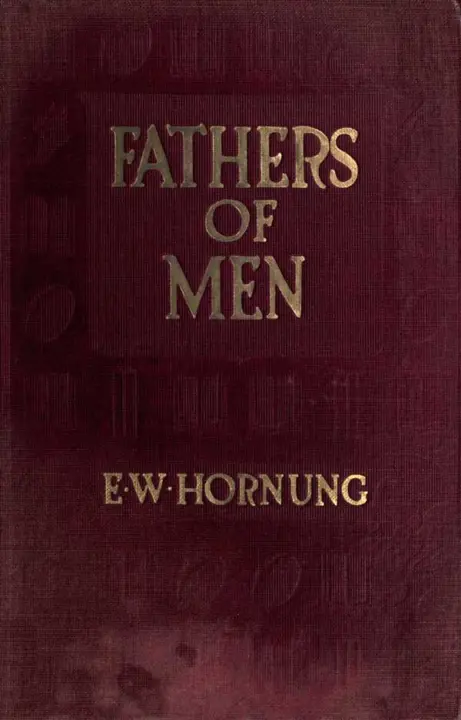
Fathers of Men
E. W. (Ernest William) Hornung
THE CLASSIC COLLECTION · 1900
"Peccavi" by E. W. Hornung is a novel written in the early 20th century. Set in the village of Long Stow, it unfolds the story of a local clergyman, Mr. Robert Carlton, grappling with guilt and scandal surrounding the death of his parishioner, Molly Musk. The central character, Carlton, struggles with the repercussions of his actions, hinting at themes of betrayal, morality, and communal judgment. The opening of the novel introduces us to the ambiance of a village church during a funeral, where a sense of foreboding looms as the protagonist grapples with the loss of Molly Musk, whose unexpected return and subsequent death stir the community. As the narrative unfolds, we learn of the discontent brewing beneath the surface, leading to a crisis for the rector when secrets of his past surface. This conflict is further fueled by the returning figure of Jasper Musk, Molly’s father, who vows to uncover the truth and seek retribution, setting the stage for an exploration of moral complexity and the weight of conscience.
Introduction adapted from the source catalogue; source summaries may be automatically generated.
Free to read · English · 103,475 words · No account needed
MAKE TIME FOR A GOOD BOOK
On by default. Untick to stop anonymous reading totals. Each page counts after 10 seconds in view. How this works.
Anonymous counting is on unless you have switched it off.
In Gwynneth's eyes burnt wondrous fires, and on her cheeks; and her breath was coming very quickly. But most persons look straight ahead as they walk and talk, and between these two fell the kindly fog besides.
"Suppose you loved somebody," the young girl cried at last; "and suppose you suddenly discovered he had once done something dreadful--unspeakable. Would that alter your feeling towards him?"
"It could never fail to do so, Gwynneth."
"It would not alter mine!"
Nurse Ella turned her head. But in the road the fog seemed thicker than in the gardens. And, apart from its vigour, Gwynneth's tone had sounded impersonal enough.
"I believe it would," her friend persisted, "when the time came."
"And I know that it would not," said Gwynneth, half under her breath and
half through her teeth.
"Well, Gwynneth," said Nurse Ella, with a laugh, "we were evidently born to differ. In my view that would be the one sort of excuse for changing one's mind about a man--whereas you see others!"
"But I am not talking about one's mind," cried Gwynneth; "the feeling I mean, the feeling those two have in the book, lies infinitely deeper than the mind."
"And no crime could alter it?"
"Not if he atoned--not if the rest of his life were one long atonement."
"But, Gwynneth, that would make all the difference."
Gwynneth walked on in silence. She was reconsidering her own last words.
"Atonement or no atonement," she exclaimed at length, "it would make no difference--if I loved the man. Atonement or no atonement!" repeated Gwynneth defiantly.
Nurse Ella had a passion for the last word, but they were come to her corner, and there was Gwynneth glowing through the fog, her eyes alight, her cheeks flaming, a new being in the puzzled eyes of her friend.
"Come with me, Gwynneth," begged Nurse Ella, at length; "don't go off by yourself. Come, dear, and hear a shrewd, hard-headed sermon, without sentiment or superstition!"
Gwynneth smiled. That was the last thing to meet her mood.
"Then where shall you go?"
"Either St. Simeon's or All Souls'," said Gwynneth. "I haven't made up
my mind."
Nurse Ella shook her head over an admission as characteristic as her disapproval. This was the Gwynneth that she knew.
"When do you make it up!" exclaimed Nurse Ella without inquiry.
"When it's a matter of the least importance," said Gwynneth, choosing to reply. "What can it signify which church I go to, what difference can it possibly make? As a matter of fact I rather think of going to All Souls'."
"I thought you didn't care about music and nothing else?"
Your reading position is saved on this browser. Take it to another device with a library code. Reading pages adapt to text, rather than matching a printed edition.
E. W. (Ernest William) Hornung
E. W. (Ernest William) Hornung
E. W. (Ernest William) Hornung
E. W. (Ernest William) Hornung
BEHIND THE BOOK
This eBook is for the use of anyone anywhere in the United States and most other parts of the world at no cost and with almost no restrictions whatsoever. You may copy it, give it away or re-use it under the terms of the Project Gutenberg License included with this eBook or online at www.gutenberg.org. If you are not located in the United States, you will have to check the laws of the country where you are located before using this eBook. Read the source licence.
The original source file, including credits and licence, is retained by this library. Request an original-format copy at no charge. Please include the book title and Project Gutenberg identifier #36115.
KEEP YOUR CURIOSITY GOING
Coulson Kernahan

Maurice Baring
Frances Wright
Cécile Tormay

Frederic Jesup Stimson

W. H. P. (William Henry Pope) Jarvis