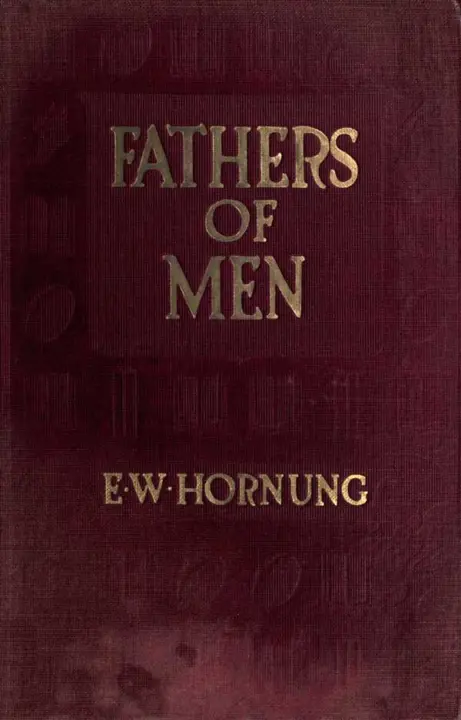
Fathers of Men
E. W. (Ernest William) Hornung
THE CLASSIC COLLECTION · 1900
"Peccavi" by E. W. Hornung is a novel written in the early 20th century. Set in the village of Long Stow, it unfolds the story of a local clergyman, Mr. Robert Carlton, grappling with guilt and scandal surrounding the death of his parishioner, Molly Musk. The central character, Carlton, struggles with the repercussions of his actions, hinting at themes of betrayal, morality, and communal judgment. The opening of the novel introduces us to the ambiance of a village church during a funeral, where a sense of foreboding looms as the protagonist grapples with the loss of Molly Musk, whose unexpected return and subsequent death stir the community. As the narrative unfolds, we learn of the discontent brewing beneath the surface, leading to a crisis for the rector when secrets of his past surface. This conflict is further fueled by the returning figure of Jasper Musk, Molly’s father, who vows to uncover the truth and seek retribution, setting the stage for an exploration of moral complexity and the weight of conscience.
Introduction adapted from the source catalogue; source summaries may be automatically generated.
Free to read · English · 103,475 words · No account needed
MAKE TIME FOR A GOOD BOOK
On by default. Untick to stop anonymous reading totals. Each page counts after 10 seconds in view. How this works.
Anonymous counting is on unless you have switched it off.
And the broad face beamed and darkened with alternate enthusiasm and defiance. Carlton beheld it with parted lips and startled eye; and so they stood through a long silence, till Carlton sat down with a smile. It was a singularly gentle smile, as he leant back in his worn old chair, and the lamplight fell upon his face.
"After all these months," he murmured; "after all these months!"
"I fare to hide my face when I count 'em up," admitted Ivey, bitterly. "But what was the good of comun when I couldn't come for good? And how could I in poor mother's time? It'd have meant--there's no sayun what that wouldn't have meant."
"You mean as regards Sir Wilton?"
"I do, Mr. Carlton."
"He will have been a good friend to you?"
"Oh, yes."
"Did those repairs, did he?"
"Yes," sighed Ivey, "he was better than his word about them; you would hardly know the place now. It made a lot of difference to mother. And I had the job."
"Oh!"
"He's kept me busy, I must say. I've never wanted work."
"Until now, I suppose?"
"To tell you the truth, sir, I'm at work for him still."
"For Sir Wilton Gleed?"
"Yes--odd jobs about the estate."
"Then my good fellow, what do you mean by offering yourself to me?"
"Mean?" exclaimed Ivey, his black determination leaping into flame. "I mean as I've made up my mind to give him the go-by for you. I'd have done that long ago if it hadn't been for mother; but better late than never. You've shown 'em the man you are, and now that's my turn. Look at what you've done with your own two hands--there'll be other two from to-morrow! You shan't work yourself right to death before my eyes. Why, your hair's white with it already!"
Carlton wheeled further from the lamp.
"Not white," he murmured.
"But that is, sir. When did you look in a glass?"
"I don't know."
"Then do you look to-morrow. That's white as snow. And your beard's
grey."
"It's certainly too long," said Carlton, covering half with his hand.
"And your hand--your hand!"
It was scarred and horny as the mason's own. Carlton removed it from the light, but said nothing.
"That's done its last day's work alone," cried Tom. "I start with you to-morrow, whether you want me or not. I'll show 'em! I'll show 'em!"
And he stood nodding savagely to himself.
"My dear fellow, you can't behave like that."
The words fell softly after a long silence.
"Why can't I?"
Carlton gave innumerable reasons.
Your reading position is saved on this browser. Take it to another device with a library code. Reading pages adapt to text, rather than matching a printed edition.
E. W. (Ernest William) Hornung
E. W. (Ernest William) Hornung
E. W. (Ernest William) Hornung
E. W. (Ernest William) Hornung
BEHIND THE BOOK
This eBook is for the use of anyone anywhere in the United States and most other parts of the world at no cost and with almost no restrictions whatsoever. You may copy it, give it away or re-use it under the terms of the Project Gutenberg License included with this eBook or online at www.gutenberg.org. If you are not located in the United States, you will have to check the laws of the country where you are located before using this eBook. Read the source licence.
The original source file, including credits and licence, is retained by this library. Request an original-format copy at no charge. Please include the book title and Project Gutenberg identifier #36115.
KEEP YOUR CURIOSITY GOING
Coulson Kernahan

Maurice Baring
Frances Wright
Cécile Tormay

Frederic Jesup Stimson

W. H. P. (William Henry Pope) Jarvis