THE CLASSIC COLLECTION✦A Christmas Carol The original manuscriptCLASSIC FREE BOOKS
A Christmas Carol The original manuscript
Charles Dickens
THE CLASSIC COLLECTION · 1854
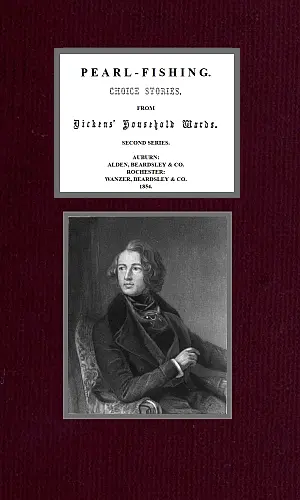
"Pearl-Fishing; Choice Stories from Dickens' Household Words; Second Series" is a collection of short stories written in the mid-19th century. This anthology features tales that stem from Charles Dickens' literary magazine, "Household Words", combining social commentary with storytelling. The stories delve into various themes of morality, class, and personal ambition, exploring the human experience through a series of engaging narratives. The opening of this collection introduces us to "The Young Advocate," where we meet Antoine de Chaulieu, a down-and-out law student of noble descent, who finds himself pitted against his former schoolmate, Jacques Rollet. Their enmity is rooted in class rivalry and personal misfortunes. As Antoine rises to prominence in the legal world, he becomes embroiled in a high-profile murder trial where moral dilemmas and the search for justice intertwine. Antoine’s ambitions are put to the test, especially when he grapples with the implications of his actions on his conscience and personal relationships, particularly as he is about to marry the love of his life, Natalie de Bellefonds. This well-crafted narrative sets the stage for poignant explorations of ambition, guilt, and the true price of success.
Introduction adapted from the source catalogue; source summaries may be automatically generated.
Free to read · English · 63,059 words · No account needed
MAKE TIME FOR A GOOD BOOK
On by default. Untick to stop anonymous reading totals. Each page counts after 10 seconds in view. How this works.
Anonymous counting is on unless you have switched it off.
“Why, what nonsense you are talking! you must be dreaming this morning. However, we are alone, I’ll light a weed, in defiance of Railway law, you shall spin that yarn; for, true or untrue, it will fill up the time to Liverpool.”
“As for yarn,” replied Balance, “the whole story is short enough; and as for truth, that you may easily find out if you like to take the trouble. I thought the poor wretch was dead, and I own it put me out meeting him this morning, for I had a curious dream last night.”
“Oh, hang your dreams! Tell us about this gentleman beggar that bleeds you of half-crowns--that melts the heart even of a pawnbroker!”
“Well, then, that beggar is the illegitimate son of the late Marquis of Hoopborough by a Spanish lady of rank. He received a first-rate education, and was brought up in his father’s house. At a very early age he obtained an appointment in a public office, was presented by the marquis at court, and received into the first society, where his handsome person and agreeable manners made him a great favorite. Soon after coming of age, he married the daughter of Sir E. Bumper, who brought him a very handsome fortune, which was strictly settled on herself. They lived in splendid style, kept several carriages, a house in town, and a place in the country. For some reason or other, idleness, or to plead his lady’s pride he said, he resigned his appointment. His father died, and left him nothing; indeed, he seemed at that time very handsomely provided for.
“Very soon Mr. and Mrs. Molinos Fitz-Roy began to disagree. She was cold, correct--he was hot and random. He was quite dependent on her, and she made him feel it. When he began to get into debt, he came to me. At length some shocking quarrel occurred; some case of jealousy on the wife’s side, not without reason, I believe; and the end of it was Mr. Fitz-Roy was turned out of doors. The house was his wife’s, the furniture was his wife’s, and the fortune was his wife’s--he was, in fact, her pensioner. He left with a few hundred pounds ready money, and some personal jewellery, and went to a hotel. On these and credit he lived. Being illegitimate, he had no relations; being a fool, when he spent his money he lost his friends. The world took his wife’s part, when they found she had the fortune, and the only parties who interfered were her relatives, who did their best to make the quarrel incurable. To crown all, one night he was run over by a cab, was carried to a hospital, and lay there for months, and was during several weeks of the time unconscious. A message to the wife, by the hands of one of his debauched companions, sent by a humane surgeon, obtained an intimation that ‘if he died, Mr. Croak, the undertaker to the family, had orders to see to the funeral,’ and that Mrs. Molinos was on the point of starting for the Continent, not to return for some years. When Fitz-Roy was discharged, he came to me limping on two sticks, to pawn his court suit, and told me his story. I was really sorry for the fellow, such a handsome, thoroughbred-looking man. He was going then into the west somewhere, to try to hunt out a friend. ‘What to do, Balance,’ he said, ‘I don’t know. I can’t dig, and unless somebody will make me their gamekeeper, I must starve or beg, as my Jezebel bade me when we parted!’
Your reading position is saved on this browser. Take it to another device with a library code. Reading pages adapt to text, rather than matching a printed edition.
Charles Dickens
Samuel McChord Crothers & Charles Dickens

Rebecca Harding Davis & Thomas De Quincey & Charles Dickens & Nathaniel Hawthorne & Edward Bulwer Lytton, Baron Lytton & Edgar Allan Poe & Harriet Elizabeth Prescott Spofford

Charles Dickens
BEHIND THE BOOK
This eBook is for the use of anyone anywhere in the United States and most other parts of the world at no cost and with almost no restrictions whatsoever. You may copy it, give it away or re-use it under the terms of the Project Gutenberg License included with this eBook or online at www.gutenberg.org. If you are not located in the United States, you will have to check the laws of the country where you are located before using this eBook. Read the source licence.
The original source file, including credits and licence, is retained by this library. Request an original-format copy at no charge. Please include the book title and Project Gutenberg identifier #50334.
KEEP YOUR CURIOSITY GOING
Coulson Kernahan

Maurice Baring
Frances Wright
Cécile Tormay

Frederic Jesup Stimson

W. H. P. (William Henry Pope) Jarvis