THE CLASSIC COLLECTION✦A Christmas Carol The original manuscriptCLASSIC FREE BOOKS
A Christmas Carol The original manuscript
Charles Dickens
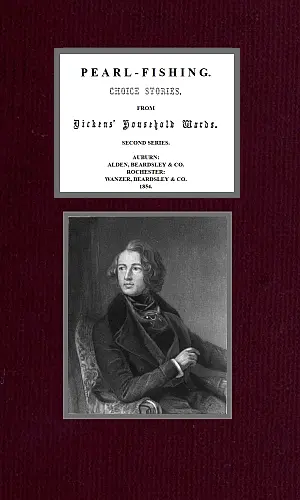
THE CLASSIC COLLECTION · 1854
"Pearl-Fishing; Choice Stories from Dickens' Household Words; Second Series" is a collection of short stories written in the mid-19th century. This anthology features tales that stem from Charles Dickens' literary magazine, "Household Words", combining social commentary with storytelling. The stories delve into various themes of morality, class, and personal ambition, exploring the human experience through a series of engaging narratives. The opening of this collection introduces us to "The Young Advocate," where we meet Antoine de Chaulieu, a down-and-out law student of noble descent, who finds himself pitted against his former schoolmate, Jacques Rollet. Their enmity is rooted in class rivalry and personal misfortunes. As Antoine rises to prominence in the legal world, he becomes embroiled in a high-profile murder trial where moral dilemmas and the search for justice intertwine. Antoine’s ambitions are put to the test, especially when he grapples with the implications of his actions on his conscience and personal relationships, particularly as he is about to marry the love of his life, Natalie de Bellefonds. This well-crafted narrative sets the stage for poignant explorations of ambition, guilt, and the true price of success.
Introduction adapted from the source catalogue; source summaries may be automatically generated.
Free to read · English · 63,059 words · No account needed
MAKE TIME FOR A GOOD BOOK
On by default. Untick to stop anonymous reading totals. Each page counts after 10 seconds in view. How this works.
Anonymous counting is on unless you have switched it off.
“A soldier’s widow,” said Mr. Spires. She had touched the softest place in the manufacturer’s heart, for he was a very loyal man, and vehement champion of his country’s honor in the war. “So young,” said he, “how did you lose your husband?”
“He fell, sir,” said the poor woman; but she could get no further; she suddenly caught up the corner of her gray cloak, covered her face with it, and burst into an excess of grief.
The manufacturer felt as if he had hit the woman a blow by his careless question; he sat watching her for a moment in silence, and then said, “Come, get into the gig, my poor woman; come, I must see you to Stockington.”
The poor woman dried her tears, and heavily climbed into the gig, expressing her gratitude in a very touching and modest manner. Spires buttoned the apron over her, and taking a look at the child, said in a cheerful tone to comfort her, “Bless me, but that is a fine thumping fellow, though. I don’t wonder you are tired, carrying such a load.”
The poor woman pressed the stout child, apparently two years old, to her breast, as if she felt it a great blessing and no load: the gig drove rapidly on.
Presently Mr. Spires resumed his conversation.
“So you are from Stockington?”
“No, sir; my husband was.”
“So: what was his name?”
“John Deg, sir.”
“Deg?” said Mr. Spires. “Deg, did you say?”
“Yes, sir.”
The manufacturer seemed to hitch himself off towards his own side of the gig, gave another look at her, and was silent. The poor woman was somewhat astonished at his look and movement, and was silent too.
After awhile Mr. Spires said again, “And do you hope to find friends in Stockington? Had you none where you came from?”
“None, sir, none in the world!” said the poor woman, and again her feelings seemed too strong for her. At length she added, “I was in service, sir, at Poole, in Dorsetshire, when I married; my mother only was living, and while I was away with my husband, she died. When--when the news came from abroad--that--when I was a widow, sir, I went back to my native place, and the parish officers said I must go to my husband’s parish, lest I and my child should become troublesome.”
“You asked relief of them?”
Your reading position is saved on this browser. Take it to another device with a library code. Reading pages adapt to text, rather than matching a printed edition.
Charles Dickens
Samuel McChord Crothers & Charles Dickens

Rebecca Harding Davis & Thomas De Quincey & Charles Dickens & Nathaniel Hawthorne & Edward Bulwer Lytton, Baron Lytton & Edgar Allan Poe & Harriet Elizabeth Prescott Spofford

Charles Dickens
BEHIND THE BOOK
This eBook is for the use of anyone anywhere in the United States and most other parts of the world at no cost and with almost no restrictions whatsoever. You may copy it, give it away or re-use it under the terms of the Project Gutenberg License included with this eBook or online at www.gutenberg.org. If you are not located in the United States, you will have to check the laws of the country where you are located before using this eBook. Read the source licence.
The original source file, including credits and licence, is retained by this library. Request an original-format copy at no charge. Please include the book title and Project Gutenberg identifier #50334.
KEEP YOUR CURIOSITY GOING
Coulson Kernahan

Maurice Baring
Frances Wright
Cécile Tormay

Frederic Jesup Stimson

W. H. P. (William Henry Pope) Jarvis