THE CLASSIC COLLECTION✦A Christmas Carol The original manuscriptCLASSIC FREE BOOKS
A Christmas Carol The original manuscript
Charles Dickens
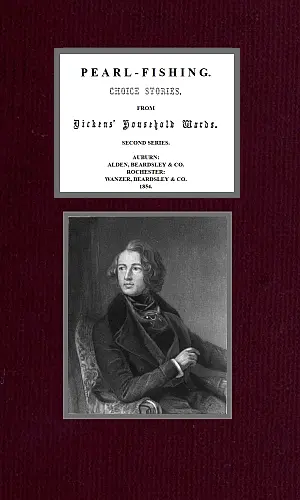
THE CLASSIC COLLECTION · 1854
"Pearl-Fishing; Choice Stories from Dickens' Household Words; Second Series" is a collection of short stories written in the mid-19th century. This anthology features tales that stem from Charles Dickens' literary magazine, "Household Words", combining social commentary with storytelling. The stories delve into various themes of morality, class, and personal ambition, exploring the human experience through a series of engaging narratives. The opening of this collection introduces us to "The Young Advocate," where we meet Antoine de Chaulieu, a down-and-out law student of noble descent, who finds himself pitted against his former schoolmate, Jacques Rollet. Their enmity is rooted in class rivalry and personal misfortunes. As Antoine rises to prominence in the legal world, he becomes embroiled in a high-profile murder trial where moral dilemmas and the search for justice intertwine. Antoine’s ambitions are put to the test, especially when he grapples with the implications of his actions on his conscience and personal relationships, particularly as he is about to marry the love of his life, Natalie de Bellefonds. This well-crafted narrative sets the stage for poignant explorations of ambition, guilt, and the true price of success.
Introduction adapted from the source catalogue; source summaries may be automatically generated.
Free to read · English · 63,059 words · No account needed
MAKE TIME FOR A GOOD BOOK
On by default. Untick to stop anonymous reading totals. Each page counts after 10 seconds in view. How this works.
Anonymous counting is on unless you have switched it off.
“No doubt, my dear friend, no doubt; but in the meanwhile, suppose we talk of this annuity. Shall we say one thousand francs a year.”
“What?” asked Bonelle, looking at him very fixedly.
“My dear friend, I mistook; I meant two thousand francs per annum,” hurriedly rejoined Ramin.
Monsieur Bonelle closed his eyes, and appeared to fall into a gentle slumber. The mercer coughed; the sick man never moved.
“Monsieur Bonelle.”
No reply.
“My excellent friend.”
Utter silence.
“Are you asleep?”
A long pause.
“Well, then, what do you say to three thousand?”
Monsieur Bonelle opened his eyes.
“Ramin,” said he, sententiously, “you are a fool; the house brings me in four thousand as it is.”
This was quite false, and the mercer knew it; but he had his own reasons for wishing to seem to believe it true.
“Good Heavens!” said he, with an air of great innocence, “who could have thought it, and the lodgers constantly running away. Four thousand? Well, then, you shall have four thousand.”
Monsieur Bonelle shut his eyes once more, and murmured “The mere rental--nonsense!” He then folded his hands on his breast, and appeared to compose himself to sleep.
“Oh, what a sharp man of business he is!” Ramin said, admiringly; but for once omnipotent flattery failed in its effect; “So acute!” continued he, with a stealthy glance at the old man, who remained perfectly unmoved. “I see you will insist upon making it the other five hundred francs.”
Monsieur Ramin said this as if five thousand five hundred francs had already been mentioned, and was the very summit of Monsieur Bonelle’s ambition. But the ruse failed in its effect; the sick man never so much as stirred.
“But, my dear friend,” urged Monsieur Ramin in a tone of feeling remonstrance, “there is such a thing as being too sharp, too acute. How can you expect that I shall give you more when your constitution is so good, and you are to be such a long liver?”
“Yes, but I may be carried off one of those days,” quietly observed the old man, evidently wishing to turn the chance of his own death to account.
“Indeed, and I hope so,” muttered the mercer, who was getting very
ill-tempered.
“You see,” soothingly continued Bonelle, “you are so good a man of business, Ramin, that you will double the actual value of the house in no time. I am a quiet, easy person, indifferent to money; otherwise this house would now bring me in eight thousand at the very least.”
Your reading position is saved on this browser. Take it to another device with a library code. Reading pages adapt to text, rather than matching a printed edition.
Charles Dickens
Samuel McChord Crothers & Charles Dickens

Rebecca Harding Davis & Thomas De Quincey & Charles Dickens & Nathaniel Hawthorne & Edward Bulwer Lytton, Baron Lytton & Edgar Allan Poe & Harriet Elizabeth Prescott Spofford

Charles Dickens
BEHIND THE BOOK
This eBook is for the use of anyone anywhere in the United States and most other parts of the world at no cost and with almost no restrictions whatsoever. You may copy it, give it away or re-use it under the terms of the Project Gutenberg License included with this eBook or online at www.gutenberg.org. If you are not located in the United States, you will have to check the laws of the country where you are located before using this eBook. Read the source licence.
The original source file, including credits and licence, is retained by this library. Request an original-format copy at no charge. Please include the book title and Project Gutenberg identifier #50334.
KEEP YOUR CURIOSITY GOING
Coulson Kernahan

Maurice Baring
Frances Wright
Cécile Tormay

Frederic Jesup Stimson

W. H. P. (William Henry Pope) Jarvis