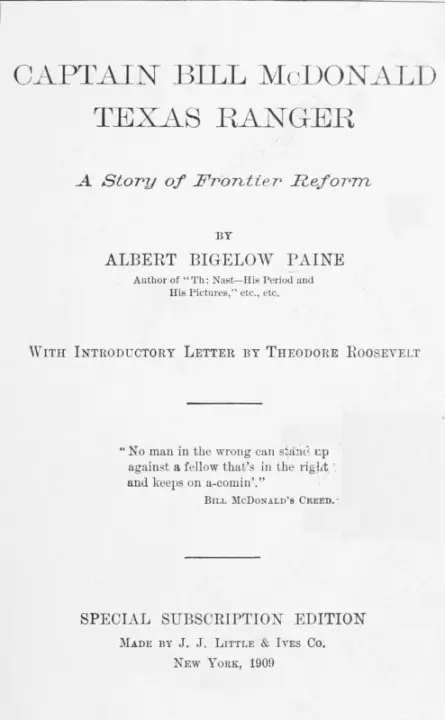
Captain Bill McDonald, Texas Ranger: A Story of Frontier Reform
Albert Bigelow Paine
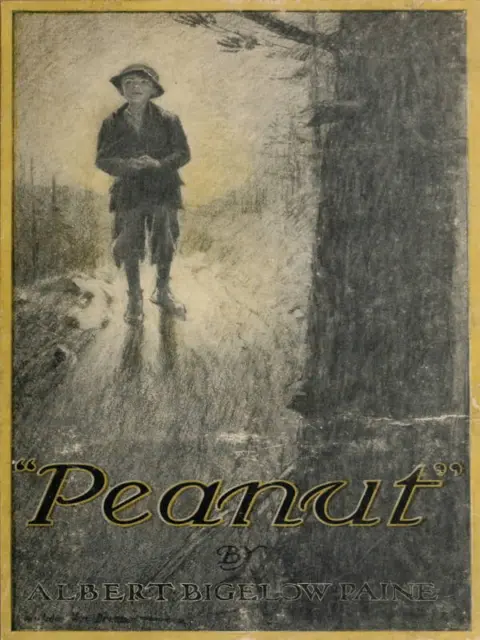
THE CLASSIC COLLECTION · 1913
"Peanut": The Story of a Boy by Albert Bigelow Paine is a novel written in the early 20th century. The book tells the poignant tale of a young boy named Peanut, or Philip Nutt, who comes to terms with loss and longing, as he navigates life following the death of his guardian, Blazer Sam, an outlaw of some renown. The story explores themes of innocence, memory, and the deep connections formed in the wilderness. The narrative unfolds in a remote mountainous setting, where Peanut lives a simple life with the "Rose of Texas," who had been Sam's companion. Peanut's world is disrupted when he meets Miss Cynthia Schofield, a teacher who aims to provide him with a formal education far removed from his wild upbringing. As he transitions to city life, Peanut struggles with homesickness and the stark differences between his two worlds. Despite being distanced from his beloved hills and bears, Peanut's journey ultimately leads him back home, where he is reunited with the Rose and, symbolically, with the memories of Sam. Through this heartfelt story, Paine captures the essence of childhood and the quest for belonging.
Introduction adapted from the source catalogue; source summaries may be automatically generated.
Free to read · English · 9,331 words · No account needed
MAKE TIME FOR A GOOD BOOK
On by default. Untick to stop anonymous reading totals. Each page counts after 10 seconds in view. How this works.
Anonymous counting is on unless you have switched it off.
Peanut had no particular reason for being afraid of women. The only one he had studied at close range had been kind to him to the point of indulgence. There was something in the voice of this one that held him fast. The woman came a step closer. She seemed young and beautiful to Peanut.
“Please tell me your name,” she said.
“Peanut.”
“Oh, that is what they call you, perhaps. Your real name, I mean.”
The boy made no reply at first to this comment. He seemed gathering something from the mists of memory.
“Sam told me that it used to be—longer than that,” he ventured at last, very slowly. “He told me once that it was Philip—Nutt, but he said P. was the same as Philip, and that he thought Peanut fit me better.”
Panic seemed about to return, as the result of this long speech, and once more it required the soothing diplomacy of Miss Schofield to detain him.
“How very nice,” she said. “And now won’t you please tell me where you live, and about Sam and the grave?”
Again Peanut hesitated. Then he pointed behind him.
“I live up there; and Sam, he—why he’s in the grave, and dam the man that moves his bones.”
Miss Schofield had been unprepared for this. Her emotion, however, was mistaken by Peanut for incredulity. “I can show it to you on the board,” he insisted, eagerly.
The woman came up close, now, and followed where his wisp of a finger pointed. As he indicated each line, he repeated it with a sort of monotonous tenderness, laying special emphasis on the last.
“Here lies the body of Blazer Sam, For life he didn’t care a dam— He was plugged by a greaser unbeknowns, And dam the man that moves his bones.”
Miss Schofield’s look of concern became one of sympathetic understanding. The waif turned to her.
“You didn’t want to take Sam away, anyhow, did you?”
“Oh, no indeed! I don’t want to take any one away—” She hesitated and looked down into the wistful face before her. “At least, not Sam,” she qualified. “I have already taken a picture of the grave and you shall have one of them. Tell me, Philip, whom you live with, so I shall know how to send it.”
The sound of his name thus spoken may have awakened a sort of dignity in
the waif.
“I live with the Rose of Texas,” he said, gravely. “Me an’ Sam both did, till Sam was plugged by a greaser unbeknowns, and—”
Miss Schofield interrupted rather hastily.
Your reading position is saved on this browser. Take it to another device with a library code. Reading pages adapt to text, rather than matching a printed edition.
Albert Bigelow Paine
Albert Bigelow Paine
Albert Bigelow Paine
Albert Bigelow Paine
BEHIND THE BOOK
This eBook is for the use of anyone anywhere in the United States and most other parts of the world at no cost and with almost no restrictions whatsoever. You may copy it, give it away or re-use it under the terms of the Project Gutenberg License included with this eBook or online at www.gutenberg.org. If you are not located in the United States, you will have to check the laws of the country where you are located before using this eBook. Read the source licence.
The original source file, including credits and licence, is retained by this library. Request an original-format copy at no charge. Please include the book title and Project Gutenberg identifier #56481.
KEEP YOUR CURIOSITY GOING
Coulson Kernahan

Maurice Baring
Frances Wright
Cécile Tormay

Frederic Jesup Stimson

W. H. P. (William Henry Pope) Jarvis