Anthony John
Jerome K. (Jerome Klapka) Jerome
THE CLASSIC COLLECTION · 1904
"Passing of the Third Floor Back" by Jerome K. Jerome is a novel written in the early 20th century. The story centers around a mysterious stranger who arrives at a boarding house in Bloomsbury and profoundly impacts the lives of its residents. Through his interactions, he explores themes of human nature, empathy, and the transformation of society's values. The narrative begins with the arrival of the stranger at the boarding house run by Mrs. Pennycherry. As he settles in, each resident reacts to him in various ways, reflecting their own personalities and insecurities. The stranger's gentle approach and insightful observations lead to transformative conversations, revealing deeper truths and prompting self-reflection among the residents. For example, Miss Kite feels challenged and confronted about her superficiality, while the charming yet disingenuous Miss Devine grapples with her own identity and aspirations against societal expectations. The stranger's influence ultimately encourages the lodgers to embrace their better selves, suggesting a hopeful vision of individual growth and collective improvement in an increasingly complex world.
Introduction adapted from the source catalogue; source summaries may be automatically generated.
Free to read · English · 7,117 words · No account needed
MAKE TIME FOR A GOOD BOOK
On by default. Untick to stop anonymous reading totals. Each page counts after 10 seconds in view. How this works.
Anonymous counting is on unless you have switched it off.
“Not what I call a smart young man,” was the opinion of Augustus Longcord, who was something in the City.
“Thpeaking for mythelf,” commented his partner Isidore, “hav’n’th any uthe for the thmart young man. Too many of him, ath it ith.”
“Must be pretty smart if he’s one too many for you,” laughed his
partner.
There was this to be said for the repartee of Forty-eight Bloomsbury Square: it was simple of construction and easy of comprehension.
“Well it made me feel good just looking at him,” declared Miss Kite, the highly coloured. “It was his clothes, I suppose--made me think of Noah and the ark--all that sort of thing.”
“It would be clothes that would make you think--if anything,” drawled the languid Miss Devine. She was a tall, handsome girl, engaged at the moment in futile efforts to recline with elegance and comfort combined upon a horsehair sofa. Miss Kite, by reason of having secured the only easy-chair, was unpopular that evening; so that Miss Devine’s remark received from the rest of the company more approbation than perhaps it merited.
“Is that intended to be clever, dear, or only rude?” Miss Kite requested
to be informed.
“Both,” claimed Miss Devine.
“Myself? I must confess,” shouted the tall young lady’s father, commonly called the Colonel, “I found him a fool.”
“I noticed you seemed to be getting on very well together,” purred his wife, a plump, smiling little lady.
“Possibly we were,” retorted the Colonel. “Fate has accustomed me to the society of fools.”
“Isn’t it a pity to start quarrelling immediately after dinner, you two,” suggested their thoughtful daughter from the sofa, “you’ll have nothing left to amuse you for the rest of the evening.”
“He didn’t strike me as a conversationalist,” said the lady who was cousin to a baronet; “but he did pass the vegetables before he helped himself. A little thing like that shows breeding.”
“Or that he didn’t know you and thought maybe you’d leave him half a spoonful,” laughed Augustus the wit.
“What I can’t make out about him--” shouted the Colonel.
The stranger entered the room.
The Colonel, securing the evening paper, retired into a corner. The highly coloured Kite, reaching down from the mantelpiece a paper fan, held it coyly before her face. Miss Devine sat upright on the horse-hair sofa, and rearranged her skirts.
“Know anything?” demanded Augustus of the stranger, breaking the somewhat remarkable silence.
The stranger evidently did not understand. It was necessary for Augustus, the witty, to advance further into that odd silence.
Your reading position is saved on this browser. Take it to another device with a library code. Reading pages adapt to text, rather than matching a printed edition.
Jerome K. (Jerome Klapka) Jerome
Jerome K. (Jerome Klapka) Jerome
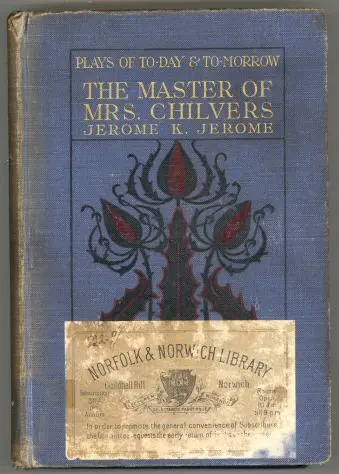
Jerome K. (Jerome Klapka) Jerome
Jerome K. (Jerome Klapka) Jerome
BEHIND THE BOOK
This eBook is for the use of anyone anywhere in the United States and most other parts of the world at no cost and with almost no restrictions whatsoever. You may copy it, give it away or re-use it under the terms of the Project Gutenberg License included with this eBook or online at www.gutenberg.org. If you are not located in the United States, you will have to check the laws of the country where you are located before using this eBook. Read the source licence.
The original source file, including credits and licence, is retained by this library. Request an original-format copy at no charge. Please include the book title and Project Gutenberg identifier #865.
KEEP YOUR CURIOSITY GOING
Coulson Kernahan

Maurice Baring
Frances Wright
Cécile Tormay

Frederic Jesup Stimson

W. H. P. (William Henry Pope) Jarvis