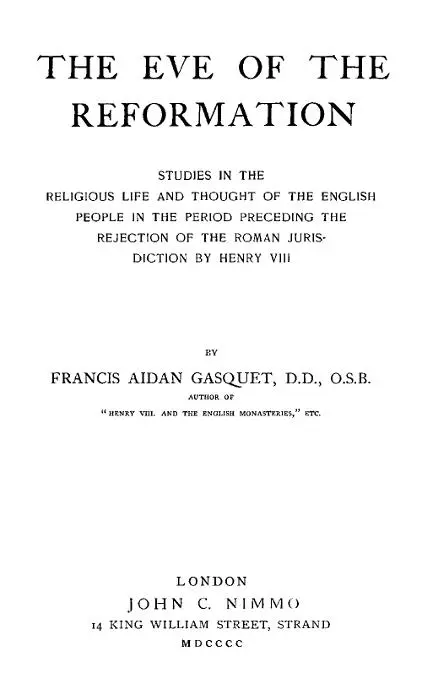
The Eve of the Reformation Studies in the Religious Life and Thought of the English people in the Period Preceding the Rejection of the Roman jurisdiction by Henry VIII
Francis Aidan Gasquet
THE CLASSIC COLLECTION · 1907
"Parish Life in Mediæval England" by Abbot Gasquet, D.D. is a historical account written in the early 20th century. This work explores the intricate and multifaceted nature of parish life during the Middle Ages in England, placing significant emphasis on the role of the parish church and its clergy within the community. It examines how the ecclesiastical structure intertwined with the daily lives of the parishioners, highlighting aspects such as communal responsibilities, religious practices, and economic obligations. The opening of the volume sets the stage for a detailed examination of what constitutes a parish, describing its origins and establishing the significance of the parish church as a focal point for communal life. Gasquet emphasizes the connection between the Church and society, arguing against simplistic portrayals that overlook the importance of the parish clergy and community in managing various secular and spiritual duties. He notes how these parishes evolved, underpinning their roles as crucial elements of social coherence and religious identity, fostering a sense of collective purpose that extended beyond mere religious observance. This groundwork prepares the reader for a deeper exploration of specific practices and structures in later chapters.
Introduction adapted from the source catalogue; source summaries may be automatically generated.
Free to read · English · 78,031 words · No account needed
MAKE TIME FOR A GOOD BOOK
On by default. Untick to stop anonymous reading totals. Each page counts after 10 seconds in view. How this works.
Anonymous counting is on unless you have switched it off.
“Experience doth teche, and shewe to the playne
That many to honour, by learninge attayne
That were of byrthe but simple and bace
Such is the goodness of God’s speciale grace.
For he that to honour by vertue doth ryse
Is doubly happy, and counted more wyse.”
The writer then warns the boys he is addressing to behave themselves when leaving school. On their way home they would do well to walk two and two, and “not in heaps, like a swarm of bees.” Another educator, Old Symon, in his “Lesson of Wysedom for all maner chyldryn,” urges diligence and plodding upon his pupils, with a jest as to possible positions to which the student may in time attain.
“And lerne as faste as thou can,
For our byshop is an old man,
And therfor thou must lerne faste
If thou wilt be byshop when he is past.”
It is unnecessary to pursue the subject of the education of the parochial clergy further. After his elementary education had been received in the schools, the student’s preparation for the reception of Orders was continued and completed at the Universities. The ordinary course here was lengthy. Grammar, which included Latin and literature with rhetoric and logic, occupied four years. The student was then admitted a Bachelor. In the case of clerical students this was followed by seven years’ training before the Bachelor’s degree in Theology was bestowed, and only after a further three years’ study of the Bible, and after the candidate had lectured at least on some one book of the Scriptures, was he considered to have earned his degree of Doctor in Theology.
The age when the candidate for Orders could be promoted to the various steps leading to the priesthood was settled by law and custom. A boy of seven, if he showed signs of having a vocation to the sacred ministry, might be made a cleric by receiving the tonsure. In “rare instances” and under special circumstances he might then receive an ecclesiastical benefice, and so get the wherewith to live while he was studying to fulfil the duties attached to his office. In the course of the next seven years the youth could be given the minor Orders of “doorkeeper,” “lector,” “exorcist,” and “acolyte.” He would then be at least fourteen years of age, and thus at the time of life at which in those days students were supposed to begin their University course. At eighteen the candidate to the priesthood might be ordained Subdeacon; at twenty he could take the diaconate, and at twenty-five be ordained Priest. It will be noticed that these ages in some way generally correspond to the academic degrees. Going to the University at fourteen, a clerical student might have, and no doubt frequently had, received the various steps of minor Orders. Four years of the liberal arts enabled him at eighteen to take his degree of Bachelor of Arts. It was at this age that he could be ordained Subdeacon. Then seven years of theological study enabled him to become a Bachelor of Divinity at twenty-five, at which time he was of the right age to receive the priesthood. This was the regular course; but without doubt the greater number of candidates for the ministry did not pass through all the schools. Some, no doubt, after entering sacred Orders, became attached to cathedrals, colleges of priests, and even parochial churches, where, in the midst of a more or less active life, they prepared themselves for further ecclesiastical advancement. Wherever they were, however, they would have to prove themselves to be sufficiently lettered and of good life before they would be accepted for Ordination, and their examination and proof was put as a conscientious duty upon the bishop before he determined upon accepting and ordaining them. For a candidate to become a cleric there was not much difficulty, if he showed sufficient diligence and good-will, and the various minor Orders were also bestowed without any serious question as to the likelihood of failure, etc., in the ecclesiastical career. With the subdiaconate, however, this was in no sense the case, and no one was allowed to be ordained without what was called a “title,” that is, he was required to show that he had been nominated to a benefice sufficient for his proper maintenance, or had been given a responsible guarantee of adequate support for one in sacred Orders. In the case of sons of well-to-do parents the bishop might accept the possession of sufficient property as guarantee under the title of “patrimony.” Moreover, the Episcopal Registers show for what large numbers of clergy the religious houses became surety for a fitting maintenance in the event of failure of health or withdrawal of ecclesiastical resources. A certificate of Orders received was to be furnished by the bishop’s official, the fee for each of which was settled in the English Church by Archbishop Stratford at 6d.
Your reading position is saved on this browser. Take it to another device with a library code. Reading pages adapt to text, rather than matching a printed edition.
Francis Aidan Gasquet
Francis Aidan Gasquet
Francis Aidan Gasquet
BEHIND THE BOOK
This eBook is for the use of anyone anywhere in the United States and most other parts of the world at no cost and with almost no restrictions whatsoever. You may copy it, give it away or re-use it under the terms of the Project Gutenberg License included with this eBook or online at www.gutenberg.org. If you are not located in the United States, you will have to check the laws of the country where you are located before using this eBook. Read the source licence.
The original source file, including credits and licence, is retained by this library. Request an original-format copy at no charge. Please include the book title and Project Gutenberg identifier #73543.
KEEP YOUR CURIOSITY GOING
Cécile Tormay

Moritz Busch
John L. Ransom
Frances Wright
Cécile Tormay

Mabel Potter Daggett