
The Truth About an Author
Arnold Bennett
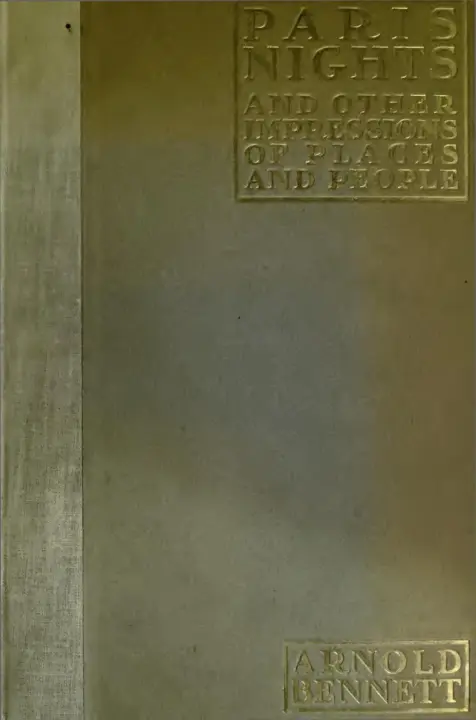
THE CLASSIC COLLECTION · 1913
"Paris Nights and Other Impressions of Places and People" by Arnold Bennett is a collection of essays written in the early 20th century. The work captures the essence of Paris, recounting the author's experiences and observations of its distinctive architecture, culture, and social interactions through vivid and insightful narratives. The opening of the collection introduces a scene where the author reflects on his first invitation to a Parisian gathering, filled with the allure of music and the charm of women. He describes the intimate setting, noting the contrast of perceptions between Paris and London, and the unique essence of the Parisians gathered—their artistic discussions, candid interactions, and emotional expressions. Bennett's keen observations create a rich tapestry of Parisian life, illustrating the romantic and sometimes absurd dynamics of its social elite, emphasizing their candor and the spirited nature of their conversations. This beginning sets the stage for an exploration of various facets of Parisian culture that promises to engage readers with a mix of humor, irony, and appreciation for the city's complexities.
Introduction adapted from the source catalogue; source summaries may be automatically generated.
Free to read · English · 86,934 words · No account needed
MAKE TIME FOR A GOOD BOOK
On by default. Untick to stop anonymous reading totals. Each page counts after 10 seconds in view. How this works.
Anonymous counting is on unless you have switched it off.
In a corner of the drawing-room she resumed the topic, always interesting to her, of my adventures among charwomen, generously instructing me the whole time in a hundred ways. And when the conversation dropped she would sigh and go back to something previously said, and repeat it. “So she polishes the door-knobs every day! Well, that is a quality, at least.” Then my hostess (her niece-inlaw) came blandly in: a woman of thirty-five, also in mourning, with a pale, powdered face and golden hair; benevolent and calm, elegant, but with the elegance of a confessed mother.
“Ça y est?” asked the Tante, meaning--were the infants at last
couched?
“Ça y est” said the mother, with triumph, with relief, and yet also
with a little regret.
There was a nurse, but in practice she was only an under-nurse; the
head-nurse was the mother.
“Eh bien, mon petit Bennett,” the mother began, in a new tone, as if to indicate that she was no longer a mother, but a Parisienne, frivolous and challenging, “what there that is new?”
“He is there,” said the Tante, interrupting.
We heard the noise of the front-door, and by a common instinct we all rose and went into the hall.
The master of the home arrived. He entered like a gust of wind, and Marthe, the thin old parlourmaid, who had evidently been lying in wait for him, started back in alarm, but alarm half-simulated. My host, about the same age as his wife, was a doctor, specialising in the diseases of women and children, and he had his cabinet on the ground-floor of the same house. He was late, he was impatient to regain his hearth, he was proud of his industry; and the simple, instinctive joy of life sparkled in his eye.
“Marie,” he cried to his wife. “I love thee!” And kissed her furiously
on both cheeks.
“It is well,” she responded, calmly smiling, with a sort of flirtatious
condescension.
“I tell thee I love thee!” he insisted, with his hands on her shoulders. “Tell me that thou lovest me!”
“I love thee,” she said calmly.
“It is very well!” he said, and swinging round to Marthe, giving her his hat. “Marthe, I love you.” And he caught her a smack on the shoulder.
“Monsieur hurts me,” the spinster protested.
“Go then! Go then!” said the Tante, as the beloved nephew directed his assault upon her in turn. She was grimly proud of him. He flattered her eye, for, even at his loosest, he had a professional distinction of deportment which her long-deceased husband, a wholesale tradesman, had probably lacked.
Your reading position is saved on this browser. Take it to another device with a library code. Reading pages adapt to text, rather than matching a printed edition.
Arnold Bennett

Arnold Bennett
Arnold Bennett
Arnold Bennett
BEHIND THE BOOK
This eBook is for the use of anyone anywhere in the United States and most other parts of the world at no cost and with almost no restrictions whatsoever. You may copy it, give it away or re-use it under the terms of the Project Gutenberg License included with this eBook or online at www.gutenberg.org. If you are not located in the United States, you will have to check the laws of the country where you are located before using this eBook. Read the source licence.
The original source file, including credits and licence, is retained by this library. Request an original-format copy at no charge. Please include the book title and Project Gutenberg identifier #55116.
KEEP YOUR CURIOSITY GOING
Wilfrid Scawen Blunt
Wilfrid Scawen Blunt

E. W. (Edgar Watson) Howe

David Patterson (Spirit) Hatch

David Patterson (Spirit) Hatch

David Patterson (Spirit) Hatch