THE CLASSIC COLLECTION✦VariationsCLASSIC FREE BOOKS
Variations
James Huneker
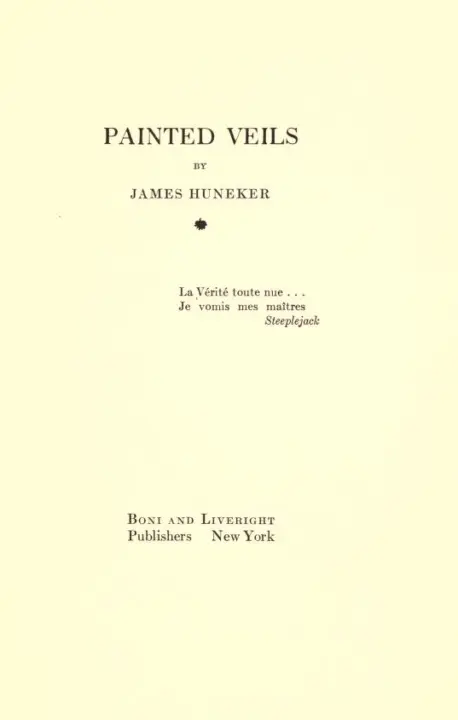
THE CLASSIC COLLECTION · 1920
"Painted Veils" by James Huneker is a novel written in the early 20th century. The story introduces Esther Brandès, a young woman who arrives in New York with dreams of becoming a successful dramatic soprano. The narrative explores her experiences as she grapples with near-desperation and homesickness while navigating the vibrant yet harsh world of the city's artistic scene. At the start of the novel, the protagonist, Esther, arrives in New York during a snowstorm, filled with anticipation and anxiety. She is greeted by Madame Felice at the Maison Felicé, a hotel frequented by artists and musicians, but immediately faces challenges when her pre-booked room is occupied, compelling her to adjust to a new, less appealing space. Despite her loneliness and the dismal winter evening, Esther’s spirits begin to lift during dinner when she meets Alfred Stone, a music critic, who takes an interest in her aspirations. The opening sets the stage for Esther’s journey as she attempts to establish herself in the competitive world of music while dealing with emotional turbulence and social intricacies.
Introduction adapted from the source catalogue; source summaries may be automatically generated.
Free to read · English · 68,188 words · No account needed
MAKE TIME FOR A GOOD BOOK
On by default. Untick to stop anonymous reading totals. Each page counts after 10 seconds in view. How this works.
Anonymous counting is on unless you have switched it off.
That's an ambitious attempt to compress the evolutionary processes into a page, she reflected. On the shelf devoted to her beloved Frenchmen she took down A Rebours and read what Huysmans wrote of the poem in prose of Mallarmé's in particular ... "the adjective placed in such an ingenious and definite way that it ... would open up such perspectives that the reader would dream whole weeks together on its meaning at once precise and multiple, affirm the present, reconstruct the past, divine the future of the characters revealed by the light of the unique epithet ... a spiritual collaboration by consent between ten superior persons scattered through the universe...." "I confess I'm not one of the ten," said Mona aloud, for she often wedded her interior dialogue to the exterior. "I should die of mental starvation on such a condensed literary diet; it may be poetic, but it is too peptonic, and my soul can't be fed with prose pemmican. Yet Frustrate is a strange panorama of sex and evolution. 'Every monad has its day.' True, I wonder if this orchestra of cells that I call 'Moi' will ever have its day? The time of my fruition is afar. Who is the Siegfried that will release this Brunnhilde from her bed of fire? That's a question which every girl puts to herself in a thousand different forms. I should like to be married. I love children. There is no other adequate method to lure them into this chilly life but the mating of men and women. Really, Mona, does the man matter much? Eugenics, a fine word for an impossible thing! I like Ulick. He wouldn't make me happy, I know. But what's the difference if I can hold his baby and mine to my breast? Nothing else counts. I'm in a nice depressed mood tonight. I musn't forget to take a pill. It's usually the liver, and calomel is the last resource of the virtuously bilious. Oh! dear, I wonder what he is doing now? With that horrid woman? Not that I care. Why should I? Ulick is nothing to me. Young men must observe the laws of hygiene or else be ill, so he says. I believe him. What about women? Are they so differently constructed? Saints? I don't believe it. If we were frank, we should tell the whole truth--women are much more amorous than men, although the emotion with us is more massive, yet more diffused. There! I've told my mirror the truth. Polichinelle's secret. Because of our excessive temperament we have been put behind bars for ages. Heavens! Every household is a harem with one lawful wife; the concubines live elsewhere. Some day women will go on a sex-strike. Then the men will crawl. If it's right for the men to go philandering, why isn't it right for the women? I wonder what Milt would say if he could peep into my brain at this moment? Horrified he would surely be. That Dora! Alfred Stone says she is very pretty. Pooh! I know what his 'pretty' means. A lascivious kitten. But she serves the purpose. I don't mind the physical facts; men have strong stomachs, but how can a superior young man like Ulick stand the vulgarity, the stupidity of such a girl! Maybe she isn't stupid or vulgar. That singer, Esther Brandès is a law unto herself; no doubt has a regular flock of lovers ... artistic women are privileged ... I wish I was an artistic woman. I've never had a real affair. If these monads of mine are to have their day it's high time they began. Only to think of it, I was once spoony over Alfred. I can't endure his presence now. They say we always return to our first loves. What nonsense. We usually turn down a side street when we see an old beau approaching. I know I do. I wonder whether Ulick really was in earnest about our dream-children? Our monads must have been mighty lively when we held hands at the Casino and at Martin's. What were their names, those children? Shamus, Tenth Earl, or is it Marquis of Thingamajig somewhere in Ireland? Shamus and----? Wasn't there a horse or a mare in the dream? Yes, yes, I have it, Brunnhilde's white horse, or was it one of the white horses of 'Rosmersholm'? No, it wasn't Ibsen at all, it was Wagner. Grane! Aha! That's it. Grane and Shamus. What darlings they must be, and their mother who conceived and bore them never saw them except in her dreams. But they are more real than flesh and blood children. Our dream children. I'm beginning to think I love Ulick.... Oh! he is a dear. I'd better go to bed or I'll end a lunatic. When a woman ceases to be mistress of herself she is likely to become the mistress of a man. Dreams. Heigho! Now for my bed of tormenting fire not on Brunnhilde's fire-begirt rock, but between my sheets. But the fire is there just the same ... the fire ... the lovely, teasing fire that brings dreams ... and Ulick ... and our dream-children, Shamus and Grane ... Shamus...."
Your reading position is saved on this browser. Take it to another device with a library code. Reading pages adapt to text, rather than matching a printed edition.
James Huneker
James Huneker
James Huneker
James Huneker
BEHIND THE BOOK
This eBook is for the use of anyone anywhere in the United States and most other parts of the world at no cost and with almost no restrictions whatsoever. You may copy it, give it away or re-use it under the terms of the Project Gutenberg License included with this eBook or online at www.gutenberg.org. If you are not located in the United States, you will have to check the laws of the country where you are located before using this eBook. Read the source licence.
The original source file, including credits and licence, is retained by this library. Request an original-format copy at no charge. Please include the book title and Project Gutenberg identifier #47141.
KEEP YOUR CURIOSITY GOING
Coulson Kernahan

Maurice Baring
Frances Wright
Cécile Tormay

Frederic Jesup Stimson

W. H. P. (William Henry Pope) Jarvis