
The Writing of News A Handbook with Chapters on Newspaper Correspondence and Copy Reading
Charles G. (Charles Griffith) Ross
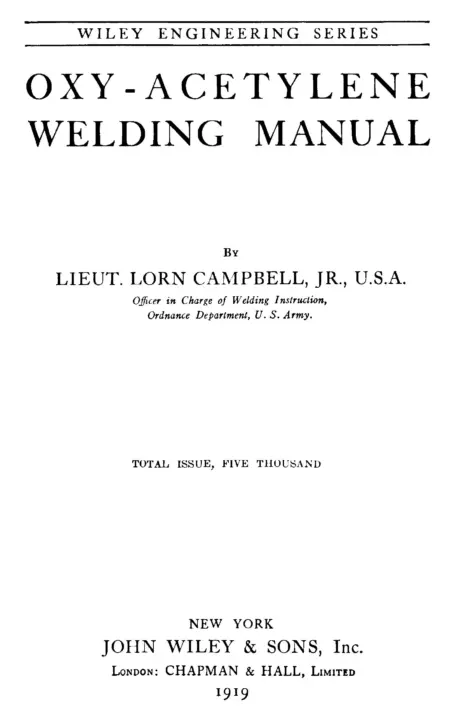
THE CLASSIC COLLECTION · 1919
"Oxy-Acetylene Welding Manual" by Lt. Lorn Campbell, Jr., is a technical manual written in the early 20th century. The book serves as a comprehensive guide for beginners in the field of oxy-acetylene welding, aiming to standardize the teaching method for both instructors and students. Its primary focus is on the principles, apparatus, and practices related to welding and cutting metals using the oxy-acetylene method, illustrating both the theoretical underpinnings and practical techniques involved. The opening of the manual sets the stage by highlighting the increased demand for skilled operators in oxy-acetylene welding, especially in response to its applications during and after the World War. Campbell discusses the significance of valuing structured instruction for beginners and points out that previous literature often catered to advanced practitioners rather than novices. He emphasizes the need for a systematic approach to teaching this craft, outlining how the manual will address fundamental concepts and operational procedures to prepare students for practical work in the field. The preface establishes a clear intention to make the manual an essential resource for welding education, guiding the reader towards proficient operation of welding equipment and methods.
Introduction adapted from the source catalogue; source summaries may be automatically generated.
Free to read · English · 42,726 words · No account needed
MAKE TIME FOR A GOOD BOOK
On by default. Untick to stop anonymous reading totals. Each page counts after 10 seconds in view. How this works.
Anonymous counting is on unless you have switched it off.
CARBONIZING FLAME. A flame with an excess of acetylene gas.
CONTRACTION. The shrinkage of metal due to cooling.
CROSS-BAR. Hand screw for adjusting the passage of gas through the
regulator.
CUTTING JET. Central jet of oxygen issuing from tip of cutting torch.
CUTTING TORCH. A torch with one or more heating jets and an oxygen jet, used for cutting metals in the oxy-acetylene process.
CYLINDER. A tank containing gas under pressure.
DUCTILE. That property which permits metal being formed or drawn into different shapes without breaking.
EXPANSION. Increase in size due to heating.
FILLER-ROD. A rod or wire used to supply additional metal to the weld.
FILLET WELD. A weld made in a corner.
FLAME PROPAGATION. The rate at which a flame will travel.
FLASH BACK. The burning back of the gases to the mixing chamber or
possibly farther.
FLUX. Chemical powder used to dissolve the oxides and clean the metal
when welding.
GAS. Erroneously applied to acetylene gas alone. Both oxygen and acetylene are in the form of gas.
GAUGE. An instrument for measuring pressures of gases.
GENERATOR. A device for manufacturing gas. Usually specified as acetylene generator or oxygen generator.
GRAIN. The arrangement of the molecules or crystals which make up a
metal.
HORIZONTAL WELDING. Welding in a level position.
I-BEAM. A steel bar with the cross-section of an I. Sometimes called
EYE BEAM.
LINE. Hose or pipe carrying gas.
MANIFOLD. A header with outlets or branches by which several cylinders of gas may be used in batteries.
MONEL METAL. An alloy of copper and nickel.
NIPPLE. A short piece of pipe.
OVERHEAD WELDING. Welding with the torch overhead.
OXIDATION. A combination with oxygen.
OXIDE. A coating or scale formed by oxygen combining with metal.
OXIDIZING FLAME. A flame with an excess of oxygen gas.
OXYGEN. A non-inflammable gas used in oxy-acetylene welding and cutting.
OXYGEN CYLINDER. A steel tank for storing and shipping oxygen. Available for commercial work in 100, 200, and 250 cubic-foot sizes. The oxygen is compressed as free gas to 1800 pounds pressure at 68 degrees Fahrenheit.
PEENING. Stretching the surface of cold metal by use of the hammer.
PENETRATION. A thorough welding completely through the joint of the
pieces or parts being fused.
PREHEATING. The heating of a metal part previous to welding. Generally used to prevent strains or distortion from contraction and expansion; also to save gas.
POOL. A small body of molten metal formed by the torch flame.
PUDDLE STICK. A steel rod flattened at one end, used to break up oxides, remove dirt and build up additional metal. Particularly helpful in welding cast aluminum.
Your reading position is saved on this browser. Take it to another device with a library code. Reading pages adapt to text, rather than matching a printed edition.
BEHIND THE BOOK
This eBook is for the use of anyone anywhere in the United States and most other parts of the world at no cost and with almost no restrictions whatsoever. You may copy it, give it away or re-use it under the terms of the Project Gutenberg License included with this eBook or online at www.gutenberg.org. If you are not located in the United States, you will have to check the laws of the country where you are located before using this eBook. Read the source licence.
The original source file, including credits and licence, is retained by this library. Request an original-format copy at no charge. Please include the book title and Project Gutenberg identifier #74867.
KEEP YOUR CURIOSITY GOING
Charles G. (Charles Griffith) Ross
Hannah Webster Foster

Emily Lawless
Edwin Hamlin Carr

Charles De Lano Hine
Andrew Ure