THE CLASSIC COLLECTION✦Frank Merriwell’s dangerCLASSIC FREE BOOKS
Frank Merriwell’s danger
Burt L. Standish
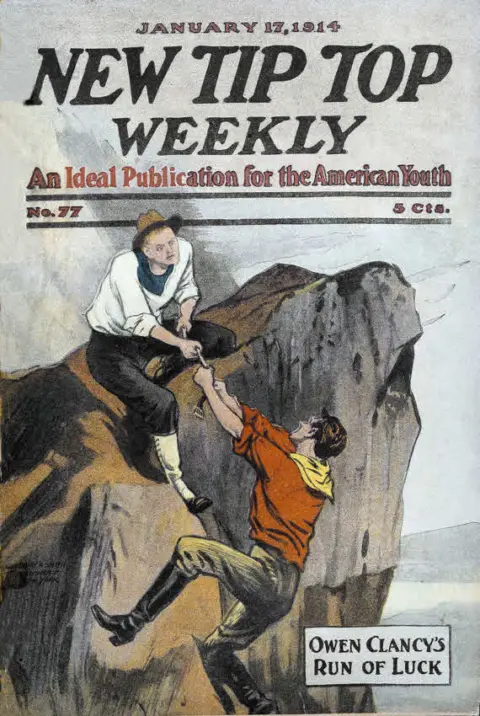
THE CLASSIC COLLECTION · 1914
"Owen Clancy's Run of Luck; or, The Motor Wizard in the Garage" by Burt L. Standish is a novel written in the early 20th century. The story follows the adventures of Owen Clancy, a young man navigating the challenges of life while seeking employment. As he travels towards Phoenix, Arizona, he encounters various situations that test his character and resolve, including a severe car accident that he witnesses. The opening portion of the book introduces us to Owen Clancy and sets a dramatic tone as he witnesses a reckless car accident where a man is nearly killed. Clancy is depicted as quick-thinking and courageous as he leaps into action to save a bystander named James Montague Fortune, who has fallen over the precipice. Their bond is strengthened through shared experiences and mutual determination to find work in Phoenix. Clancy's quest leads him to a garage where he hopes to collect a debt owed to his family, setting the stage for further developments and conflicts involving unscrupulous figures like the garage owner, Silas Rockwell. As the plot unfolds, it hints at a deeper mystery and potential danger surrounding Clancy and his new companion, Fortune.
Introduction adapted from the source catalogue; source summaries may be automatically generated.
Free to read · English · 36,942 words · No account needed
MAKE TIME FOR A GOOD BOOK
On by default. Untick to stop anonymous reading totals. Each page counts after 10 seconds in view. How this works.
Anonymous counting is on unless you have switched it off.
When Weisenberger’s leg was amputated he ordered it delivered to an undertaker with instructions for the latter to embalm it and keep it for the complete burial. His orders were followed.
Smallest High-school Boy.
George Fielding, a freshman in the Brazil, Ind., High School, is the smallest pupil who ever entered the school. He is 2 feet 10 inches high. He stands well in his studies. His home is at Carbon.
“Some Punkins.”
There are 500 pumpkins on one vine which covers an eighth of an acre on Doctor R. G. Sloan’s farm, at Little River, S. C. One of the pumpkins weighs 100 pounds.
No Reason for Egg Famine.
Although the country faces something like an egg famine to-day, the number of eggs produced in this country has increased more rapidly than the population, according to the census bureau. Between 1899 and 1909 the population increased 11 per cent, but the egg production grew 23 per cent.
This estimate does not include the large number of eggs produced by amateur poultrymen in the suburbs of cities. It shows merely the farm product.
The price of eggs paid to the farmers in that period advanced an average of about 11 cents to an average of 19 cents.
Illinois enjoyed the cheapest egg supply. The price there in 1912
varied from 22 to 28 cents a dozen. In New York it was 29 cents to 41
cents.
The estimated production of eggs for 1913 is 1,734,529,000 dozen, an average of 17.7 dozen per capita. In 1909 the production was only 1,591,311,000 dozen.
Curley, the Crow, Still Living.
“Curley, the Crow,” the only survivor of the Custer massacre, a half-blood Sioux scout, is in his seventy-second year. He declares that the famous painting, “Custer’s Last Stand,” does not truly represent the scene, since it shows scalped and mutilated American soldiers on the field of battle at Little Horn, where, on June 24, 1876, Custer and practically all of his command perished. “There was no scalping and no mutilation,” says Curley. “Four hundred and seventy-three soldiers were killed, and not a mark was found on them that was not made by bullets. I was General Custer’s scout, and he had sent me for re-enforcements the night before the battle. I was returning with Captain Bentline and his command. While I was still a long way off my horse was shot from under me, and I got down and ran until I came into the thick of the fighting. As I got there, I saw the soldiers were lying dead right and left. Those four hundred and seventy-three had been surrounded by six thousand Sioux. I saw Custer fighting with his saber, and I thought he was the last man alive there, but I soon saw that his brother, Lieutenant Tom Custer, was fighting beside him. He fell, and General Custer then stood alone. The Indians could easily have killed him before that, but the purpose was to take him alive. Fourteen Indians whom he had slashed and gashed with his saber lay near him, most of them dead or dying. I called to General Custer, meaning to tell him of General Reno’s refusal to come, and he said, ‘You here, Curley? We’ll fight to the end.’ Those were his last words. A big Sioux seized his arm, and Custer turned on him and dealt a terrible saber stroke that half cut his head off. As he did this, the son of the Sioux fired his rifle at Custer, and the bullet went through his heart. I pushed through toward Custer as he fell. I held his head as he sank back dead.”
Your reading position is saved on this browser. Take it to another device with a library code. Reading pages adapt to text, rather than matching a printed edition.
Burt L. Standish
Burt L. Standish
Burt L. Standish
Burt L. Standish
BEHIND THE BOOK
This eBook is for the use of anyone anywhere in the United States and most other parts of the world at no cost and with almost no restrictions whatsoever. You may copy it, give it away or re-use it under the terms of the Project Gutenberg License included with this eBook or online at www.gutenberg.org. If you are not located in the United States, you will have to check the laws of the country where you are located before using this eBook. Read the source licence.
The original source file, including credits and licence, is retained by this library. Request an original-format copy at no charge. Please include the book title and Project Gutenberg identifier #55463.
KEEP YOUR CURIOSITY GOING
Coulson Kernahan

Maurice Baring
Frances Wright
Cécile Tormay

Frederic Jesup Stimson

W. H. P. (William Henry Pope) Jarvis